A cracked tooth does not always need a crown. Sometimes the crack is only a fine line in the enamel and causes no real problem. In other cases, a crack runs through the part of the tooth that takes the pressure when you chew, and the tooth needs more protection.
The difficult part is that you cannot always tell the difference by looking at the tooth.
A tooth can look fairly normal and still hurt when you bite on it. Another may have a visible line but need little or no treatment. If the crack has reached the pulp inside the tooth, the treatment may also involve a root canal before the tooth is restored.
What matters is where the crack is, how far it extends, and what condition the rest of the tooth is in.
That is what your dentist is trying to establish before deciding whether a crown is appropriate.
What does a cracked tooth actually mean?
People often use “cracked tooth” to describe any line they see on a tooth. Dentists make finer distinctions because those different types of damage do not carry the same consequences.
Some teeth have craze lines. These are tiny cracks limited to the enamel and are common in adult teeth. They usually do not cause pain or require treatment.
A fractured cusp is different. Part of the chewing surface has broken away, often around an existing filling. Depending on the amount of damage, the tooth may be restored with a filling or a crown.
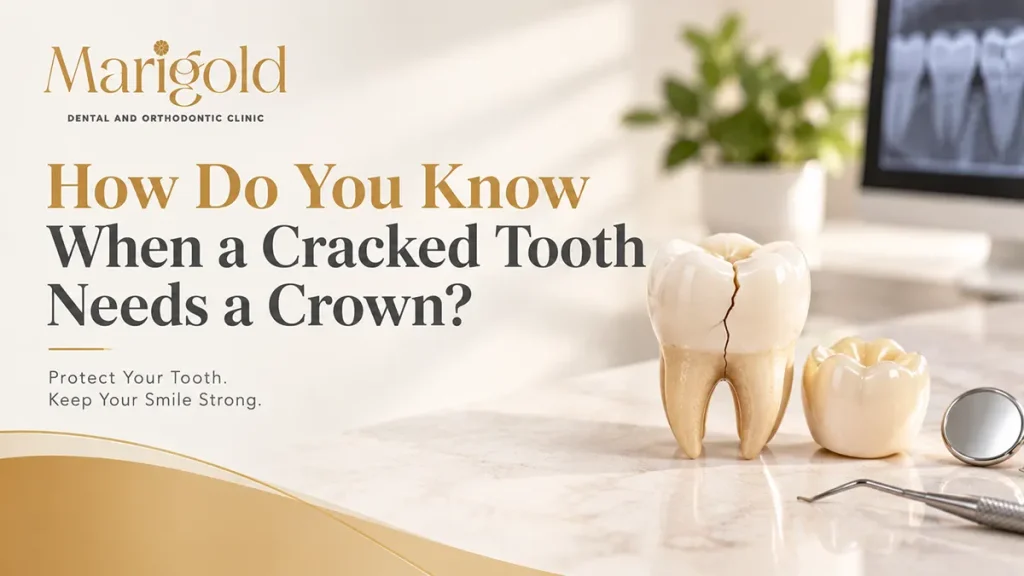
A true cracked tooth is more concerning. The crack usually starts on the chewing surface and extends downward through the tooth. The tooth has not completely separated, but the crack can continue to progress.
There are also more extensive fractures, including split teeth and vertical root fractures. Those situations can have very different treatment options and prognoses.
That is why seeing a line on a tooth is not enough to decide whether it needs a crown. The dentist needs to establish what that line represents.
What will the dentist look for?
The first clue is often the way the tooth behaves.
A cracked tooth may hurt when you bite down. Some patients notice the pain more when they release the bite. Hot or cold foods and drinks can also trigger sensitivity. The discomfort may come and go, and sometimes it is surprisingly difficult to identify which tooth is causing it.
The symptoms are useful, but they do not tell the whole story.
Your dentist will examine the tooth and look at the surrounding gum and supporting tissues. The tooth may also be tested by asking you to bite in a particular way. Other tests can help reveal where the crack is and whether the inside of the tooth has been affected.
The amount of remaining healthy tooth is another important consideration.
A crown can protect and restore a tooth, but it still needs a sound tooth underneath it. The dentist therefore has to look beyond the visible crack and consider how much tooth structure remains and where the fracture extends.
The pulp matters too.
The pulp is the living tissue inside the tooth, containing its nerves and blood vessels. A crack can irritate or damage it. If the pulp has become irreversibly inflamed or has died, the treatment plan may need to include root canal treatment before the final restoration.
The dentist may also consider how the tooth is being loaded. A heavily restored back tooth, for example, may already have less natural structure supporting it. Clenching or grinding can place additional stress on a tooth that has already been weakened.
None of these findings, by themselves, means that a crown is automatically required.
They help the dentist answer the more important question:
Can this tooth be restored, and what will give it the best chance of continuing to function?
How is a cracked tooth diagnosed?
There is no single test that tells a dentist everything about a cracked tooth.
The examination usually starts with the history. When does it hurt? Is it painful when you bite, or when you let go? Does cold trigger it? Has the pain been getting worse, or does it disappear for weeks at a time?
Then the tooth itself is tested.
Your dentist may ask you to bite on a small instrument to see whether that reproduces the familiar pain. The tooth can be examined under magnification, and a light may be passed through it to make a crack easier to see. The gums around the tooth are checked as well. A deeper crack can sometimes produce a narrow area of inflammation or bone loss beside the tooth.
X-rays can be useful, although a crack itself is not always visible on a conventional dental X-ray. The images may still show changes around the tooth that help with the diagnosis. In selected cases, three-dimensional imaging may provide additional information.
Pulp testing is another part of the picture. A cracked tooth can irritate the pulp long before there is obvious swelling or severe pain.
Even with all of these tests, diagnosis is not always straightforward. The American Association of Endodontists notes that there is no standard examination that can reliably predict the long-term outcome of every cracked tooth.
That is one reason a dentist may recommend an endodontic assessment when the source of the pain or the extent of the crack is uncertain.
So when does a cracked tooth need a crown?
A crown becomes relevant when the tooth has lost enough structural strength that covering and protecting it is part of the treatment.
This is particularly important with a cracked tooth because the crack does not simply sit on the surface. Biting can put movement through the weakened parts of the tooth. The aim of the restoration is to reduce that movement and protect the remaining tooth structure while restoring its function.
But there is an important distinction here.
The crown does not make the crack disappear.
A tooth that has cracked does not heal in the same way a broken bone does. A crown can provide substantial protection, but it cannot guarantee that a crack will never progress.
The decision also depends on what is happening inside the tooth.
If the pulp is still healthy, a cracked tooth may sometimes be treated with a full-coverage restoration without root canal treatment. If the crack has caused irreversible pulp damage or infection, the pulp may need to be treated first. The tooth can then be restored once that treatment has been completed.
That is why two teeth that look quite similar from the outside can end up with different treatment plans.
What if the crack does not need a crown?
This is where the word crack can be misleading.
A craze line limited to enamel usually does not need restorative treatment. A small fractured cusp may sometimes be repaired with a filling or another conservative restoration. Some cracks can be monitored when the tooth remains healthy and the damage is limited.
The treatment has to match the damage.
Putting a crown on every tooth that has a visible line would remove healthy tooth structure unnecessarily. Leaving a structurally compromised tooth untreated, on the other hand, can allow the problem to progress.
There is no useful rule that says every crack gets a crown.
There is also no useful rule that says a tooth is safe simply because the crack looks small.
The examination is what separates those situations.
What if the crack has reached the pulp?
Once the pulp becomes involved, the conversation changes.
The pulp contains the nerves and blood vessels inside the tooth. A crack can allow irritation and bacteria to reach this tissue. The result may be inflammation, persistent sensitivity or, eventually, loss of pulp vitality and infection.
If testing shows that the pulp cannot recover, root canal treatment may be needed to remove the diseased tissue and seal the inside of the tooth. A crown or another suitable restoration may then be needed to protect the remaining tooth.
Importantly, the presence of a crack alone does not tell the dentist that a root canal is required.
The pulpal diagnosis matters.
The AAE’s clinical guidance makes this distinction explicitly: the pulp and surrounding tissues have to be assessed rather than deciding on root canal treatment from crack detection alone.
When can a cracked tooth no longer be restored?
This is the difficult part of the assessment, because not every crack stops in a place where the tooth can be predictably repaired.
A split tooth, for example, has progressed beyond a simple crack. The tooth has separated into distinct segments, and the entire tooth cannot usually be preserved as one unit.
Cracks extending toward the root also require careful assessment. The traditional view has been that deeper cracks involving the root have a poor prognosis. More recent endodontic literature is more cautious about treating all of these teeth the same way. Some deeply cracked teeth can survive with appropriate treatment, depending on the exact pattern and the condition of the surrounding tissues.
So this is not a decision that should be made from a photograph or from the word “deep” alone.
The dentist needs to establish how far the fracture has travelled, whether there is a periodontal defect, whether the pulp is involved and whether enough sound tooth remains to support treatment.
Sometimes the answer is a crown.
Sometimes the tooth needs root canal treatment as well.
And sometimes the fracture has progressed far enough that saving the whole tooth is no longer predictable.
Does a cracked tooth need to be painful before you have it checked?
No.
Cracked teeth can be surprisingly inconsistent. A tooth may hurt sharply when you bite one day and feel completely normal the next. Some cracks produce temperature sensitivity. Others cause very little discomfort until the problem has progressed.
There are also cracks that are found during an examination for another reason.
So waiting for severe pain is not a good way to judge whether a cracked tooth needs attention. If you can see a crack, have broken part of a tooth, or repeatedly feel a sharp pain from one particular tooth when chewing, it is worth having the tooth examined.
The earlier the dentist can establish what is happening, the more clearly the treatment options can be defined.
The crown comes after the diagnosis
cracked tooth does not start with a crown.
It starts with finding out what has actually happened to the tooth.
If the crack has weakened the tooth but it remains restorable, a crown may be used to protect it and restore normal function. If the pulp has been damaged, root canal treatment may form part of the treatment first. If the damage is limited, a more conservative restoration may be enough.
If a crown is recommended, you can learn more about dental crowns and bridges in Abu Dhabi and what the treatment involves.
The right restoration depends on the tooth in front of the dentist, not just the crack that the patient can see. Once a crown is considered appropriate, the next decision is the restoration itself, including the material and design suited to the tooth’s position, function and appearance. The different types of dental crowns available and how they differ are covered separately.