Crowns and veneers come up in the same conversations, recommended by the same dentists, and both change how a tooth looks. That’s about where the similarity ends.
What separates them isn’t aesthetics. Both of them can produce a convincing, natural result on the right tooth. The difference is what’s happening structurally underneath. How much tooth remains? What it’s been through? And what it needs to keep functioning reliably going forward?
Some situations allow a genuine choice between the two. Others don’t, and the tooth’s condition is what decides, not patient preference. Knowing which side of that line you’re on is what changes the conversation.
Two Different Solutions to Two Different Problems
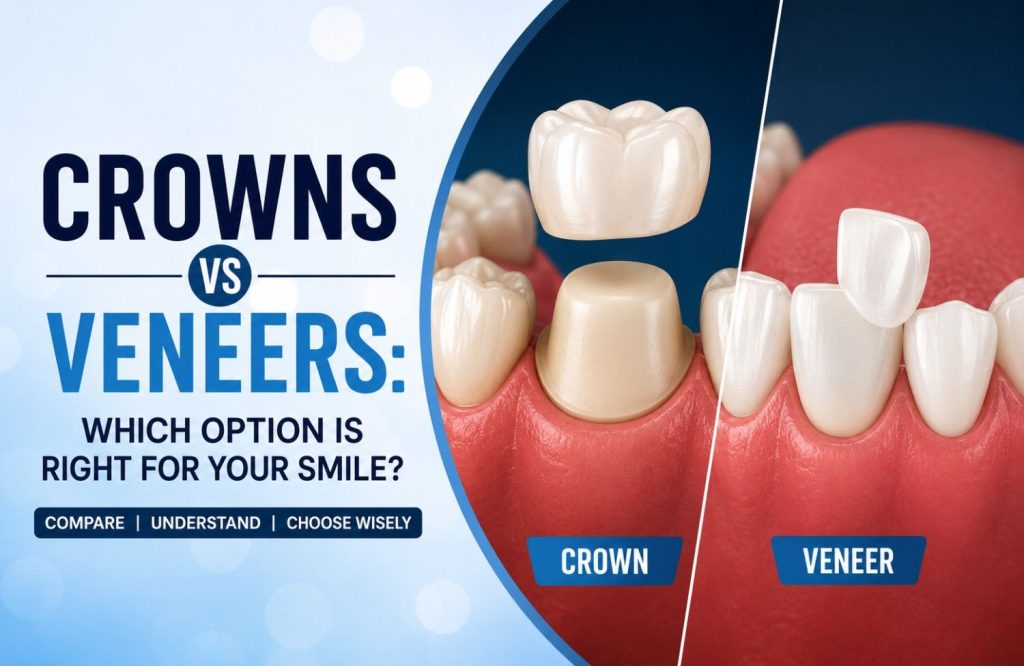
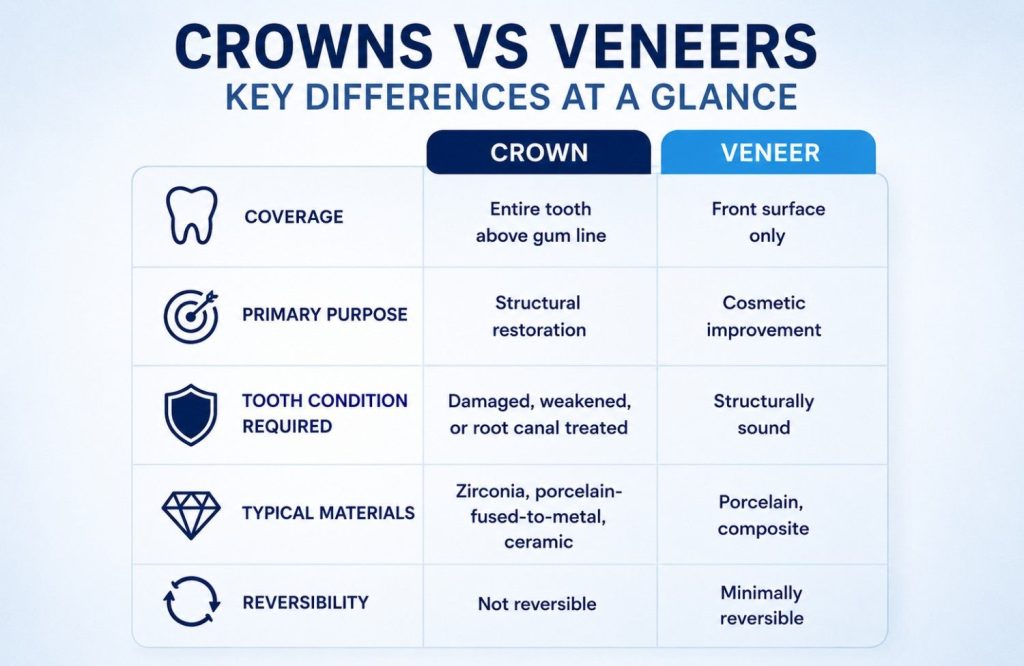
A crown encases the entire visible portion of the tooth above the gum line. The outer structure is prepared down on all sides and the crown fits over what remains, replacing the tooth’s exterior completely. The root stays. Where enough inner structure survives, that stays too. What changes is everything the eye sees and everything that takes the pressure of biting.
A veneer is a thin shell, typically 0.5 to 1mm, bonded to the front-facing surface only. The back of the tooth, the biting edge, the sides remain largely as they are. A veneer changes what’s visible when the tooth faces forward. The structural situation underneath doesn’t change with it.
That difference in coverage is what determines when each is used. Crowns are restorative first. Veneers are cosmetic first, and they require the tooth underneath to be sound enough to make that a viable starting point.
What Happens to the Tooth Underneath
Before anything is fitted, something has to happen to the tooth. That process is where crowns and veneers diverge most clearly.
Crown preparation removes structure from all surfaces. Front, back, sides, the biting surface. The tooth is reduced circumferentially to create space for the crown to sit over it without altering the bite. How much comes off depends on the material and the state of the tooth beforehand, but the preparation covers every side.
Veneer preparation removes a thin layer from the front surface only, typically under 1mm. Everything else stays as it is. Ultra-thin veneers sometimes require even less, occasionally none at all, depending on the tooth’s existing dimensions.
A tooth that has lost significant structure to decay, fracture, or repeated filling work doesn’t offer enough sound surface for a veneer to bond to reliably. Veneer preparation assumes a largely intact tooth as its starting point. When that starting point is gone, full coverage isn’t a stylistic decision.
The less natural tooth structure that remains, the more a crown becomes the clinically correct choice rather than an alternative one. Both treatments follow the same two-appointment sequence: preparation and impressions first, fitting the final restoration second. A temporary restoration protects the tooth between visits.
When the Tooth’s Condition Makes the Decision
For many patients, the decision has already been made before they sit in the chair. The tooth’s condition is what decided it.
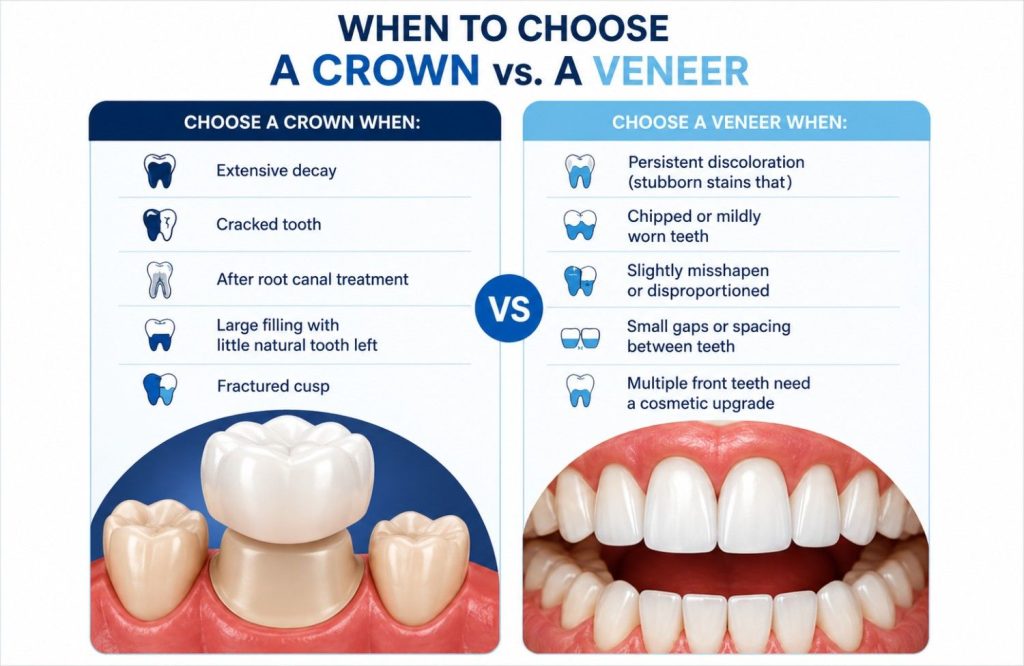
A crown is the appropriate treatment when (and the different types of dental crowns available will depend on your specific case):
- The tooth has extensive decay. Once decay has consumed a substantial portion of the structure, what remains after the cavity is cleared isn’t enough surface for a veneer to bond to reliably. The crown restores what’s missing and protects what’s left.
- The tooth is cracked. Cracks that compromise structural integrity need full coverage to prevent the fracture from spreading under biting pressure. A veneer bonded to a cracked tooth doesn’t address what’s happening beneath the surface.
- The tooth has had root canal treatment. Removing the pulp leaves the tooth without its internal moisture source. Root canal treated teeth become brittle over time and fracture under loads that a healthy tooth would handle without issue. Full crown coverage distributes that force and protects against it. A root canal treated tooth left without a crown is one of the more common causes of avoidable tooth loss.
- A large filling occupies more of the tooth than the natural structure around it. The remaining walls are thin. A crown holds them together. A veneer relies on them to hold it.
- A cusp has fractured. The damage changes how load is distributed across the whole tooth, not just the visible surface. Front coverage alone doesn’t resolve that.
Placing a veneer over a tooth in any of these situations doesn’t fix the problem. When the tooth eventually fails under it, the situation is usually harder to resolve than it would have been with a crown from the start.
When the Goal Is Cosmetic and the Tooth Is Sound
When the tooth underneath is structurally intact, a crown takes away more than the situation calls for. The preparation required for full coverage on a healthy tooth removes structure that didn’t need to go. In these cases a veneer is the appropriate choice, and it’s chosen because the tooth warrants it, not because it’s the easier option. If you’re considering getting veneers, this is where they genuinely make sense.
Veneers are the appropriate treatment when:
- The tooth is permanently discolored and whitening hasn’t reached it. Tetracycline staining, fluorosis, and trauma-related discoloration sit within the tooth structure rather than on its surface. A veneer covers it fully without altering the structural integrity of the tooth underneath.
- The tooth is chipped or mildly worn. Where the damage is cosmetic and the structure beneath is sound, a veneer restores what’s visible without the circumferential preparation a crown requires.
- The tooth is slightly misshapen or disproportionate. Irregularities in length, shape, or surface texture on front teeth that are otherwise healthy are precisely what veneers address.
- Small gaps or spacing issues exist between front teeth. Where the bite is sound and the concern is cosmetic, veneers can close or reduce spacing in the right cases without orthodontic treatment.
- Several front teeth need a unified cosmetic result. Veneers placed across the smile line can align the color, shape, and proportion of multiple teeth on a patient whose underlying dentition is healthy enough to support them.
On a sound tooth, preserving natural structure is always the better clinical outcome. A veneer does that. A crown on the same tooth wouldn’t.
What Patients Usually Ask Before Deciding
Does getting a veneer damage the tooth underneath?
Veneer preparation removes a thin layer of enamel from the front surface permanently. Enamel doesn’t regenerate, so the tooth will always need a veneer or crown covering that surface from that point forward. That’s the part worth understanding before committing to the treatment.
It isn’t structural damage. The dentin, pulp, and root aren’t involved in the preparation. What changes is the outer surface, and what replaces it is designed to function there long term. Irreversible and damaging aren’t the same thing, but the distinction deserves a clear explanation rather than a reassurance.
Crown preparation removes more, but it’s typically done on teeth that have already lost significant structure. The preparation reflects the clinical situation rather than creating a new problem.
How long do crowns and veneers actually last?
Porcelain and zirconia crowns last 15 to 25 years or longer under normal conditions with regular maintenance. Porcelain veneers run 10 to 20 years. Composite veneers are less durable and typically need repair or replacement within 5 to 7 years.
Longevity for both comes down to the same factors. Grinding and clenching accelerate wear on any restoration. Decay developing at the margins shortens the lifespan of a crown or veneer faster than the restoration material itself failing. Regular check-ups catch margin issues early, which is where most restoration failures begin.
Is one significantly more expensive than the other?
Crowns and veneers sit in a broadly similar price range per tooth in most markets. Material choice, porcelain, zirconia, composite, or porcelain-fused-to-metal, affects the cost more than the treatment type does. The number of teeth, the complexity of the preparation, and laboratory fabrication all factor in.
Choosing on cost when the clinical situation points clearly toward one option tends to create a more expensive problem later. A veneer placed on a tooth that needed a crown isn’t a saving. It’s a delay.
Final Thought
In many cases, the tooth decides long before the patient does. A structurally compromised tooth needs protection first. A healthy tooth with cosmetic concerns allows for a more conservative approach. Crowns and veneers can both improve appearance, but they solve very different problems underneath.
Some situations leave room for preference. Others become a clinical decision based on how much natural structure remains and what the tooth needs to function predictably over time. A consultation is what clarifies that difference. Looking at the tooth directly will answer more than any comparison between veneers and a dental crown Abu Dhabi ever can.