Cold water hits one tooth and the reaction disappears before it fully registers. A few hours later, something sweet triggers the same spot again. Then nothing for the rest of the day.
That inconsistency is what makes sensitivity difficult to read properly. Cavities can cause it, but so can exposed roots, enamel wear, grinding, even brushing habits that have been repeated the same way for years. For everything about tooth sensitivity, it helps to understand the full picture first.
Sometimes the tooth settles completely after a few seconds. Sometimes the sensation lingers longer than it used to, or keeps returning to the same area. The feeling itself rarely explains much on its own.
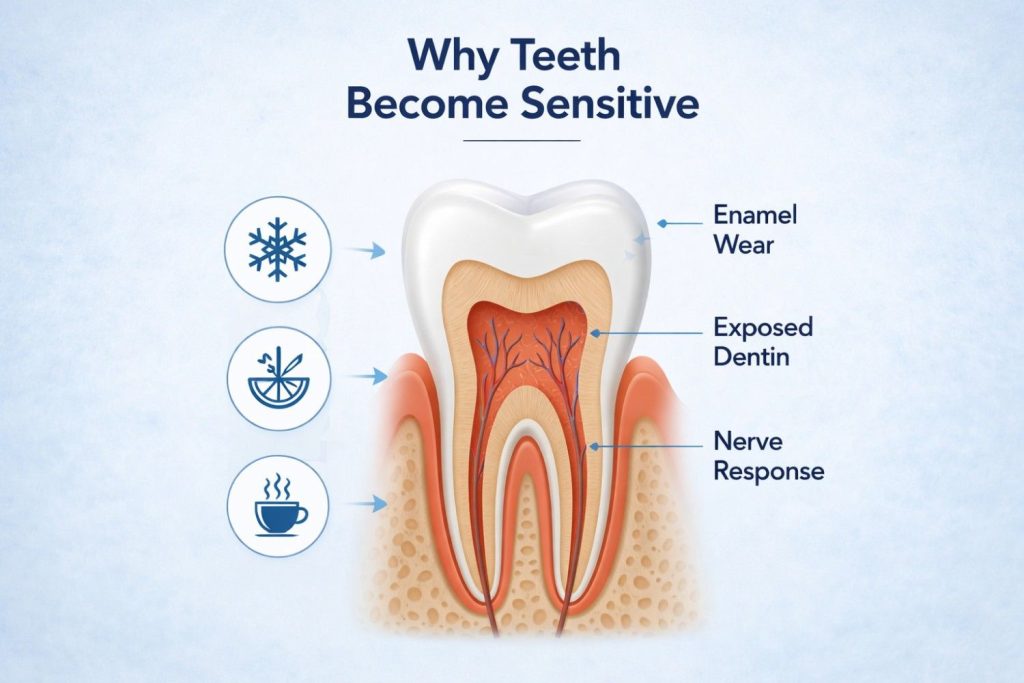
What’s Actually Happening When a Tooth Feels Sensitive
Under the enamel sits a softer layer called dentin, threaded with microscopic channels that lead to the nerve. Enamel keeps them sealed. When it wears down or gums recede, those channels open up to cold, heat, sugar, pressure.
The nerve picks up all of it.
That response feels identical whether the cause is decay, grinding, gum recession, or acid erosion. The sensation gives you nothing to go on. What’s causing it is a different question entirely, and the answer is what changes the treatment.
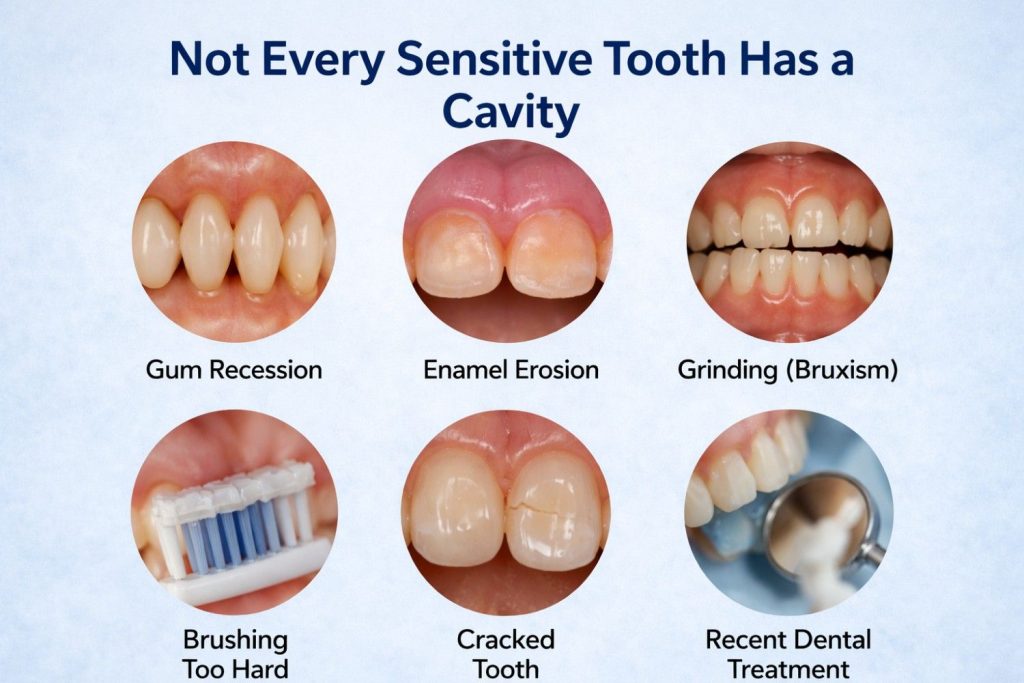
Not Every Sensitive Tooth Has a Cavity Behind It
Sensitivity is the symptom. A cavity is one possible cause. Patients often arrive convinced they’re the same thing, and that assumption tends to create a lot of anxiety before anything has actually been looked at.
Several conditions produce sensitivity with no decay involved:
- Gum recession exposes the root surface, which has no enamel. Root surfaces react to temperature and pressure far more readily than the crown of the tooth.
- Enamel erosion from acidic food and drinks strips the protective layer gradually. Citrus, fizzy drinks, coffee. It happens slowly enough that sensitivity is often the first sign something has changed.
- Bruxism wears enamel down through grinding or clenching, frequently during sleep. A significant number of patients find out they’re doing it only after the damage shows up.
- Brushing too hard with a firm-bristled brush damages both enamel and the gum margin. It’s a slow process, which makes it easy to overlook.
- A cracked tooth produces sensitivity that can be nearly indistinguishable from a cavity: sharp, localized, triggered by temperature or biting pressure on a specific spot.
- Recent dental treatment, cleaning, whitening, a new filling, can leave teeth reactive for days to a couple of weeks. This is temporary and resolves on its own.
The pattern behind the sensitivity matters as much as the sensitivity itself. Recession tends to affect multiple teeth near the gum line. Bruxism usually shows up across the back teeth. A crack almost always points to one tooth, one spot, one specific trigger. These distinctions are what a clinical assessment is actually looking for.
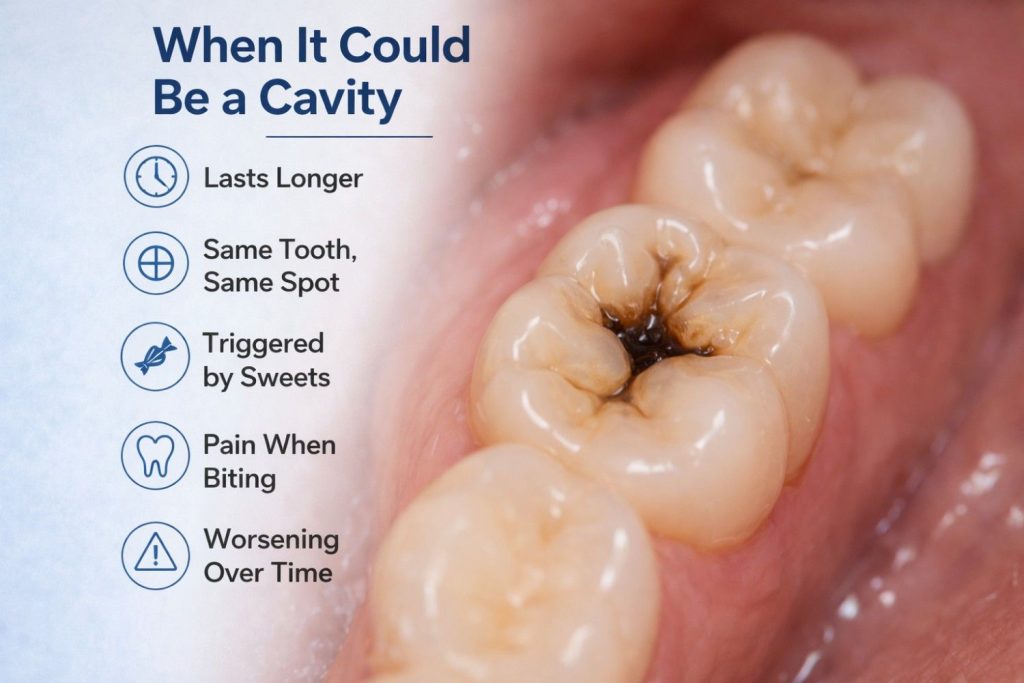
When Sensitivity Is Trying to Tell You Something More Serious
The distinction between general sensitivity and a cavity isn’t always clean, but certain signals shift the picture toward decay.
Duration is one of the clearest. Sensitivity from worn enamel or gum recession spikes and disappears within seconds of removing the trigger. Cavity-related sensitivity tends to linger; the trigger sets it off, but the discomfort stays for a minute or more after the cause is gone. That difference in duration reflects how deeply the irritation has reached.
Location narrows things further. Sensitivity spread across several teeth points toward something systemic, diet, grinding, brushing habit. The same tooth, the same spot, every time, is a different conversation.
Sweet foods are a more specific signal than most people expect. Temperature sensitivity can come from several non-cavity sources. Sensitivity reliably triggered by sugar, particularly concentrated in one tooth, correlates more closely with early decay. The bacteria behind cavities produce acid as a byproduct, and that reaction to sugar is fairly distinct.
A few other things worth noting:
- Pain when biting down, separate from temperature or sweetness, suggests structural involvement.
- Sensitivity that has been gradually worsening over weeks, not staying stable.
- A visible dark spot, a rough surface, or a texture that feels different than it used to.
- Discomfort that appears without any trigger, or that wakes you up.
Any one of these on its own might mean little. Several of them together, or one that keeps returning, is worth having looked at sooner rather than later.
The Pattern of Your Sensitivity Matters More Than the Sensation Itself
Two patients can describe identical sensitivity and be dealing with completely different problems. The sensation itself carries less information than when it happens, how long it stays, which teeth are involved, and whether it’s changing over time.
A few things worth paying attention to before an appointment:
How long does it last? Sensitivity that clears within 30 seconds of removing the trigger points to surface involvement. Lingering past a minute means the nerve is closer to what’s happening.
One tooth or several? Sensitivity across multiple teeth suggests something broad, acid erosion, grinding, brushing damage. The same tooth every time is a more specific finding.
Is it getting worse? Sensitivity that appeared once and hasn’t returned is different from something that started mild a few weeks ago and has been quietly building. How it changes over time matters more than how it feels on any given day.
What sets it off? Temperature sensitivity is common across many causes. Sweet-triggered sensitivity in one specific tooth is a narrower signal. Pain from biting pressure points toward structural damage.
Dentists ask these questions because a visual exam doesn’t always show the full picture. Cavities forming between teeth or below the gum line stay hidden until they’re well established. The pattern often gets there first.
What a Dentist Is Actually Looking For
Before anything is examined, there are questions. When the sensitivity started, what brings it on, whether it’s one tooth or spread across several, whether it’s been shifting. That conversation does more diagnostic work than most patients expect, often before a single instrument is picked up.
The examination fills in what the history can’t show. Gums and tooth surfaces checked visually, probing for recession or wear, the bite assessed for uneven pressure. If the clinical picture suggests decay between teeth or below the gum line, where nothing appears on the surface, X-rays follow.
An early cavity usually means a dental filling and not much else. Caught before it reaches the nerve, it stays a contained procedure. Left another six months, the same cavity rarely does.
No decay found shifts the focus entirely. The findings point toward whatever the assessment actually shows, grinding, recession, erosion, technique. From there the treatment is specific to the cause, not a general response to the symptom.
Final Thought
Sensitivity becomes easier to understand once the pattern starts repeating.
One tooth reacts every time. Sweet foods trigger the same spot. Cold lingers longer than it used to. Small details like that tend to matter more than the intensity itself.
Sometimes the cause is minor. Sometimes it isn’t. The important part is that teeth usually don’t keep reacting the same way for no reason.