A crown recommendation usually comes with a material attached. Zirconia, E-Max, porcelain-fused-to-metal. The material is named, a price is quoted, and the conversation moves on. The clinical reasoning behind the choice rarely gets explained in the same level of detail even though understanding how crowns and bridges transform oral health helps make sense of why material matters at all.
That reasoning exists and it’s specific. Crown material affects how a restoration performs under biting pressure, what it looks like against neighboring teeth, how it behaves at the gum line as tissue changes over years, and how long it holds before something goes wrong. Different materials optimize for different requirements, and the tooth’s clinical situation is what determines which requirements matter most.
Understanding that logic doesn’t mean selecting the material. It means walking into the consultation with the right questions.
The Four Crown Materials in Clinical Use
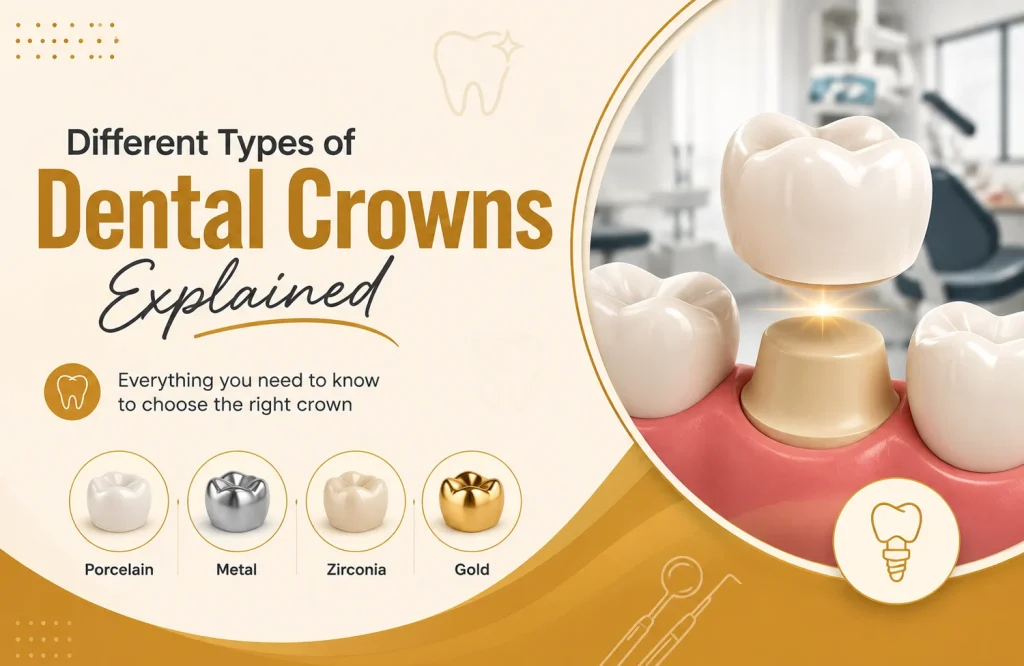
Five crown materials are in current clinical use. What separates them isn’t a hierarchy of quality. It’s a set of different trade-offs between structural performance and optical quality, and the tooth’s clinical situation is what determines which trade-off is appropriate.
Full zirconia (monolithic) is milled from a single block of zirconia with no separate substructure and no ceramic layering. The single-piece construction is the source of its strength. Earlier versions were opaque enough to limit their use to posterior positions. High-translucency zirconia has changed that, producing a material that performs well aesthetically in most positions while retaining the structural advantage of monolithic construction.
Layered zirconia adds a hand-applied porcelain surface to a zirconia substructure. The substructure provides the load-bearing capacity. The porcelain layer provides the aesthetic refinement that monolithic zirconia approaches but doesn’t match in the anterior zone. The consequence of layering is that the porcelain surface becomes the point of vulnerability. Ceramic chips on layered crowns are the most common complication across all crown types that use a ceramic outer layer.
E-Max (lithium disilicate) is a full glass ceramic with no substructure of any kind. Its optical properties sit closest to natural enamel of any crown material in current use. Light transmission, translucency, and color depth can be matched to adjacent teeth with a precision that no other material consistently achieves. The constraint is load: E-Max flexural strength is sufficient for anterior and premolar positions but the fracture rate in high-load molar use, particularly under parafunctional habits, is higher than zirconia alternatives.
Porcelain-fused-to-metal (PFM) combines a metal substructure with a ceramic outer layer. The metal provides structural reliability. The ceramic provides tooth-colored appearance. PFM has decades of clinical data behind it and performs reliably. The issue that surfaces over time is at the margin: the metal substructure extends to the gum line, and as gingival tissue recedes naturally over years, that margin becomes visible as a dark line at the base of the crown.
Full cast metal, gold or base metal alloy, has the strongest longevity data of any crown material. It requires less tooth reduction than any other crown type and tolerates the highest occlusal forces without fracture risk. The material is used exclusively in posterior positions where visibility isn’t a clinical concern, and in situations where preserving tooth structure and maximizing durability take priority over aesthetics.
What Each Material Does Well and Where It Falls Short
Structural performance and optical quality pull in opposite directions across all crown materials. The strongest materials are not the most aesthetically refined. The most aesthetically refined are not built for the highest forces. Where each material sits on that axis is what the clinical placement decision follows from.
Full cast metal handles the highest occlusal forces of any crown material and produces no aesthetic result. Its fracture resistance under bruxism and heavy posterior load is unmatched. One specific point worth knowing: metal is softer than zirconia ceramic, which means opposing natural teeth wear less against a metal crown than against a zirconia one. For posterior positions with high functional demand and no visibility concern, that combination of properties is difficult to improve on.
Monolithic zirconia is the material that handles high load with acceptable aesthetics most consistently. High-translucency versions have brought its optical quality into a range appropriate for most positions, including anterior when the aesthetic requirement isn’t the most demanding. Under bruxism conditions, it performs more reliably than any ceramic-layered alternative, with the caveat that its hardness requires careful occlusal adjustment to avoid wearing opposing natural teeth.
E-Max produces the closest optical match to natural enamel of any crown material. That property makes it the default choice for anterior restorations where distinguishing the crown from adjacent teeth is the primary clinical goal. The flexural strength that works in the anterior zone is the same property that limits its use posteriorly. A patient with a heavily loaded molar, a deep bite, or significant parafunctional habits is a poor candidate for E-Max in that position regardless of the aesthetic outcome it would produce.
Layered zirconia improves on monolithic zirconia’s aesthetics without fully matching E-Max. The porcelain surface layer is where the visual refinement comes from and where the complication risk concentrates. Ceramic chipping is the most frequently reported complication across all layered crown types. Patients with bruxism or heavy occlusal contacts are at meaningfully higher risk of that complication than those with lighter functional loads. In those patients, the aesthetic improvement over monolithic zirconia doesn’t justify the added vulnerability at the ceramic surface.
PFM’s track record is longer than any of the ceramic alternatives. The metal substructure handles load reliably across decades. The two issues that surface over time are ceramic chipping at the biting surface and the dark line at the gum margin as tissue naturally recedes. Both are aesthetic rather than structural problems, but both are the reason patients with PFM crowns eventually return asking about replacement.
| Strength | Aesthetics | Bruxism Tolerance | Best Position | |
| Full cast metal | Highest | None | Excellent | Posterior, hidden |
| Monolithic zirconia | Very high | Good | Very good | Posterior, premolar |
| Layered zirconia | High | Very good | Moderate | Anterior, premolar |
| E-Max | Moderate | Excellent | Low | Anterior, premolar |
| PFM | High | Moderate | Moderate | Variable |
The Tooth’s Position in the Mouth Changes the Material Priority
An upper central incisor and a lower second molar require different things from a crown. The incisor sits in full view during every conversation and smile; it takes comparatively light biting forces. The molar handles the majority of chewing load and is largely out of sight. The material appropriate for one position is not the optimal choice for the other.
Anterior teeth sit in what clinicians call the aesthetic zone. The primary clinical requirement is optical: the crown needs to match adjacent natural teeth in translucency, color depth, and surface texture closely enough to be indistinguishable in normal social interaction. E-Max meets that requirement most consistently. High-translucency layered zirconia is used when the aesthetic demand is high but the patient’s parafunctional habits or bite depth put E-Max at higher fracture risk in that position. Monolithic zirconia and full cast metal are not anterior materials for most patients; their optical properties don’t meet aesthetic zone requirements regardless of their structural advantages elsewhere.
Posterior teeth carry the majority of occlusal force. Aesthetics are a secondary consideration in positions where the crown isn’t visible in normal interaction. Monolithic zirconia handles posterior load reliably and its appearance in molar and premolar positions is acceptable to most patients. Full cast metal remains clinically appropriate for lower second molars where maximum durability, minimum tooth reduction, and zero visibility concern align. In patients with severe bruxism requiring a posterior crown, the conversation between monolithic zirconia and full cast metal is a genuine one rather than a formality.
The first and second premolars sit between those two demands. Visible in a broad smile but load-bearing enough to rule out the most fragile ceramic options. Layered zirconia and E-Max are both used in this transition zone, with the choice depending on the individual occlusion, bite depth, and whether parafunctional habits are present. The clinical assessment in the transition zone involves more variables than in either a purely anterior or purely posterior situation.
A patient receiving crowns on multiple teeth across different positions may end up with different materials on different teeth. An upper central incisor in E-Max alongside a lower second molar in monolithic zirconia reflects the position-specific material logic rather than inconsistency in treatment planning.
Why Some Crowns Show a Dark Line at the Gum
Patients with PFM crowns placed several years ago sometimes notice a dark or grey line appearing at the base of the crown where it meets the gum. The explanation is structural and specific.
A PFM crown has a metal substructure that runs to the crown margin, the edge where the restoration meets the prepared tooth at the gum line. When the crown is first placed, the ceramic layer covers that margin and the crown appears tooth-colored throughout. Gum tissue at that point sits at a level that keeps the metal hidden. As gingival tissue recedes over years, which it does in most patients regardless of oral hygiene, the metal margin either becomes directly visible or shows through thinning tissue as a dark shadow at the crown base.
The line is not decay and not structural failure. It’s the metal margin becoming exposed as the gum moves. A PFM crown placed a decade ago that now shows a dark line is functioning exactly as the material was designed to, in a gum environment that has changed since placement.
Full ceramic crowns don’t produce this effect. Zirconia and E-Max crown margins are tooth-colored material throughout. Gum recession on a full ceramic crown changes the visible length of the restoration but doesn’t expose a dark margin because the material at the margin is the same color as the rest of the crown.
Replacement with a full ceramic crown resolves the dark line aesthetically. Whether the crown warrants replacement on clinical grounds depends on its overall condition, the state of the underlying tooth, and whether other signs indicate the restoration has reached the end of its functional life. Those indicators are covered specifically in Signs Your Crown or Bridge Needs Replacement.
Longevity Varies by Material, Position, and What Happens Between Appointments
Longevity figures for crown materials appear in the clinical literature with enough specificity to be useful, and they vary by material and position in ways that generic ranges don’t capture.
Full cast metal has the most extensive longevity data of any crown material. Survival rates above 90% at twenty years in posterior positions are consistently reported across studies. The material doesn’t chip or fracture under normal occlusal load. When metal crowns fail, the failure is almost always at the margin, secondary decay where oral hygiene has been inadequate or crown fit has degraded over time, rather than in the material itself.
Monolithic zirconia shows posterior survival rates above 95% at ten years in available studies. The complication profile is cleaner than layered alternatives because there is no ceramic surface to chip. Long-term data beyond fifteen years is less extensive than for metal, reflecting the material’s more recent entry into wide clinical use rather than any identified limitation at longer timeframes.
Layered zirconia has reliable structural survival but a higher complication rate than monolithic zirconia. The crown substructure rarely fails. The ceramic surface chips, with frequency that increases in patients with heavy occlusal load or parafunctional habits. Some chips are repairable. Others, depending on location and extent, are replacement indications.
E-Max shows anterior and premolar survival rates above 90% at ten years. The same studies show higher complication rates in full molar positions, particularly under parafunctional loading. The material performs reliably where it’s clinically indicated and at higher risk where it isn’t, which is why position specificity matters more with E-Max than with structurally stronger alternatives.
PFM has the longest clinical track record of any tooth-colored crown material, with survival rates at ten and fifteen years comparable to zirconia in posterior positions. Complications are predominantly ceramic chipping and the gingival margin issue as tissue recedes. Complete crown failure in properly placed PFM is relatively uncommon.
Longevity data reflects controlled conditions. Secondary decay at the crown margin, unmanaged bruxism, and periodontal disease affecting the supporting structure all reduce the functional life of any crown regardless of material. Regular professional cleaning, consistent oral hygiene at the crown margins, and a night guard where bruxism is present are the maintenance variables that determine whether a crown reaches its material lifespan or falls short of it. The clinical signs that a crown is approaching the end of its functional life are covered in Signs Your Crown or Bridge Needs Replacement.
The Material Decision Is a Clinical One, Not a Preference
The material recommendation a patient receives follows from variables that an examination establishes: where the tooth sits in the arch, what load it carries, whether parafunctional habits are present, what the aesthetic requirement of that position is, and what the surrounding gum and bone look like. None of those variables are negotiable in the material decision. All of them are worth understanding before the consultation rather than after it.
What this blog covers is the framework. What it can’t cover is the specific clinical picture of a particular tooth in a particular patient’s mouth. That’s what changes a general understanding of crown materials into a specific treatment recommendation.
A dental crown consultation in Abu Dhabi applies that framework to the actual tooth, the actual bite, and the actual habits of the patient in the chair. That’s where the material decision moves from general to specific, and where the longevity of the result gets determined. If the concern is more cosmetic than structural, crowns vs veneers covers that distinction in more detail.