Usually patients discover what their dental insurance doesn’t cover at the worst possible moment. Sitting in the chair, treatment planned, and the receptionist explains that the crown needs pre-authorization, or that implants aren’t covered, or that the annual limit ran out two visits ago.
UAE dental insurance is genuinely complex. Six major insurers. Multiple plan tiers within each. Network restrictions, exclusion lists, co-payment structures, and pre-authorization requirements that vary enough between plans to make assumptions dangerous.
Understanding the system before the appointment is what prevents that moment.
How Dental Insurance Plans Work in the UAE
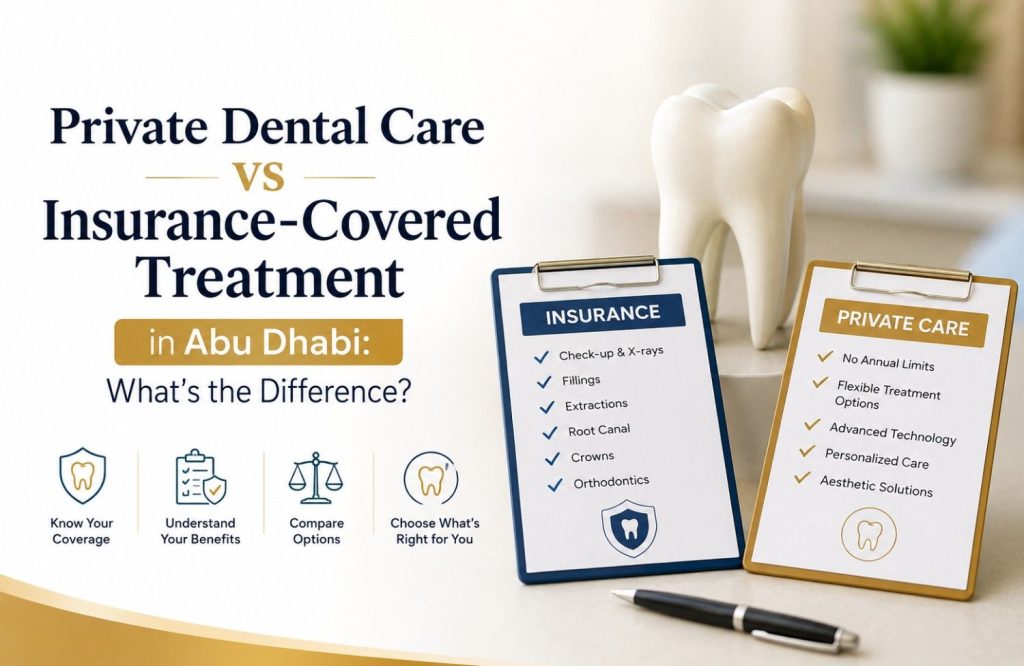
UAE dental plans are sold in tiers. Basic plans cover preventive treatment: check-ups, X-rays, and scale and polish. Enhanced plans add restorative treatment including fillings, extractions, and root canals, usually with a co-payment. Comprehensive plans extend into major restorative work, crowns and bridges, and in some cases limited orthodontic treatment, with higher premiums reflecting the broader coverage.
The tier a patient holds determines what treatment the insurer will pay for. A patient on a Basic plan whose dentist recommends a root canal pays privately for that procedure. Clinical necessity is irrelevant to the coverage decision.
Network restrictions determine where coverage applies. Each insurer maintains a list of approved clinics. Treatment at a clinic outside that network is either uncovered entirely or reimbursed at a reduced rate after the patient pays upfront. Direct billing, where the clinic invoices the insurer directly, only applies at in-network providers. At out-of-network clinics, the patient pays and claims reimbursement separately with no guarantee the full amount is returned.
Annual limits cap the total the insurer will pay across a benefit year, and co-payments add a patient contribution on top of insurer coverage. A plan with an AED 3,000 annual dental limit covers that amount in total. The third filling in a year may land partly or entirely outside the limit. A plan covering 80% of a filling leaves the patient responsible for the remaining 20%. On expensive restorative treatment that figure adds up quickly.
Dental Coverage by Insurer: Thiqa, Daman, AXA, ADNIC, NAS and Neuron UAE
Coverage parameters below reflect general plan structures. Specific coverage depends on the individual plan document. Confirming coverage with the insurer or the clinic before treatment is the only reliable method.
Thiqa is the Abu Dhabi government employee insurance scheme administered by Daman. Coverage is broader than most private Enhanced plans. Check-ups, X-rays, fillings, extractions, root canals, and crowns are generally covered with minimal co-payment at approved providers. Thiqa-insured patients hold the most comprehensive routine dental coverage available in the Abu Dhabi market.
Daman operates multiple plan tiers. Basic covers preventive only. Enhanced covers fillings, extractions, root canals, and some crown work with co-payments ranging from 20% to 30%. Comprehensive extends to major restorative and, in selected plans, limited orthodontic treatment with age restrictions. Daman is the most widely held private insurance in Abu Dhabi.
AXA follows a similar tiered structure. Enhanced and above covers restorative treatment. Pre-authorization is required for crowns and any treatment above a plan-specific cost threshold. Cosmetic treatment is excluded across all AXA plan tiers without exception.
ADNIC plans broadly mirror Daman Enhanced for standard employer plans. Pre-authorization thresholds and co-payment percentages vary by employer contract. ADNIC’s provider network in Abu Dhabi is well-established.
NAS is common among mid-market employers. Basic NAS plans cover preventive and emergency treatment only. Enhanced adds restorative with co-payments. Orthodontic treatment is excluded from the majority of NAS plans regardless of tier.
Neuron UAE is a newer insurer with growing Abu Dhabi presence. Coverage parameters sit broadly in line with mid-tier Daman. Network expansion in Abu Dhabi is ongoing, so confirming clinic network status directly before booking is particularly relevant for Neuron-insured patients.
Marigold Dental accepts all six insurers and handles direct billing internally for in-network patients.
Dental Treatments UAE Insurance Plans Typically Do Not Cover
Exclusion lists are where the gap between what patients expect and what insurers pay is largest. The treatments below are excluded from most UAE dental plans across most insurers and most plan tiers.
Cosmetic treatment is excluded universally. Teeth whitening, porcelain veneers, and composite bonding placed for aesthetic rather than functional reasons are not covered by any standard UAE dental plan. A patient whose treatment plan includes whitening or veneers pays privately for those components regardless of insurer or tier.
Dental implants fall outside standard coverage on the majority of UAE plans. Where Comprehensive tier plans include implants, coverage is partial, subject to annual limits, and associated procedures including bone grafting are typically excluded separately. A patient assuming implant coverage without confirming the specific plan document is at significant financial risk. The full breakdown of what implant treatment involves and costs is covered in [Dental Implants in Abu Dhabi: What Does the Cost Actually Include?](link to implant cost piece)
Orthodontic treatment is excluded from Basic and Enhanced plans. Where Comprehensive plans include orthodontics, age limits typically under 18 and annual sub-limits apply. Adult orthodontic treatment is privately funded in the vast majority of cases regardless of insurer.
Pre-existing conditions are handled differently across insurers, but the general position is consistent. Conditions identified before the insurance policy start date may have a waiting period before coverage applies, or may be excluded entirely.
Waiting periods affect new policyholders. A patient who joins a plan and immediately needs a crown may find that major restorative treatment carries a three to six month waiting period. Preventive treatment is typically covered from day one.
Treatment without pre-authorization is rejected regardless of whether the treatment falls within the covered list. A crown placed without written insurer approval before preparation begins becomes a private expense even if crowns are covered under the plan.
Dental Pre-Authorization in the UAE: How It Works and Why It Matters
Pre-authorization is a formal insurer approval required before certain dental treatments begin. Without it, the claim is rejected. The treatment may be clinically necessary and within the covered list. Neither fact protects a patient who skipped the approval step.
Treatments that typically require pre-authorization include crowns, bridges, root canals, periodontal treatment beyond a standard scale and polish, surgical extractions, and orthodontics where covered. The threshold varies by insurer and plan. Some plans require pre-authorization for any single treatment above AED 500.
The process: the clinic prepares a treatment plan with supporting X-rays and clinical notes. The submission goes to the insurer electronically. Most insurers respond within two to five working days. The response is an approval, a request for additional information, a partial approval, or a decline.
Approval is not automatic. An insurer can decline a crown on the grounds that the tooth hasn’t met their clinical criteria for major restorative treatment. A patient who has already had the tooth prepared and a temporary crown placed, then receives a declined claim, has no straightforward remedy.
Before any treatment above basic restorative is scheduled, confirm that pre-authorization has been submitted and written approval received. Not verbal confirmation from the front desk. Written approval from the insurer.
Marigold submits pre-authorization as a standard part of the treatment planning process. Patients don’t manage the submission themselves.
When Private Dental Payment in Abu Dhabi Costs Less Than Using Insurance
Insurance is not always the financially rational choice. Four specific situations make private payment the better option.
Annual limit exhaustion changes the insurance calculation entirely. A patient whose plan carries an AED 3,000 annual dental limit who has already used AED 2,800 has effectively AED 200 of remaining coverage. A filling at that point costs AED 300 to AED 400 privately. Using insurance for AED 200 of that, while managing pre-authorization paperwork and a co-payment, produces minimal financial benefit against the administrative friction.
Co-payment structures on certain plans narrow the gap between insured and private rates for straightforward treatment. A plan covering 70% of a filling that costs AED 350 privately leaves the patient paying AED 105 as a co-payment. At a transparent private rate the same filling may be AED 200 to AED 250. The insurer’s contribution is real but not transformative for low-cost treatment.
Excluded treatments are always private regardless of the plan held. A patient planning implants, whitening, veneers, or adult orthodontic treatment pays privately. Knowing this before the treatment conversation begins avoids frustration built on a false assumption.
Network restriction creates a fourth scenario. A plan that covers dental treatment only at clinics outside a patient’s preferred area, or at clinics the patient has reason to avoid, creates a genuine case for private payment at a preferred provider.
Self-employed patients and those between jobs evaluating individual dental insurance should calculate the annual premium against realistic expected treatment cost. A plan costing AED 2,400 that a healthy patient uses for one check-up and a polish worth AED 600 is not rational purchasing.
Maximizing Dental Insurance Coverage in Abu Dhabi
For patients whose insurance is worth using, using it well requires understanding the plan before treatment begins rather than during it.
Preventive treatment first. Check-ups, X-rays, and scale and polish are covered on virtually every plan from day one with no waiting period and minimal co-payment. Early decay identified at a covered check-up is a filling. Left until symptomatic, the same decay is a root canal.
Plan major restorative treatment across benefit years where clinically appropriate. A patient approaching the annual limit in October who needs two crowns can discuss whether sequencing one before December 31 and one after January 1 is clinically feasible. The clinical picture determines timing. Where timing is flexible, the financial case for spreading treatment is real.
Submit pre-authorization before scheduling any preparation appointment. Written approval, not verbal confirmation.
Call the clinic directly to confirm network status. Insurer network lists online are frequently out of date. A two-minute call establishes whether direct billing applies before the appointment rather than at checkout.
Keep copies of all pre-authorization approvals, treatment plans, and invoices. Insurance disputes resolve faster with a clear paper trail than without one.
Dental Insurance and Private Dental Care at Marigold Dental Abu Dhabi
Marigold Dental & Orthodontic Clinic accepts Thiqa, Daman, AXA, ADNIC, NAS, and Neuron UAE. Insurance coordination, including pre-authorization submission and direct billing, is handled internally. Private patients are welcome with transparent pricing discussed at consultation before any treatment begins.
For insured patients unsure whether a specific treatment is covered, the clinic’s insurance team confirms network status and initiates a pre-authorization check before the appointment is scheduled. Marigold is located at Danet Tower B, Al Sa’adah, Zone 1, Abu Dhabi.
Book a dental consultation at Marigold Dental Abu Dhabi by phone at +971 26414020 or through the website.
Frequently Asked Questions: Dental Insurance in Abu Dhabi
What does Thiqa cover for dental treatment in Abu Dhabi? Thiqa covers preventive treatment, basic restorative including fillings and extractions, root canals, and crown work at approved providers with minimal co-payment. Coverage is broader than most private Enhanced plans. Specific coverage depends on the individual Thiqa plan document.
Does dental insurance in the UAE cover implants? Dental implants are excluded from Basic and Enhanced plans. Some Comprehensive plans include partial implant coverage subject to annual sub-limits, but associated procedures including bone grafting are typically excluded separately. Confirming implant coverage directly with the insurer before treatment planning is essential.
What is the difference between Daman Basic and Enhanced dental cover? Daman Basic covers preventive treatment only: check-ups, X-rays, and scale and polish. Daman Enhanced adds restorative treatment including fillings, extractions, and root canals with a co-payment of 20% to 30%. Crown work may be covered under Enhanced depending on the specific employer plan.
Is orthodontic treatment covered by insurance in the UAE? Orthodontic treatment is excluded from Basic and Enhanced plans across all major UAE insurers. Some Comprehensive plans include limited orthodontic coverage with age restrictions, typically under 18, and annual sub-limits. Adult orthodontic treatment is privately funded in the majority of cases.
How does dental pre-authorization work in the UAE? Pre-authorization is a formal insurer approval required before major dental treatment begins. The clinic submits a treatment plan with X-rays and clinical notes. The insurer responds within two to five working days with an approval, request for additional information, or decline. Treatment started without approval is not covered even if the procedure falls within the plan’s covered list.
Can I use my dental insurance at any clinic in Abu Dhabi? Coverage applies at in-network clinics only. Treatment at out-of-network providers is either uncovered or reimbursed at a reduced rate after the patient pays upfront. Confirming network status directly with the clinic before booking is faster and more reliable than the insurer’s online network list.