Why Fillings Are So Common in the UAE
Tooth decay rates in the UAE rank among the highest in the region, driven partly by sugar consumption patterns and partly by how often decay goes unnoticed until it needs treatment. Our guide on UAE decay rates covers those contributing factors in more depth.
Fillings are the most routine restorative procedure in dentistry as a direct result. Almost everyone needs one eventually, whether from a small cavity caught early or decay that’s progressed further.
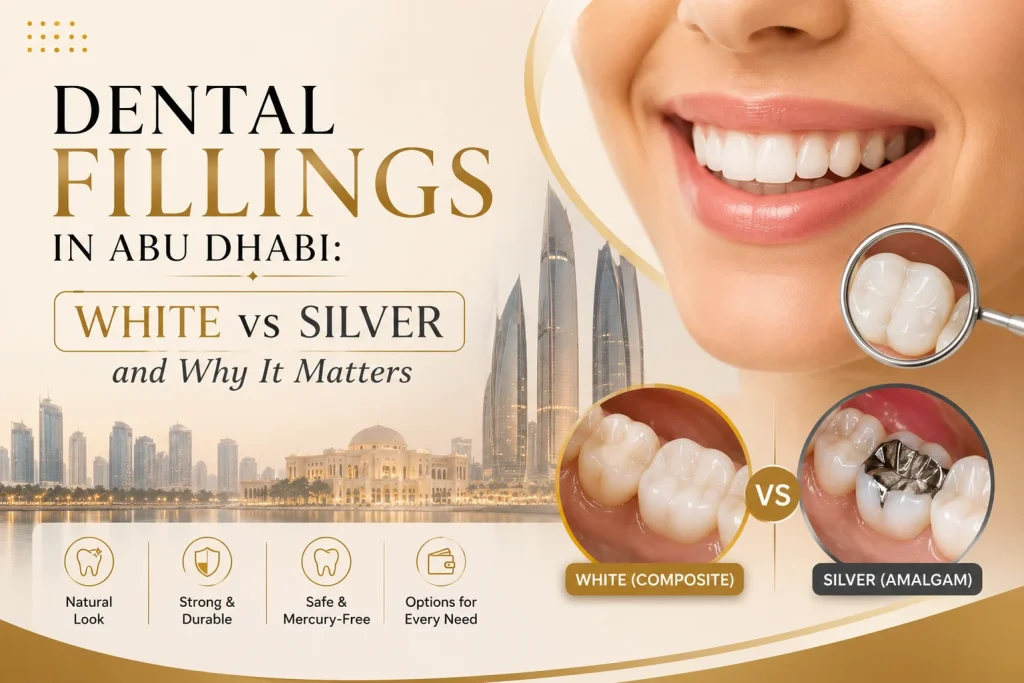
White Filling or Silver Filling: What Actually Separates Them
A white filling is made from composite resin, a tooth-coloured material that bonds directly to the remaining tooth structure. A silver filling is made from amalgam, a metal alloy combining silver, tin, copper, and a small amount of mercury.
The bonding method differs in a way that matters beyond appearance. Composite chemically bonds to the tooth. This means less healthy tooth structure needs removing to place it. Amalgam is mechanically retained instead, shaped into a cavity cut wide enough to hold it in place without bonding.
Composite also sets immediately under a curing light. Amalgam takes several hours to fully harden, though it feels solid enough to bite on within the same day.
Durability: Which One Actually Holds Up Better in Back Teeth
Amalgam typically lasts ten to fifteen years. Composite typically lasts five to seven years before it needs replacing or repairing. In large molar fillings under heavy daily bite force, amalgam still holds a genuine durability edge.
Composite has improved significantly over the past two decades and performs well in most cavity sizes. Very large, multi-surface fillings in back teeth remain the one scenario where amalgam’s strength advantage is hardest to match.
Front teeth carry far less bite force, so this durability gap matters much less there than it does in a molar.
Should You Replace Old Silver Fillings? The Honest Answer
Amalgam is considered safe by major dental health authorities worldwide, supported by decades of clinical use. A silver filling that’s intact, with no cracking, leaking, or decay underneath, generally doesn’t need replacing purely because it’s amalgam.
Replacement becomes appropriate under specific conditions instead. A cracked or chipped filling justifies replacement. So does visible decay forming at its edges, or a filling that’s come loose. Proactively replacing a functioning amalgam filling for aesthetic reasons alone is a reasonable personal choice, but it isn’t a safety necessity.
A dentist can check the condition of existing fillings at a routine check-up and flag anything that actually needs attention.
Filling Cost in Abu Dhabi and What Insurance Actually Covers
Amalgam is typically the least expensive filling material. Composite costs somewhat more per tooth, reflecting the material and the additional technique involved in shaping and bonding it.
Insurance coverage works differently for fillings than it does for cosmetic treatment. Most UAE insurance plans cover basic restorative fillings as standard care. Some plans specifically cover only the amalgam-equivalent cost for back teeth. Choosing composite instead may then involve a modest upgrade fee rather than the full cost out of pocket.
Coverage details vary by provider and plan, so confirming the specifics before treatment avoids surprises at the front desk.
Choosing Between White and Silver for Your Specific Tooth
Front and visible teeth almost always favour composite. The cosmetic difference matters in a spot people actually see when smiling or speaking, and composite’s shorter lifespan matters less on a tooth that carries lighter bite force.
Back molars are where the real trade-off applies. A large cavity in a heavily used molar is the scenario where amalgam’s durability advantage is most relevant, and where composite’s shorter lifespan is most likely to mean an earlier repeat visit.
A dentist’s in-person assessment determines which material actually fits a specific tooth. Cavity size and location matter more than a blanket preference for one material over the other.
What to Expect After a Filling
Mild sensitivity to hot, cold, or biting pressure is normal for a few days after a filling. The tooth typically settles as it adjusts to the new material and the surrounding area calms down from the procedure.
Sensitivity that lasts several weeks, worsens instead of improving, or comes with sharp pain when biting down is not typical. It’s worth a follow-up call in that case. Our guide on tooth sensitivity covers what separates a normal healing response from something needing a closer look.
A bite that feels slightly off in the first day or two often needs a small adjustment, which a dentist can correct quickly at a short follow-up visit.
Frequently Asked Questions
Is white filling better than silver filling?
Neither is universally better. Composite suits visible teeth well and needs less tooth structure removed. Amalgam holds up better under heavy bite force in large back-tooth fillings.
How long do composite fillings last?
Composite fillings typically last five to seven years. Amalgam fillings typically last ten to fifteen years, with a stronger durability edge in large molar restorations.
Should I replace my old silver fillings?
A functioning silver filling with no cracking, leaking, or decay generally doesn’t need replacing purely because it’s amalgam. Replacement is appropriate when damage or decay is actually present.
Does insurance cover white fillings in Abu Dhabi?
Most UAE insurance plans cover basic restorative fillings. Some plans cover only the amalgam-equivalent cost for back teeth, meaning composite may involve a modest upgrade fee.
Are amalgam fillings safe?
Amalgam is considered safe by major dental health authorities, supported by decades of clinical use. Safety concerns alone don’t typically justify replacing a functioning amalgam filling.
Getting the Right Material for Your Tooth
The right filling material depends on where the cavity sits and how much bite force that tooth handles daily. A molar under heavy daily use and a front tooth people actually see call for different priorities entirely. Marigold Dental & Orthodontic Clinic’s team assesses cavity size and location at consultation before recommending either material.
Call +971 26414020 to book that assessment.