
Is it tooth sensitivity or somethings else
Cold water hits one tooth and the reaction disappears before it fully registers. A few hours later, something sweet triggers the same spot again. Then nothing for the rest of the day. That inconsistency is what makes sensitivity difficult to read properly. Cavities can cause it, but so can exposed roots, enamel wear, grinding, even brushing habits that have been repeated the same way for years. Sometimes the tooth settles completely after a few seconds. Sometimes the sensation lingers longer than it used to, or keeps returning to the same area. The feeling itself rarely explains much on its own. What’s Actually Happening When a Tooth Feels Sensitive Under the enamel sits a softer layer called dentin, threaded with microscopic channels that lead to the nerve. Enamel keeps them sealed. When it wears down or gums recede, those channels open up to cold, heat, sugar, pressure. The nerve picks up all of it. That response feels identical whether the cause is decay, grinding, gum recession, or acid erosion. The sensation gives you nothing to go on. What’s causing it is a different question entirely, and the answer is what changes the treatment. Not Every Sensitive Tooth Has a Cavity Behind It Sensitivity is the symptom. A cavity is one possible cause. Patients often arrive convinced they’re the same thing, and that assumption tends to create a lot of anxiety before anything has actually been looked at. Several conditions produce sensitivity with no decay involved: Gum recession exposes the root surface, which has no enamel. Root surfaces react to temperature and pressure far more readily than the crown of the tooth. Enamel erosion from acidic food and drinks strips the protective layer gradually. Citrus, fizzy drinks, coffee. It happens slowly enough that sensitivity is often the first sign something has changed. Bruxism wears enamel down through grinding or clenching, frequently during sleep. A significant number of patients find out they’re doing it only after the damage shows up. Brushing too hard with a firm-bristled brush damages both enamel and the gum margin. It’s a slow process, which makes it easy to overlook. A cracked tooth produces sensitivity that can be nearly indistinguishable from a cavity: sharp, localized, triggered by temperature or biting pressure on a specific spot. Recent dental treatment, cleaning, whitening, a new filling, can leave teeth reactive for days to a couple of weeks. This is temporary and resolves on its own. The pattern behind the sensitivity matters as much as the sensitivity itself. Recession tends to affect multiple teeth near the gum line. Bruxism usually shows up across the back teeth. A crack almost always points to one tooth, one spot, one specific trigger. These distinctions are what a clinical assessment is actually looking for. When Sensitivity Is Trying to Tell You Something More Serious The distinction between general sensitivity and a cavity isn’t always clean, but certain signals shift the picture toward decay. Duration is one of the clearest. Sensitivity from worn enamel or gum recession spikes and disappears within seconds of removing the trigger. Cavity-related sensitivity tends to linger; the trigger sets it off, but the discomfort stays for a minute or more after the cause is gone. That difference in duration reflects how deeply the irritation has reached. Location narrows things further. Sensitivity spread across several teeth points toward something systemic, diet, grinding, brushing habit. The same tooth, the same spot, every time, is a different conversation. Sweet foods are a more specific signal than most people expect. Temperature sensitivity can come from several non-cavity sources. Sensitivity reliably triggered by sugar, particularly concentrated in one tooth, correlates more closely with early decay. The bacteria behind cavities produce acid as a byproduct, and that reaction to sugar is fairly distinct. A few other things worth noting: Pain when biting down, separate from temperature or sweetness, suggests structural involvement. Sensitivity that has been gradually worsening over weeks, not staying stable. A visible dark spot, a rough surface, or a texture that feels different than it used to. Discomfort that appears without any trigger, or that wakes you up. Any one of these on its own might mean little. Several of them together, or one that keeps returning, is worth having looked at sooner rather than later. The Pattern of Your Sensitivity Matters More Than the Sensation Itself Two patients can describe identical sensitivity and be dealing with completely different problems. The sensation itself carries less information than when it happens, how long it stays, which teeth are involved, and whether it’s changing over time. A few things worth paying attention to before an appointment: How long does it last? Sensitivity that clears within 30 seconds of removing the trigger points to surface involvement. Lingering past a minute means the nerve is closer to what’s happening. One tooth or several? Sensitivity across multiple teeth suggests something broad, acid erosion, grinding, brushing damage. The same tooth every time is a more specific finding. Is it getting worse? Sensitivity that appeared once and hasn’t returned is different from something that started mild a few weeks ago and has been quietly building. How it changes over time matters more than how it feels on any given day. What sets it off? Temperature sensitivity is common across many causes. Sweet-triggered sensitivity in one specific tooth is a narrower signal. Pain from biting pressure points toward structural damage. Dentists ask these questions because a visual exam doesn’t always show the full picture. Cavities forming between teeth or below the gum line stay hidden until they’re well established. The pattern often gets there first. What a Dentist Is Actually Looking For Before anything is examined, there are questions. When the sensitivity started, what brings it on, whether it’s one tooth or spread across several, whether it’s been shifting. That conversation does more diagnostic work than most patients expect, often before a single instrument is picked up. The examination fills in what the history can’t show. Gums and tooth surfaces checked visually, probing for recession or wear, the bite assessed for uneven pressure. If the clinical picture suggests decay between teeth or below the gum line, where nothing appears on the surface, X-rays follow. An early cavity usually means a dental filling and not much else. Caught before it reaches the nerve, it stays a contained procedure. Left another six months, the same cavity rarely does. No decay found shifts the focus entirely. The findings point toward whatever the assessment actually shows, grinding, recession, erosion, technique.
Scaling & Polishing: When Do You Need It?
The question usually comes down to a number. Six months gets mentioned often, sometimes a year, sometimes longer. It sounds like something that should follow a fixed gap. Plaque doesn’t build at the same rate for everyone. After a few months, one person may have very little to remove, while another already has visible deposits along the gum line. The routine may look the same on the surface, but the result inside the mouth doesn’t match. What matters is how quickly deposits form and how the gums respond to them. That part doesn’t stay consistent from one person to another. Buildup starts in the areas brushing doesn’t fully reach Plaque doesn’t spread evenly across the teeth. It settles more in certain areas, especially near the gum line and between teeth where brushing doesn’t always reach fully. Those spots don’t always feel different at first. The surface may still seem smooth, but a thin layer starts to stay in place if it isn’t removed properly. Over time, that layer hardens. Once it does, regular brushing no longer clears it, and it stays in the same areas until it’s removed professionally. A rough feeling near the gums that doesn’t go away after brushing Some areas stop feeling completely clean, even right after brushing. The front teeth may feel smooth, but near the gums or behind the lower teeth, there’s a slight roughness that keeps coming back. The surface feels smooth in most areas, but near the gums or behind certain teeth, the texture is different. Brushing doesn’t change that spot the way it does the rest. The same area feels rough again later, even after cleaning. It settles briefly, then returns in the same place. With time, the change becomes easier to notice. Not because it suddenly gets worse, but because it doesn’t clear the way other areas do. Teeth that stay smooth longer without much buildup Some mouths don’t develop that roughness as quickly. The surface stays smooth for longer, even in areas close to the gums or between teeth. Brushing clears most of what builds up, and it doesn’t return in the same spots right away. The texture remains consistent, without that one area standing out from the rest. Even after a longer gap, there may be very little to remove. The difference isn’t in the routine, but in how the mouth responds over time. Buildup that hardens and stays in place over time When deposits are left for longer, they don’t stay soft. The surface near the gums begins to feel more solid, and brushing no longer changes it. That layer starts to sit along the same line, especially on the inner side of the lower teeth or around the back molars. It doesn’t shift or reduce with regular cleaning. As it builds, the gums around those areas may not feel the same. Not sharp pain, just a change in how they respond during brushing or eating. The right time is when buildup starts to stay instead of clearing As long as the surface returns to normal after brushing, there isn’t much to remove. The teeth feel consistent, and no single area stands out. Once certain spots stop clearing the same way, the timing changes. The surface stays rough in the same place, or a layer remains near the gums without shifting. That’s usually the point where waiting longer doesn’t improve anything. The buildup stays in place, and regular cleaning stops making a difference. What brushing leaves behind over time Some areas don’t respond to brushing once the deposits have hardened. The surface may feel unchanged no matter how thoroughly it’s cleaned at home. That layer stays close to the gums or between teeth, where it continues to build without being removed. In those cases, scaling and polishing helps remove buildup that brushing cannot reach Closing Thought Some teeth stay smooth for longer, while others start to feel different in specific areas. The change isn’t always obvious at first, but it shows up in how the surface responds over time. The timing usually becomes clear from that. Not from a fixed gap, but from what starts to stay instead of clearing
Signs You Need a Dental Check-Up
Something feels slightly off, but not enough to act on. A bit of sensitivity that comes and goes. Gums that bleed once, then seem fine again. A tooth that feels different for a day, then settles. Nothing stands out on its own. It’s easy to move past it and carry on as usual. Over time, those small changes begin to repeat. Not in a way that interrupts the day, but enough to notice if you pay attention. That’s usually where the question starts. Not whether something is wrong, but whether it’s worth checking at all. Sensitivity that doesn’t stay long enough to take seriously Cold water hits one tooth differently. Not every time, just enough to register for a moment before it disappears again. By the time it’s gone, it doesn’t feel like something worth paying attention to. Bleeding during brushing can show up once, then not return the next day. Without any consistency, it’s easy to treat it as nothing unusual and move on. There are also moments when a specific spot feels slightly off while eating. No clear pain, no sharp reaction, just a difference that wasn’t there before. It passes quickly, which makes it easier to ignore. Sensitivity that doesn’t stay long enough to take seriously Cold water hits one tooth differently. Not every time, just enough to register for a moment before it disappears again. By the time it’s gone, it doesn’t feel like something worth paying attention to. Bleeding during brushing can show up once, then not return the next day. Without any consistency, it’s easy to treat it as nothing unusual and move on. There are also moments when a specific spot feels slightly off while eating. No clear pain, no sharp reaction, just a difference that wasn’t there before. It passes quickly, which makes it easier to ignore. The same tooth or area starts to come back into focus A single incident is easy to ignore. What’s harder to dismiss is when the same spot draws attention again, even if the feeling is mild. It might be the same tooth reacting during meals, or a gum area that feels irritated every few days without a clear reason. Nothing feels serious in the moment, which is why it gets pushed aside. But the repetition stands out over time, especially when it doesn’t fully disappear between those moments. That’s usually where the shift happens. Not because the discomfort increases, but because it doesn’t stay isolated. Bleeding during brushing or breath that doesn’t stay fresh Brushing happens every day, and most of the mouth feels fine. Still, one area doesn’t settle the way it should. It might be the same tooth reacting now and then, or a spot near the gums that never quite feels right. Nothing feels serious enough to stop and deal with it. The routine stays the same, so it seems like it should improve on its own. But the same place keeps drawing attention, even if the discomfort is mild. Over time, that repetition stands out more than the sensation itself. Not because it gets worse, but because it doesn’t fully go away. The same tooth keeps bothering you even when nothing obvious is wrong One tooth reacts again while eating. A few days later, the same spot feels off during brushing. There’s no clear reason for it, and nothing else in the mouth behaves the same way. The routine hasn’t changed. The discomfort doesn’t spread. It stays in one place and keeps returning. That’s the point where it stops being random. A dental check-up can identify what’s happening beneath the surface before it develops further. A tooth reacts during brushing, then later while eating. Nothing else behaves the same way. The reaction settles, then returns in the same spot after a short gap.
Benefits of Night Guards for Teeth Grinding
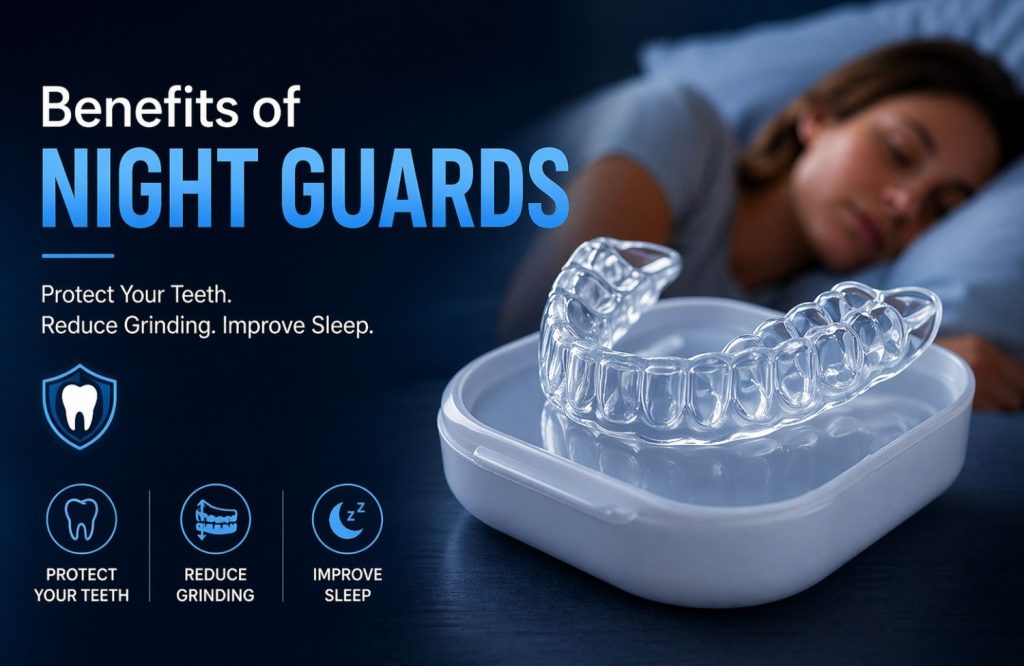
Teeth grinding usually doesn’t announce itself. It happens during sleep, without any clear signal at the time. The effects tend to show up later, often in ways that don’t immediately point to the cause. A tight feeling in the jaw, slight discomfort in the morning, or sensitivity that wasn’t there before. Each on its own can feel unrelated. Over time, those changes begin to connect. The pressure placed on the teeth during the night starts to leave a visible and physical impact. Grinding does not happen in a controlled way. The teeth come into contact with more force than they are meant to handle, often for longer than a normal bite would last. It’s not a single movement. It can repeat, or continue for short periods without interruption. The pressure is not evenly distributed. Certain areas take more of it, especially where the teeth meet first. Over time, those points begin to show the effect. The jaw is involved as well. Muscles stay active when they are supposed to be at rest. That tension carries through the night, even without being noticed. By the time morning comes, the teeth and jaw have already gone through repeated strain. Signs That Are Often Overlooked The signs are not always obvious. A slight tightness in the jaw in the morning can pass within minutes, so it rarely stands out. It feels like stiffness, not something linked to the teeth. There can also be small changes along the edges of the teeth. Nothing dramatic at first, just a difference in how they feel when the tongue runs across them. Some people notice sensitivity without a clear reason. Cold or pressure starts to feel different, even though nothing in the routine has changed. Each of these on its own can seem minor. It’s only when they start to repeat that the pattern becomes clearer. How Grinding Affects Teeth and Jaw Over Time The effect doesn’t show all at once. At first, the changes are subtle. The edges of the teeth begin to feel slightly different, not as sharp or defined as before. It’s easy to overlook unless attention is drawn to it. With time, the surface starts to wear. The contact between teeth becomes flatter in certain areas, and the natural shape begins to change. The jaw is affected alongside it. Tension that was occasional becomes more familiar, especially in the morning or after periods of rest. As the pattern continues, the impact is no longer limited to one area. Teeth and jaw begin to respond together, and the strain becomes part of the daily routine rather than an isolated event. Where a Night Guard Makes a Difference The change begins when the contact between the teeth is no longer direct. Instead of one surface pressing against another, there is a layer in between that absorbs part of that force. The pressure is still there, but it no longer falls on the same points in the same way. That shift reduces how much the teeth wear against each other during the night. The edges are not exposed to the same repeated contact, and the surface is less affected over time. The jaw responds differently as well. When the force is distributed more evenly, the tension does not build in the same way as before. It doesn’t stop the habit itself. What changes is the impact it leaves behind. The difference is not only in what is reduced, but in how the teeth and jaw respond over time. With that layer in place, the contact no longer affects the same areas repeatedly. The surface is not exposed in the same way night after night. Small changes begin to show first. The edges stop wearing at the same rate. Sensitivity does not increase in the same pattern as before. The jaw also settles differently. The tension that used to carry into the morning doesn’t build in the same way when the pressure is absorbed rather than transferred directly. Nothing changes overnight. The effect is gradual, but more controlled compared to the pattern without it. When a Night Guard Becomes Necessary It’s not always a single symptom that leads to it. More often, it becomes clear through repetition. The same areas of discomfort return, or the same patterns continue without changing. What starts as something occasional begins to settle into a routine. Morning tightness, sensitivity, or uneven contact between teeth no longer feels temporary. In some cases, the change is visible. The edges of the teeth don’t look the same, or certain spots begin to wear more than others. At that point, it’s less about noticing isolated signs and more about recognizing a pattern that continues without improving. Treatment Option When the pattern continues without change, the focus shifts from managing the effects to limiting the impact. At that stage, the goal is not to stop the habit itself, but to reduce how much strain it places on the teeth and jaw during the night. A night guard creates that separation. It changes how the pressure is distributed and prevents the same areas from taking repeated force. In such cases, a custom night guard can help protect the teeth and reduce pressure during sleep Closing Changes from grinding don’t always stand out at first. What matters is how they continue. When the pattern stays the same or becomes more noticeable over time, the impact tends to follow.
How to Prevent Cavities in Kids
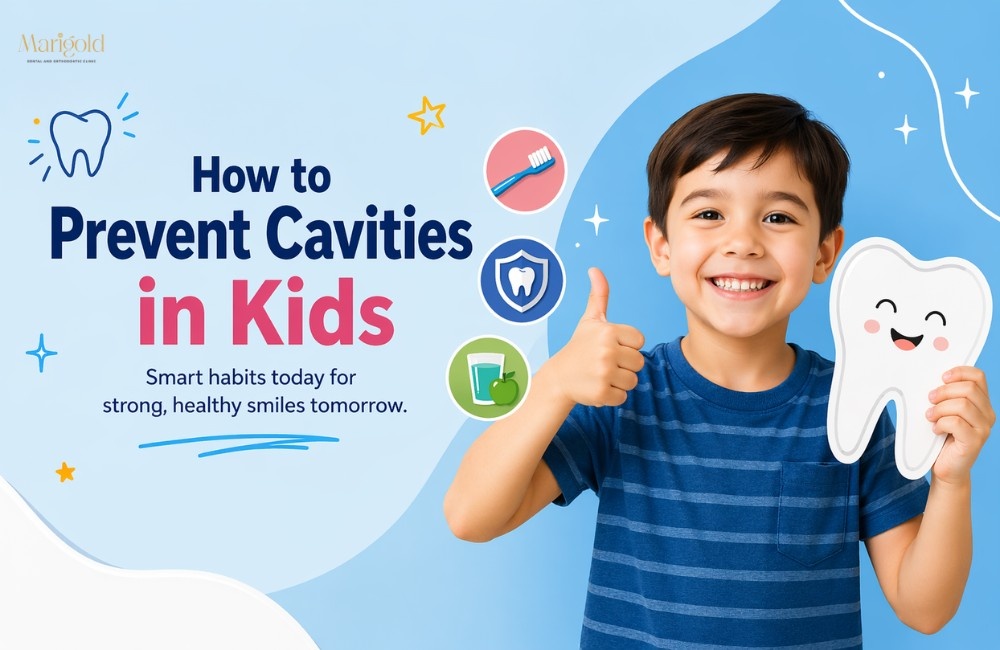
Cavities in children rarely come from one obvious cause. A child may brush daily and still develop decay. Nothing in the routine seems off at first, yet the same issue returns over time. The change usually builds in smaller ways. What is eaten, how often, and how thoroughly the teeth are cleaned all play a role, even when each part seems manageable on its own. Understanding where those small gaps happen makes it easier to prevent them from building into something larger. How Cavities Develop in Children Cavities form over time, not in a single moment. After eating, small amounts of food remain on the teeth, especially in areas that are harder to reach while brushing. When those areas are not cleaned properly, they stay undisturbed for longer than expected. The surface of children’s teeth is more vulnerable compared to adults. That makes it easier for early damage to develop if the same spots are missed repeatedly. It’s not only about what is eaten. How often the teeth are exposed, and how well they are cleaned afterward, shapes how the process develops. What Actually Helps Reduce the Risk Prevention usually comes down to how consistently certain moments are handled. Spacing between meals makes a difference. When the teeth are not constantly exposed, there is time for the surface to recover before the next intake. Cleaning also becomes more effective when it’s not rushed. The difference is not in adding steps, but in how evenly the routine covers all areas, especially the ones that are easy to miss. Supervision can change the outcome as well. Not in a strict sense, but in making sure the routine is carried out with enough attention rather than quickly completed. Over time, these small adjustments tend to shift the pattern. The same habits remain, but the way they are followed becomes more consistent. Why Cavities Still Happen Despite Brushing Brushing on its own doesn’t always cover how cavities develop. The areas that matter most are often the ones that are hardest to reach. Even with regular brushing, certain spots may not be cleaned as thoroughly as expected. Frequency also plays a role. When teeth are exposed multiple times through the day, the effect builds between routines, not just around them. There are also factors that aren’t always visible. Early changes in the enamel or buildup in less noticeable areas can continue without drawing attention. Because of that, a routine can feel consistent and still leave room for cavities to develop over time. Professional Support When cavities continue to develop despite a consistent routine, the focus shifts to understanding what is being missed. Some areas are not easy to assess during daily care. Early decay, changes in enamel, or buildup in less visible spots can progress without clear signs. At that stage, a more detailed evaluation helps identify where the pattern is coming from and how it can be adjusted. In such cases, a pediatric dental checkup helps identify early signs of decay and guide proper care. Closing Cavities in children rarely come from one clear cause. What matters is how small patterns continue over time. When those patterns don’t shift, the result tends to follow, even when the routine feels consistent.
Signs You Need a Root Canal
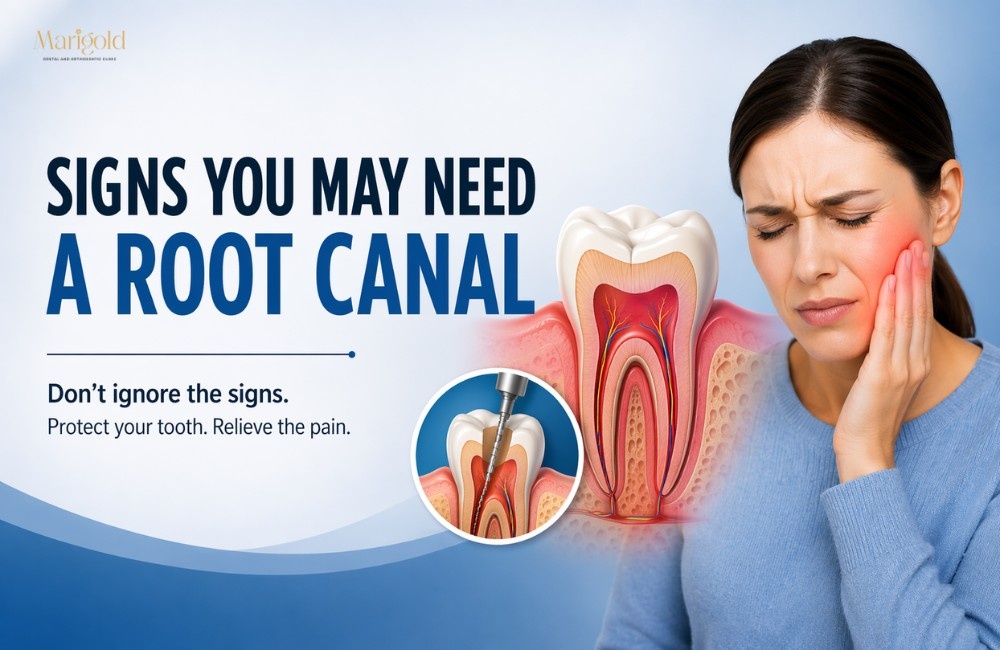
A tooth that starts hurting does not always behave the same way. It might react when you drink something cold. Later, the same tooth feels fine. Then it comes back when you bite down, or when you leave it alone. That shift is what makes it confusing. The problem is not always the intensity. It is the change in how the tooth responds. Some patterns point to irritation near the surface. Others suggest something deeper inside the tooth. What a Root Canal Actually Treats Inside the tooth, beneath the outer layers, there is a soft tissue that contains nerves and blood supply. When that area becomes irritated or infected, the tooth starts to respond differently. The reaction is not always constant. It may appear only under certain conditions at first. The source of the problem is not the surface. It develops deeper, where routine cleaning does not reach. As the condition progresses, the response becomes more consistent. What starts as occasional sensitivity can turn into discomfort that no longer settles on its own. A root canal is used to address that internal infection while preserving the structure of the tooth. When Symptoms Become More Serious At some point, the tooth stops settling back the way it used to. What felt occasional starts showing up without a clear reason. You’re not eating or drinking anything specific, but the sensation is there anyway. Biting becomes something you notice more than before. Not every time, but often enough that you begin to avoid using that side. Sometimes the change shows visually. The tooth looks slightly different, or the area around it doesn’t feel the same when you press against it. It’s not one symptom that stands out. It’s the shift from something that came and went… to something that stays. Types of Pain That Point to a Deeper Problem Pain does not stay the same when the source is deeper. At first, it may only appear with something specific. Cold, heat, or pressure. Then it starts to show up without a clear trigger, or stays longer than expected after the cause is gone. There’s also a difference in how it feels. A brief reaction is one thing. A sensation that lingers, or returns on its own, feels different. It’s harder to ignore. Biting can change as well. One spot feels sharper than the rest, or the pressure doesn’t distribute evenly. You begin to notice it without trying to. In some cases, the discomfort becomes more constant. Not always intense, but present enough that it doesn’t fully settle. What Happens If the Infection Is Left Untreated When the source of the problem is not addressed, the condition doesn’t stay the same. What begins inside the tooth can extend beyond it over time. The discomfort that was once occasional becomes more consistent, and the tooth no longer settles between episodes. Pressure and sensitivity may increase, but not always in a sudden way. In many cases, the change is gradual, becoming more noticeable as normal use of the tooth becomes difficult. The surrounding area can also be affected. The issue is no longer limited to a single point, and the response begins to involve nearby tissue. It’s not always immediate, but the direction tends to move forward rather than resolve on its own. When Treatment Becomes Necessary When the condition reaches a point where the tooth no longer settles, routine care is no longer enough to manage it. At that stage, the source lies deeper within the tooth. The discomfort may vary, but the underlying issue remains present and does not resolve on its own. Treatment is considered when the infection affects the inner structure and begins to interfere with normal function. The goal is not only to relieve discomfort, but to prevent further progression. In such cases, root canal treatment may be required to address the infection and preserve the tooth Closing Changes in a tooth rarely follow a clear pattern at the beginning. What matters is how those changes develop over time. When the response becomes more consistent, or begins to interfere with normal use, it usually points to something that needs closer attention.
Foods That Stain Your Teeth & How to Prevent
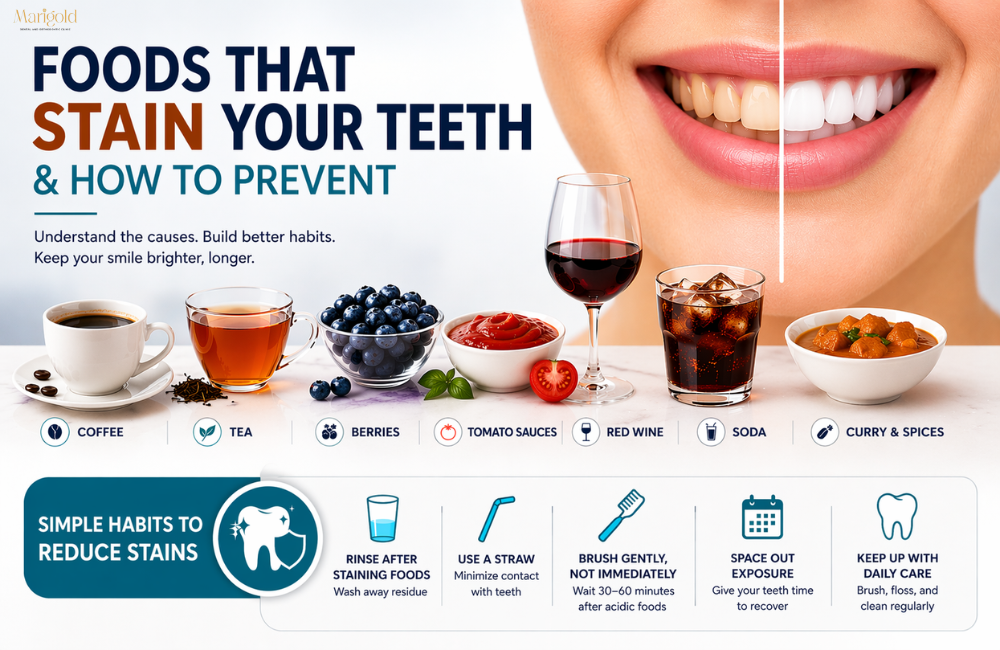
Teeth don’t suddenly turn yellow after one cup of coffee. It’s more gradual than that. A drink here, another later, something in between. The exposure adds up, but not in a way that’s easy to notice day to day. Dark beverages, sauces, even certain fruits leave behind residue each time. Not enough to see immediately, but enough to settle over time. The change usually becomes visible later, not when it starts. How Teeth Staining Actually Happens Staining starts in a way that is easy to miss. A cup of coffee, a sip of tea, a meal with strong color. Nothing changes right away. The surface looks the same after brushing, so it feels like nothing has stayed behind. What actually remains is a thin residue. It settles along the enamel, especially near the gum line and between teeth where cleaning is less precise. Acidic drinks and foods affect the surface differently. The enamel becomes slightly more receptive for a short period, which allows color to attach more easily if exposure happens again soon after. The pattern matters more than the quantity. Frequent contact during the day leaves a stronger effect than a single intake, even if the amount is small. Foods and Drinks That Cause Staining Not all staining comes from obvious sources. Some of it builds through routine exposure rather than a single item. Dark beverages are one of the more consistent contributors. Coffee and tea come into contact with the teeth multiple times a day in many routines. The color is strong, but the frequency is what makes the difference. Certain foods leave a similar effect. Berries, tomato-based sauces, and dishes with deep pigments tend to stay on the enamel for longer than lighter foods. The residue is not always removed completely with a quick rinse or a short brushing. Acidic items add another layer to it. Citrus drinks and soft beverages do not leave strong color on their own, but they change the surface of the enamel for a short period. If something with color follows, it tends to settle more easily. Combinations often go unnoticed. Coffee followed by a snack, or repeated sipping throughout the day, keeps the teeth exposed for longer than a single intake would. Habits That Make Staining Worse Staining is not only about what is consumed. It is often shaped by how it fits into the day. Sipping over long periods is one of the more common patterns. A drink that stays in contact with the teeth for hours leaves a different effect than one taken in a short time. Rinsing is often skipped. After coffee or strongly colored food, the residue remains on the surface until the next cleaning. In many cases, that delay is enough for it to settle. Timing between intake also matters. Repeated exposure, especially without any break, keeps the enamel in contact with pigments throughout the day. Some routines combine multiple factors without noticing. A drink, followed by something acidic, then another drink. The sequence creates conditions where staining becomes more likely. What Can Be Done to Reduce Staining Staining is not only tied to what is consumed. It often comes down to how long the teeth stay in contact with it. A drink finished in a few minutes passes quickly. The same drink, stretched across an hour, keeps returning to the surface again and again. Rinsing is often overlooked. Without it, whatever remains stays in place until the next time the teeth are cleaned. Spacing also changes the pattern. Repeated intake through the day leaves less time for the surface to clear between exposures. Acidic foods affect timing. Brushing immediately after can work against the enamel rather than protect it. The difference usually comes from how these moments are handled across the day, not from removing certain foods entirely. What Staining Cannot Be Removed at Home Not all staining stays on the surface. Some discoloration settles deeper, beyond what brushing or rinsing can reach. It develops gradually, often from repeated exposure over time rather than a single source. At that stage, the surface may feel clean, but the color does not change. Regular cleaning continues, but the appearance remains the same. These types of stains do not respond to routine care alone. They require a different approach to be reduced or removed. Professional teeth whitening can help address deeper staining that does not respond to daily care After Whitening – What to Be Careful With After whitening, the surface of the teeth becomes more responsive for a short period. During that time, color can attach more easily than usual. Certain foods and drinks tend to affect the result if they are introduced too soon. Coffee, tea, and strongly pigmented items can begin to leave marks again before the surface settles back to normal. The timing of intake becomes more noticeable here. Reintroducing these items gradually helps maintain the result for longer. For a clearer idea of what fits into this period, it helps to look at what you can eat after teeth whitening Common Misconceptions About Teeth Staining Staining is often misunderstood, especially in how it develops and how it can be managed. Brushing harder will remove stains Pressure does not affect deeper discoloration. It can wear the enamel without improving appearance. All stains behave the same way Surface stains and deeper discoloration respond differently. Treating them the same rarely works. Quick fixes can reverse staining Changes in color develop over time. Reversing them is rarely immediate. If teeth feel clean, staining is gone Surface smoothness does not reflect color. Discoloration can remain even when the teeth feel clean. For a clearer breakdown of these ideas, it helps to go through common teeth whitening myths and facts. Closing Staining develops gradually, often without drawing attention at the start. Daily habits shape how it builds over time. Small patterns, repeated throughout the day, tend to leave a stronger impact than occasional exposure. Keeping those patterns in check, along with periodic care when needed, helps maintain the appearance over the long term.
Daily Oral Hygiene Routine: Complete Guide
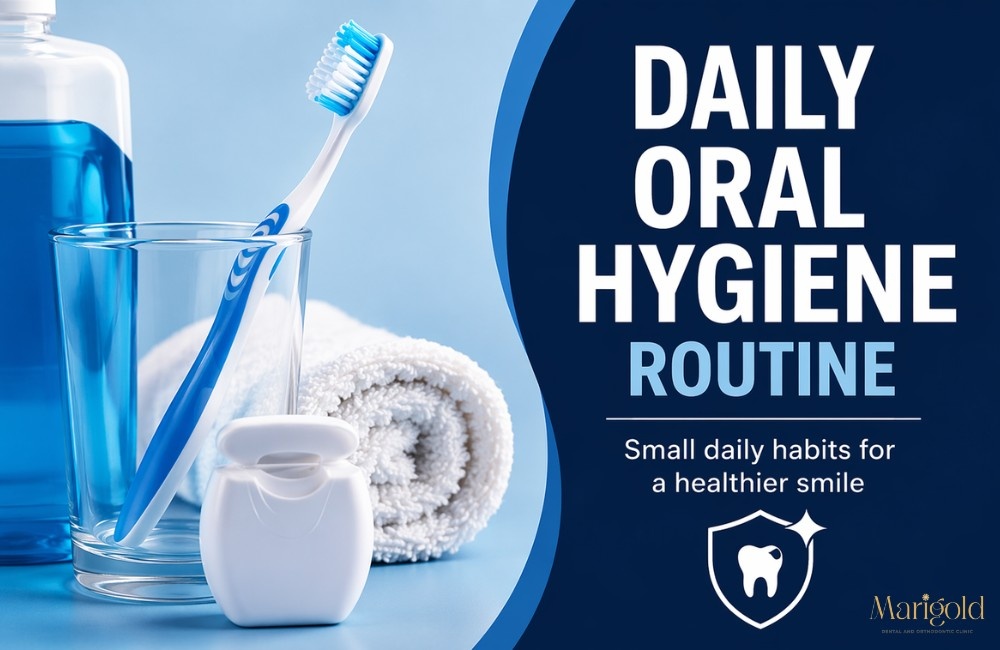
Brushing twice a day is common. For many, that feels like enough. But brushing alone does not cover everything. Areas between the teeth are missed. Certain surfaces are cleaned quickly and unevenly. Over time, those gaps in the routine begin to show. Not immediately, but gradually through plaque buildup or early gum irritation. A complete routine depends on how well each step is done and how consistently it is followed. What a Daily Oral Hygiene Routine Includes Brushing is often treated as the routine. In reality, it leaves out areas that a toothbrush cannot reach. Plaque does not build evenly. It collects between teeth, along the gum line, and in spots that can be easily ignored unless attention is given. Timing is one crucial factor that is often overlooked. Experts suggest not brushing immediately after eating. Brushing straight after food, especially acidic foods or drinks, can affect enamel. Waiting for an hour can provide sufficient cleaning with ease. Technique is inconsistent in most cases. Areas that are more exposed are brushed more easily, while hidden or uneven areas are often skipped without notice or in a hurry. A routine only works when all surfaces are cleaned properly, including the less visible ones. Brushes with varying bristle density are available. Use a soft brush or choose one based on your comfort level. How the Routine Differs Between Morning and Night A routine usually settles into two parts of the day. Morning and night, but they are not identical. Morning brushing is often quicker. It helps remove buildup from overnight and freshens the mouth before the day starts. The focus here is basic cleaning, but it still needs enough time to cover all areas, not just the front teeth. Night care matters more than most people assume. Food particles and plaque left behind stay in place for hours during sleep. That makes thorough cleaning at night more important than speed. Flossing fits better into the evening routine. It reaches areas that brushing misses, especially between teeth where buildup is more likely to stay undisturbed. Rinsing can help, but it does not replace brushing or flossing. It works as an addition, not a substitute. What matters most is not adding more steps, but doing the routine without rushing through it or skipping the less visible areas. Common Mistakes in Daily Oral Hygiene Even with a regular routine, a few things are often left out or done without much attention. Brushing for too little time A quick pass over the teeth feels sufficient, but certain areas don’t get cleaned properly. Back teeth and inner surfaces are often missed. Skipping between the teeth Brushing alone does not reach the spaces between teeth. Without flossing, buildup stays in place, even if the visible surfaces look clean. Rushing at night Cleaning at the end of the day is often done quickly. Fatigue plays a role, and parts of the routine get shortened or skipped. Brushing right after meals Especially after acidic food or drinks. Enamel is more vulnerable at that point, and brushing immediately can cause damage. Using the same technique everywhere Teeth are not aligned the same way. Some areas need more attention, but the same motion is repeated across all surfaces. Replacing the brush too late Worn bristles lose effectiveness. Cleaning becomes less thorough even if the routine stays the same. Limits of a Daily Oral Hygiene Routine A consistent routine keeps the teeth clean superficially, but it does not always reveal what is happening behind the surface. Plaque can harden in areas that are not easy to clean during daily care. Early signs of decay or gum issues may remain invisible until they begin to develop. Most problems develop without any known symptoms. There is no discomfort in the early stages, and the routine continues as usual without any indication that something is changing. Some changes are not visible during daily care. Early decay, gum inflammation, or buildup below the surface can go unnoticed without a proper examination. Regular dental checkups help detect these issues early and allow timely treatment. A routine works best when it is consistent and done with attention. Small gaps in daily life can be missed easily and tend to develop with the time being. Keeping the routine complete, along with periodic checkups, helps maintain long-term oral health.
Do You Really Need Braces?
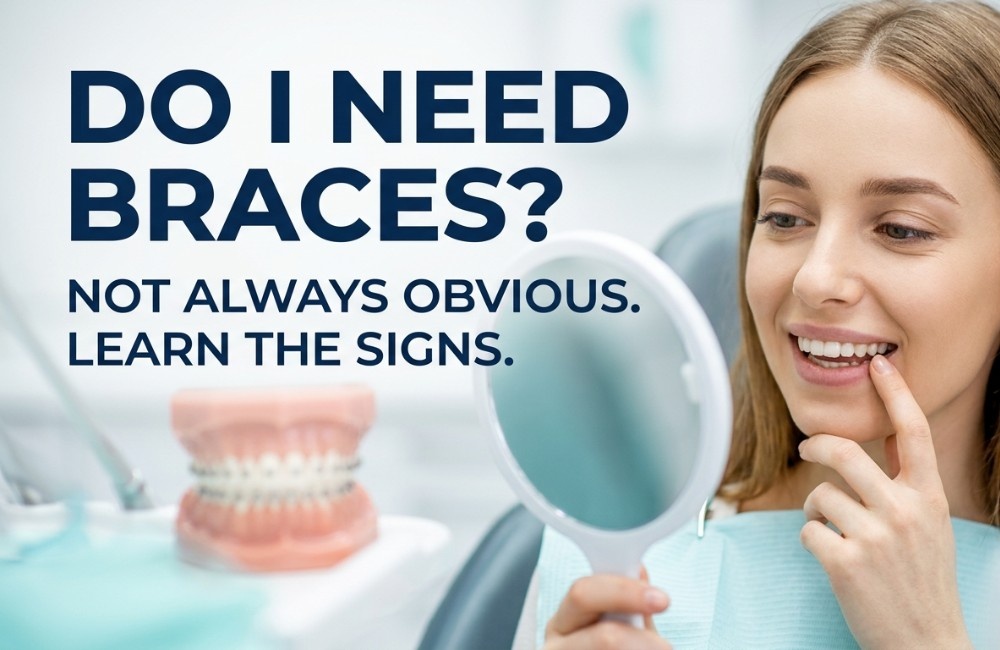
It’s not always obvious. You notice your teeth here and there. Maybe in photos. Maybe while brushing. Nothing extreme, but enough to make you pause for a moment. Then the question comes up, quietly. Is this something that needs to be fixed, or is it normal? Not every alignment issue requires braces. Some changes are minor. Others are easier to recognize once you know what to look for. What Counts as an Alignment Issue? Perfect alignment is not the standard. Minor variations in how teeth sit are common and often do not require treatment. The concern begins when positioning starts to interfere with cleaning or function. Crowded teeth, for example, can trap plaque in areas that are difficult to reach. Over time, that increases the risk of decay or gum problems. Spacing creates a different issue. Gaps may seem harmless, but they can change how force is distributed when biting. In some cases, certain teeth take more pressure than they should. Bite alignment is another factor. When the upper and lower teeth do not meet correctly, the effect builds over time rather than appearing immediately. Some teeth begin to wear down faster, while others carry more pressure than they should. Jaw discomfort can also develop, especially during chewing. Mild alignment changes do not always require treatment. The concern begins when function is affected or stability starts to decline. At that point, the issue extends beyond appearance and requires clinical attention. Signs You May Need Braces Certain changes are easier to recognize once you know what to look for. Crowding is one of the more noticeable signs. Teeth begin to overlap or rotate, and cleaning becomes less effective in those areas. Over time, plaque tends to build up more easily. Gaps between teeth can also indicate alignment issues. In some cases, spacing affects how pressure is distributed when biting, especially if certain teeth carry more load than others. Bite problems are not always visible at first. Difficulty chewing, uneven contact between teeth, or strain in the jaw can point to misalignment that needs correction. Shifting over time is another sign. Teeth that were previously straight may begin to move, even in adulthood, without an obvious cause. In these situations, it helps to understand how braces treatment works and what the process involves, as well as what are the different type of braces available for teeth alignment. When It May Not Require Treatment Mild irregularities often remain unchanged for years. Teeth may not sit perfectly, but they function without difficulty and can be cleaned without obstruction. Treatment is not always required when: Cleaning is not affected No areas where plaque builds up because of crowding. Brushing and flossing remain straightforward. Biting feels normal No pressure in specific spots. No strain while chewing. Position remains stable No ongoing shifting or increasing crowding. No visible side effects No gum irritation. No unusual wear. No signs of stress in the jaw. In these situations, monitoring is often enough. Treatment can be considered later if changes begin to appear. When to See an Orthodontist Some changes are easy to overlook without an examination. Ongoing shifting is one example. Teeth that were stable before begin to move, and the change does not stop on its own. Discomfort while chewing can also point to a problem. Not constant pain, but pressure in certain areas or a bite that feels uneven. Cleaning may become less effective. Certain areas are harder to reach, or plaque builds up in the same spots despite regular brushing. At that stage, a proper assessment by an orthodontist helps determine what is actually happening. If you’re considering expert evaluation, consulting an orthodontist in Abu Dhabi for braces and teeth alignment treatment can provide a clear diagnosis and personalized treatment plan.
Braces vs Invisalign: Which Is Better?

You might notice it in a photo first. Not something obvious, but enough to make you pause for a second. Later, it comes up during a routine dental visit. Alignment, spacing, bite. Nothing urgent, but not something to ignore either. From there, the question starts to build quietly. Should I actually fix this? That question often leads to a deeper one do you really need braces for your teeth condition, or is it something that can be left as it is? That’s usually when you begin looking into options. Braces come up. Then Invisalign. And before long, you’re trying to understand which one makes more sense for you, not just in theory, but in real life. What Are Braces? Braces are a fixed treatment used to correct the position of teeth over time. Small brackets are attached to the surface of each tooth and connected with a wire. That wire is adjusted at intervals, applying controlled pressure to place the teeth into alignment. Tooth movement is created by applying controlled force through the wire. Each adjustment places pressure on specific teeth and shifts them toward the planned position. The system remains fixed, so each adjustment produces a predictable change. Complex alignment and bite correction require precise control during each adjustment. Daily habits do change during treatment. Certain foods become difficult to manage, especially in the beginning. Cleaning also takes more time, since the brackets create additional areas where plaque can build up. With time, these adjustments become routine. Most patients settle into it once they understand what to expect. If you’re considering braces, it also helps to understand the types-of-braces and how braces treatment actually works from start to finish. What Is Invisalign? Invisalign is a teeth-straightening method that uses clear, removable aligners instead of fixed brackets and wires. Each aligner is custom-made to fit your teeth closely. A new set is introduced every one to two weeks, with each stage designed to move specific teeth in a controlled sequence. The aligners remain in place for most of the day and are removed only during meals and oral hygiene. This allows you to maintain normal eating habits and routine brushing without additional restrictions. Because the system is removable, treatment depends on consistent wear. Skipping hours or removing aligners frequently can delay progress and affect results. Patients who follow the schedule closely usually adapt within the first few weeks. Once the routine is established, the process becomes easier to manage, particularly for those who prefer a less visible option during treatment. Differences Between Braces and Invisalign Which Option Is Right for You? A clinical assessment is what determines the approach. It shows how much movement is needed, how long it may take, and which option fits the case. If you’re unsure where to start, speaking with an experienced specialist can make things clearer. A consultation with an orthodontist-abu-dhabi for braces or Invisalign treatment helps you understand exactly what your teeth require and which option is more suitable for your situation. You can explore both options in more detail at Invisalign treatment information and how braces treatment is carried out step by step. Treatment Time: Is There a Difference? Treatment time depends on how much movement is required. Cases involving minor alignment can be completed in a shorter period. More complex corrections, especially those involving bite changes, take longer regardless of the method used. Braces are often used in situations where movement needs to be more controlled. In those cases, treatment may extend over a longer duration. Invisalign can be quicker in simpler cases, but only when the aligners are worn as prescribed. Inconsistent use can delay progress and extend the timeline. The type of treatment does influence duration, but it is not the only factor. The condition of the teeth and how closely the plan is followed both affect the outcome. A proper assessment provides a more accurate estimate based on the specific case. Making the Right Decision At this stage, the difference is already clear. What remains is how it fits you. Some patients prefer a fixed approach that runs on its own. Others are comfortable managing something removable, as long as it stays consistent. Neither choice is automatic. It depends on how you want to go through the process, not just the result. The clinical side sets the limits. The rest comes down to preference and routine. If there’s still uncertainty, that’s expected. Most decisions are not made from reading alone. A consultation usually answers what written information cannot. It shows what applies to your case, not just what works in general. Let’s Help You Decide If you’ve reached this point, you probably already have a sense of which direction feels more suitable. Still, it’s not always easy to decide based on general information alone. An in-person consultation gives a clearer picture. It allows the condition of your teeth to be assessed properly, and the options can be explained in a way that relates directly to your case. There’s no need to rush the process. Taking the time to understand what works best usually leads to a more comfortable and predictable outcome.