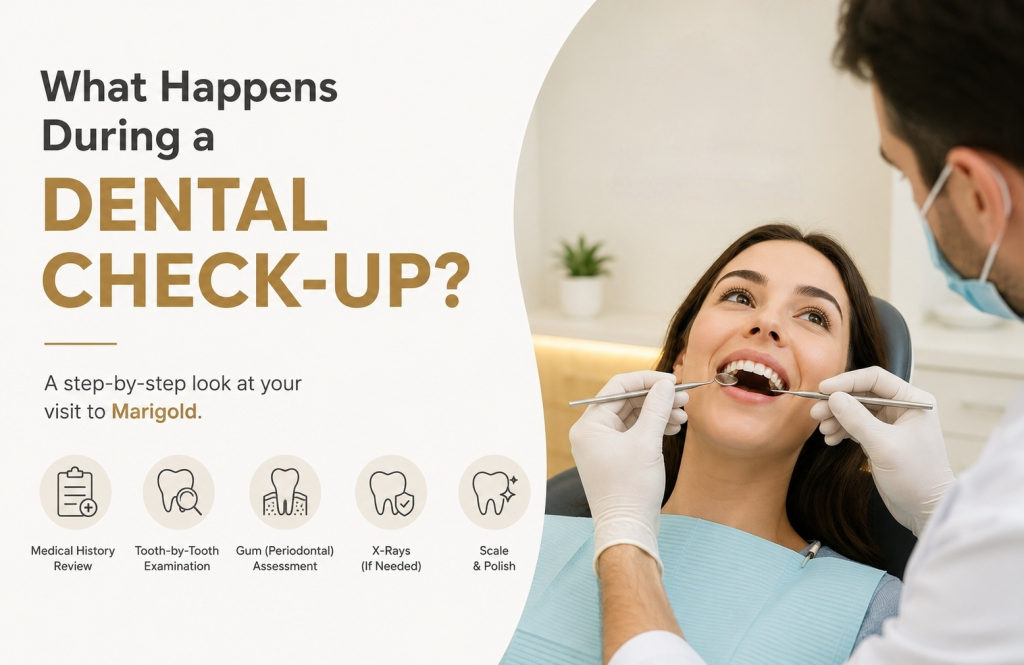
A check-up at Marigold covers six clinical stages: medical history review, full tooth-by-tooth examination, periodontal assessment, soft tissue screening, X-rays where clinically indicated, and a scale and polish. For a new patient the appointment runs 45 to 60 minutes. For an established patient with an existing chart and recent X-rays, closer to 30 to 45. Nothing in the appointment should feel unexpected after reading this.
The sequence below follows the order the appointment actually happens.
Why a Dentist Asks About Your Medications and Medical History
Before the clinical examination begins, a medical history form covers current medications, systemic health conditions, recent surgeries, allergies, and for female patients, pregnancy status. Patients who haven’t been asked these questions at a dental practice before sometimes treat it as administrative routine. It isn’t.
Certain medications directly affect what happens in the appointment. Blood thinners change how gum tissue responds to probing and scaling. Bisphosphonates, used for osteoporosis, affect how jaw bone responds to certain procedures and need to be flagged before any extractions or implant work is planned. Immunosuppressants affect healing. Antihistamines and antidepressants reduce saliva production, which increases decay risk in a specific and measurable way.
Diabetes changes the periodontal assessment and the follow-up plan. Poorly controlled blood sugar produces more aggressive gum disease progression, and the finding of significant periodontal disease in a patient who hasn’t been diagnosed with diabetes is occasionally the first clinical indicator of the condition.
Blood pressure outside normal range affects which local anesthetic is used and in what concentration. A dentist who doesn’t know a patient’s blood pressure before administering anesthetic is treating without complete information.
Pregnancy affects which X-rays are taken, which materials are used, and which treatments are deferred to the second trimester or post-partum. The form exists because the answers change what happens next.
What a Dentist Examines During a Routine Check-Up
Each tooth is examined visually and with a fine metal probe. The probe detects softness in the enamel surface that indicates early decay before it becomes visible, assesses the margins of existing fillings and crowns for breakdown or secondary decay, and identifies cracks and wear that a visual examination alone misses.
Existing restorations are checked specifically. A filling placed five years ago may have an intact surface but a failing margin at the gum line. A crown that looks fine from the front may have a dark line developing at the base that warrants investigation. The examination records the current condition of every restoration as a baseline for future comparison.
The bite relationship gets assessed separately. How upper and lower teeth meet when the patient closes normally and moves the jaw sideways reveals wear patterns, grinding habits, and occlusal forces that affect both the teeth and the temporomandibular joint. A patient who has been grinding during sleep often shows wear facets on the biting surfaces of their teeth before they report any symptoms.
Cold sensitivity testing identifies teeth with pulpal involvement that aren’t yet producing spontaneous pain. A tooth that reacts sharply to cold and takes more than a few seconds to settle is behaving differently from a tooth with normal sensitivity, and that difference gets recorded.
All findings go into a dental chart, a tooth-by-tooth record that becomes the baseline against which every future appointment is compared. A first examination at a new practice is more detailed than a recall examination precisely because no baseline exists yet.
Gum Pocket Measurement: What It Is and Why It Is Part of Every Check-Up
Yes, a check-up includes a gum assessment. At six points around each tooth, a calibrated probe measures the depth of the sulcus, the space between the tooth surface and the surrounding gum tissue. The measurement takes seconds per tooth and the numbers are called out to be recorded.
Healthy pockets measure between 1 and 3 millimetres. A reading of 4mm indicates inflammation. Readings of 5mm and above indicate periodontal disease of varying severity depending on whether bone loss is also present on the X-ray. Bleeding when the probe touches the tissue is recorded separately; consistent bleeding indicates active gum inflammation even when the patient reports no pain or visible problem.
The Basic Periodontal Examination, or BPE score, summarizes the periodontal status across six sections of the mouth as a single reference code. It’s the number that determines whether a patient needs a standard scale and polish, a more thorough subgingival clean, or a referral for specialist periodontal treatment.
In Abu Dhabi, where periodontal disease prevalence is among the highest in the region for reasons covered in detail in Gum Disease: Early Signs Most People Miss, a patient attending a first comprehensive examination without an existing periodontal baseline is at the stage where the assessment is most clinically significant. A pocket depth reading of 5mm with no prior charting doesn’t tell the dentist how long the disease has been present or how quickly it’s progressing. The baseline appointment is where that measurement begins.
Soft Tissue Examination and Oral Cancer Screening at a Dental Check-Up
A check-up includes a systematic examination of the soft tissues: lips, inner cheeks, tongue, floor of the mouth, palate, and the back of the throat. The examination is visual and tactile, conducted with gloved hands and a mouth mirror, and takes two to three minutes.
The dentist is looking for asymmetry, discoloration, ulceration that hasn’t resolved within two weeks, unusual surface texture, and any lump or thickening that doesn’t correspond to normal anatomy.
Oral cancer identified at stage one carries a survival rate above 80%. Identified at stage four, below 20%. The examination costs two minutes of the appointment. The finding it produces, when there is one, changes the outcome significantly. Tobacco use, regular alcohol consumption, and HPV exposure are the primary risk factors, but the examination is conducted for every patient regardless of perceived risk because a significant proportion of oral cancer diagnoses occur in patients without obvious risk factors.
Anything that warrants further investigation is referred. The dental examination is not a diagnostic procedure. It’s a screening one, and its value is in identifying what needs to be looked at more closely, not in providing a definitive answer on the spot.
Dental X-Rays: Which Type, When, and What Each One Shows
Dental X-rays are not taken at every appointment. The type taken, and whether any are taken at all, depends on clinical findings, the time elapsed since the last set, and the patient’s individual decay and periodontal risk profile.
Bitewing X-rays position the film or sensor to capture the crowns of upper and lower back teeth simultaneously. They show interproximal decay, the decay that forms between teeth where the probe and the eye can’t access, as well as the bone level between teeth and the condition of existing restoration margins. For a patient at moderate decay risk with no recent X-rays, bitewings are the standard.
Periapical X-rays show a single tooth from crown to root tip. They’re taken when there’s a specific clinical reason to assess root length, periapical bone, the supporting structures around a particular tooth, or when a tooth is symptomatic in a way the bitewing doesn’t explain.
An OPG, orthopantomogram, produces a single panoramic image of both jaws, all teeth, the temporomandibular joints, and the maxillary sinuses. At Marigold it’s typically taken at a first examination for a new patient who has no recent dental records, or when a broader overview is clinically indicated, such as before orthodontic treatment or implant planning.
The radiation dose from dental X-rays is low. A full set of bitewing X-rays delivers approximately the same radiation exposure as two hours at altitude on a commercial flight.
What a Scale and Polish Removes and What It Does Not
A scale and polish removes calculus and surface staining. It does not whiten teeth or change their underlying shade.
Calculus is mineralized bacterial plaque. It forms at and below the gum line regardless of brushing frequency and cannot be removed by brushing once it has hardened. Its removal reduces the bacterial load directly responsible for gum inflammation and the progressive bone loss that follows untreated gum disease.
Ultrasonic scaling uses high-frequency vibration to break calculus apart. The sensation is pressure and vibration. In healthy gum tissue with shallow pockets it produces minimal discomfort. In inflamed tissue with deeper pockets the sensation is more pronounced, which is itself a clinical finding: the more uncomfortable the scaling, the more significant the gum inflammation.
Hand scaling instruments follow the ultrasonic to access areas the tip can’t reach, particularly the surfaces between teeth and below the gum margin. Polishing paste applied afterward removes surface staining from coffee, tea, and tobacco and leaves the tooth surface smooth, which slows the rate at which plaque reattaches.
Sensitivity in the 24 to 48 hours following a scale and polish is normal. The cleaning removes the calculus that was covering the dentinal surfaces near the gum line, and those surfaces are temporarily more exposed to temperature. It settles.
What the Dentist Discusses After the Examination
The post-examination conversation covers every finding specifically: which tooth, what was found, what it means, and what the options are. Where monitoring is appropriate rather than immediate treatment, the dentist says so and gives a specific timeframe for review. Where treatment is recommended, the clinical reason comes with the recommendation, not after it.
A written treatment plan with itemized treatments and costs is provided before anything is booked. The verbal discussion and the written plan should match. If they don’t, the discrepancy is worth raising before leaving the appointment.
The recall interval, when to come back, is set based on the individual clinical picture rather than a blanket six months. A patient with healthy gums, low decay risk, and no active treatment needs may be seen at twelve months. A patient with moderate periodontal disease and multiple restorations that need monitoring returns at three to four months. The interval reflects the clinical situation, not the clinic’s appointment schedule.
Book a Dental Check-Up at Marigold Dental in Abu Dhabi
Marigold Dental & Orthodontic Clinic accepts Thiqa, Daman, AXA, ADNIC, NAS, and Neuron UAE and handles insurance coordination internally. The clinic is located at Danet Tower B, Al Sa’adah, Zone 1, Abu Dhabi.
A dental check-up at Marigold covers everything described above. New patient appointments run 45 to 60 minutes. Booking is available by phone at +971 26414020 or through the website.
If you would like to understand what to look for before making an appointment, our guide on How to Choose a Dentist in Abu Dhabi explains the factors that matter and the questions worth asking before you book.
Questions Patients Ask Before a Dental Check-Up in Abu Dhabi
What does a dental check-up at Marigold include? Medical history review, full clinical examination of every tooth, periodontal pocket measurement, soft tissue and oral cancer screening, X-rays where clinically indicated, and a scale and polish. New patient appointments run 45 to 60 minutes.
Is a dental check-up covered by Thiqa or Daman insurance in Abu Dhabi? Marigold Dental accepts Thiqa, Daman, AXA, ADNIC, NAS, and Neuron UAE. Coverage for routine check-ups varies by plan tier. The clinic handles insurance coordination directly so patients don’t need to manage pre-authorizations themselves.
Does a dental check-up include X-rays every time? No. X-rays are taken based on clinical need, time since the last set, and individual risk profile. A new patient without recent dental records will typically have X-rays at the first appointment. An established patient with recent X-rays and no new symptoms may not.
Does a dental check-up include a clean? Yes. A scale and polish is included in the routine check-up appointment. It removes calculus and surface staining. It does not change the underlying shade of the teeth.
How often should I have a dental check-up in Abu Dhabi? The recall interval is set individually based on periodontal health, decay risk, and existing restoration condition. Intervals range from three months for patients with active periodontal disease to twelve months for patients with low risk across all categories. A blanket six-month recommendation applies to a broad middle range, not to every patient.