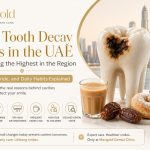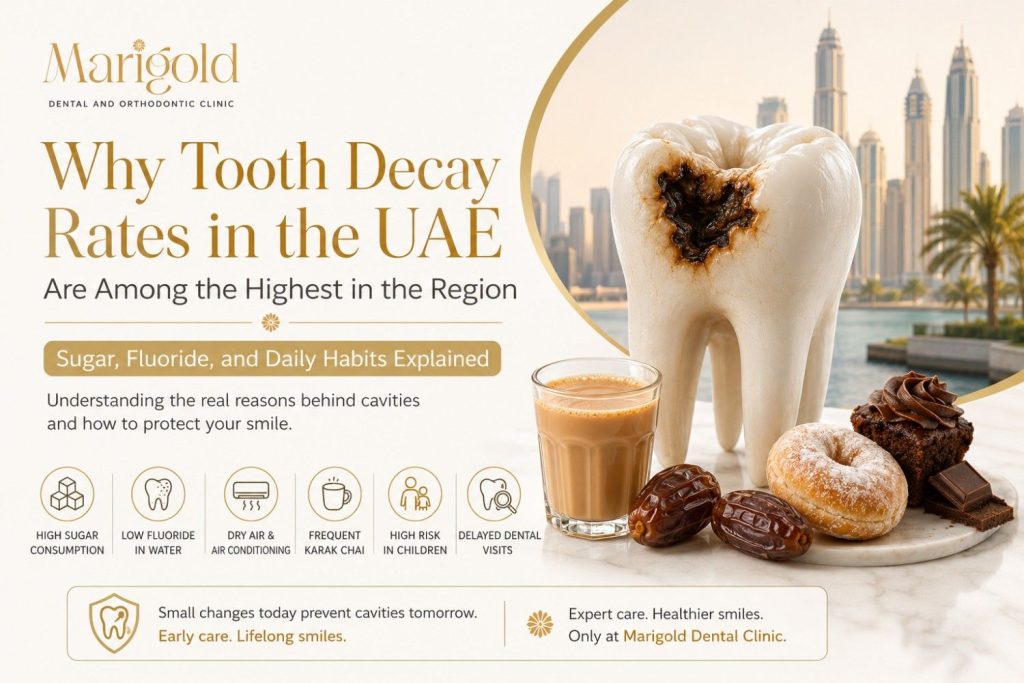
The UAE has some of the highest rates of dental caries in the world. Studies published by the UAE Ministry of Health and regional dental associations consistently place the country among the global leaders in tooth decay, particularly among children. The reasons extend well beyond brushing habits.
High sugar consumption, frequent karak chai, desalinated water with little natural fluoride, heavily air-conditioned environments, and delayed dental visits all shape oral health in ways that are specific to life in the Emirates. No single factor explains the numbers. It is the combination, along with the pace and habits of daily life, that makes tooth decay so common.
Understanding why cavities develop here is more useful than generic advice about brushing twice a day.
Why Sugar Exposure Matters More Than Quantity
The UAE ranks among the highest globally for per capita sugar consumption. The figure from the World Health Organization places UAE sugar intake at more than double the recommended daily limit on average. That statistic covers the obvious sources: soft drinks, sweets, pastries. It doesn’t fully account for how sugar enters the diet in less visible ways.
Karak chai, consumed multiple times daily by a significant portion of the population, combines condensed milk, sugar, and tea in a preparation that sits against tooth surfaces for extended periods. The frequency matters as much as the quantity. Each sugar exposure triggers an acid response from oral bacteria that lasts approximately twenty minutes. A patient who drinks karak three times between meals is creating three separate acid cycles on top of their meals. The enamel doesn’t recover between them.
Date consumption follows a similar pattern. Dates are nutritionally dense and culturally significant, and the concentrated sugars they carry, combined with their sticky texture and the frequency with which they’re consumed during social occasions and Ramadan, create sustained acid exposure that low-frequency consumption wouldn’t produce.
How Abu Dhabi’s Climate and Air Conditioning Affect Oral Health
Abu Dhabi’s climate drives indoor air conditioning use at a level that directly affects oral health. Heavily air-conditioned environments reduce ambient humidity significantly. Dry air reduces salivary flow over time, and saliva is the mouth’s primary natural defense against decay: it neutralizes acid, remineralizes enamel, and mechanically clears food debris from tooth surfaces.
A patient spending twelve hours daily in air-conditioned offices, vehicles, and homes, while compensating for the heat outside with frequent cold drinks, has a different oral environment from someone in a more temperate climate. The cold drinks themselves are frequently carbonated or sweetened, compounding the salivary and acid exposure problem simultaneously.
Why Tooth Decay Rates Are So High Among Children in the UAE
The statistics on childhood caries in the UAE are stark. Research published in the International Journal of Dentistry found caries prevalence in UAE preschool children exceeding 70% in some studied populations. A separate study from the UAE University found that children attending government schools had significantly higher decay rates than those in private schools, correlating with socioeconomic factors and dietary patterns rather than access to dental services alone.
Early childhood caries in the UAE is driven substantially by bottle feeding practices, specifically prolonged bottle use with sweetened beverages or juice at sleep time, combined with late introduction to dental care. The first dental visit recommendation in the UAE is frequently delayed well beyond the internationally recommended age of one year, which means early decay is often identified only once it has become symptomatic rather than at the preventable stage.
How Expat Lifestyles and Diet Increase Cavity Risk
The UAE population is roughly 90% expatriate. Dietary transitions that accompany relocation from South Asia, Southeast Asia, the Philippines, and Western countries interact with the local food environment in specific ways.
South Asian dietary patterns bring high carbohydrate consumption, frequent snacking, and significant tea consumption with sugar. When those patterns meet the UAE’s food environment, which provides cheap, highly processed food, round-the-clock availability of sweetened beverages, and a social culture built around frequent eating and hospitality, the cariogenic load increases.
The other factor is irregular dental attendance. Expatriate workers in the UAE on short-term contracts, particularly lower-income workers whose insurance coverage is limited, frequently delay dental care until symptoms become acute. Decay that would have been a simple filling at the twelve-month mark becomes a root canal or extraction at the two-year mark. The pattern repeats across the working population in a way that inflates the severity of decay in the data alongside its prevalence.
Does Abu Dhabi’s Water Contain Fluoride?
Water fluoridation at therapeutic levels (0.7 parts per million) has been one of the most cost-effective public health interventions for decay prevention in countries that have implemented it. The UAE relies predominantly on desalinated water, which has negligible natural fluoride content. The desalination process removes essentially all minerals, fluoride included, and the UAE does not fluoridate its municipal water supply at therapeutic levels.
This means the passive fluoride protection that residents of fluoridated countries receive through tap water consumption simply isn’t present here. The gap is partially filled by fluoridated toothpaste, but only for the population that uses it consistently and in adequate amounts, which doesn’t include a significant portion of young children whose parents are managing fluoride exposure without guidance.
The compounding effect of no water fluoridation, high sugar intake, reduced salivary flow from climate and air conditioning, and irregular dental attendance produces decay rates that exceed what any single factor would explain.
How UAE Residents Can Reduce Their Risk of Tooth Decay
Decay in the UAE isn’t primarily a brushing problem. A patient who brushes twice daily with fluoride toothpaste but drinks three sweetened beverages between meals, lives in a heavily air-conditioned environment, and hasn’t had a professional cleaning in two years is more decay-prone than a patient who brushes once daily but drinks water between meals, has good salivary flow, and attends regular check-ups.
The interventions that move the needle are the unglamorous ones: reducing between-meal sugar exposure, rinsing with water after sweetened drinks, using fluoride toothpaste correctly, staying adequately hydrated to support salivary flow, and attending a check-up at an interval that catches early decay before it becomes symptomatic.
Early decay is silent and reversible. The same decay six months later is neither. Professional assessment at Marigold Dental in Abu Dhabi identifies what’s developing before it becomes a treatment rather than a conversation.
Questions About Tooth Decay
Why does the UAE have such high tooth decay rates? A combination of high sugar consumption, low water fluoridation, reduced salivary flow from air-conditioned environments, irregular dental attendance, and specific dietary patterns across the expat population all contribute. No single factor explains the rates; the combination does.
Is karak chai bad for teeth? The combination of sugar, condensed milk, and frequency makes karak a significant cariogenic exposure when consumed multiple times daily between meals. Rinsing with water after and limiting consumption to mealtimes reduces the acid cycling effect considerably.
Do UAE children have worse teeth than other countries? Caries prevalence in UAE preschool children exceeds 70% in some studied populations, significantly above the global average. Late introduction to dental care and specific bottle-feeding practices are identified as primary contributing factors alongside diet.
Does Abu Dhabi fluorinate its water? No. Abu Dhabi’s water supply is primarily desalinated, which removes natural fluoride. The UAE does not fluoridate municipal water at therapeutic levels, making fluoride toothpaste the primary available source of passive fluoride protection.