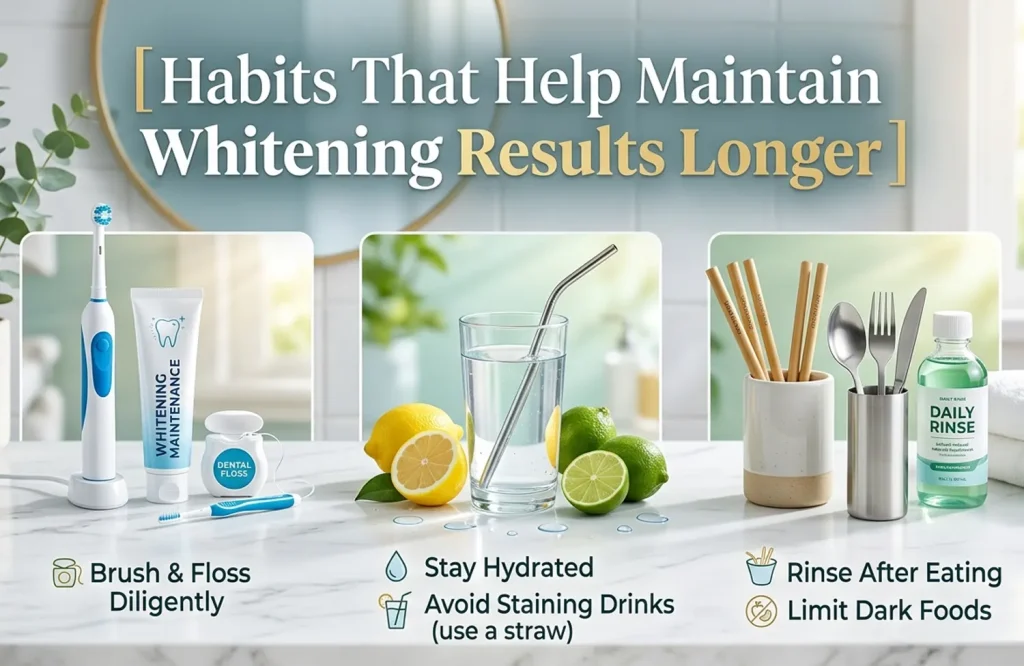
Whitening aftercare advice tends to arrive as a list with no priority order. Avoid coffee. Use whitening toothpaste. Rinse after meals. The individual items aren’t inaccurate. The format implies they’re roughly equivalent in impact, which they aren’t. A patient who can only realistically change a few habits needs to know which few habits actually affect how long the result holds.
The two-week post-treatment window is its own specific period, covered in detail in How Long Does Professional Teeth Whitening Last? Past that window, maintenance looks different.
The habits that carry the most weight in the long-term picture aren’t always the most prominent ones on the standard list, and the clinical reason behind each one is what makes it worth following rather than ignoring.
Brushing Frequency and Timing Matter More Than Technique
Twice-daily brushing is the baseline for oral health generally. For whitening maintenance specifically, when those sessions happen matters more than the fact of them. A patient who brushes at 7am and 10pm and drinks three cups of coffee in between is leaving chromogenic compounds in contact with enamel for hours at a stretch. The brushing frequency is correct. The maintenance value of it is undermined by the timing.
Chromogenic compounds from coffee, tea, and dark foods begin binding to enamel within minutes of contact. Saliva clears some of that passively during waking hours, but the rate is insufficient when exposure is repeated across a day. Mechanical disruption is what actually interrupts the binding process. Brushing after the last coffee of the day rather than two hours later isn’t a significant change in routine. The chromogen contact time it eliminates across a year of daily coffee consumption is.
The pre-sleep session carries weight independently of chromogen timing. Salivary flow drops significantly during sleep, removing the passive clearance that operates during waking hours. Whatever surface deposits are present at bedtime have six to eight hours of minimal salivary activity ahead of them. A fluoride toothpaste at that session supports enamel remineralization overnight rather than just clearing the surface.
One specific qualifier: after acidic food or drink, waiting thirty minutes before brushing is clinically appropriate because acid temporarily softens enamel and brushing immediately causes surface abrasion. After non-acidic chromogenic drinks, including most coffees and teas, that rationale is weaker than the contact-time argument. The practical guidance is to brush after the coffee. The waiting logic applies to acid, not to chromogens.
Reducing Staining From Diet Without Eliminating It
Telling a patient who drinks two cups of coffee every morning to avoid coffee is advice that gets filed and forgotten. For the full list of foods that stain your teeth, the useful question here is which chromogenic sources stain fastest, what determines that rate, and what practical interventions reduce exposure without requiring dietary restructuring.
Red wine sits at the top of the staining rate hierarchy for most patients, and the reason goes beyond its chromogen concentration. The acidity temporarily increases enamel porosity at the point of contact, giving those compounds structural access that a non-acidic chromogen source of equivalent concentration wouldn’t have. The combination of chromogenic content and acid is what makes red wine a more potent staining agent than its color alone would suggest.
Coffee stains faster than most patients expect relative to tea. Temperature is a significant contributor. Hot liquid temporarily increases enamel permeability, delivering chromogenic compounds to a transiently more permeable surface than the same drink consumed cold. A hot coffee consumed quickly is a different enamel exposure event than an iced coffee of identical composition. Within the tea category, black tea stains faster than green because of higher tannin concentration. Herbal teas without tannins are largely neutral regardless of color.
Drinking through a straw is a commonly cited tip that works under specific conditions. For cold drinks consumed through a straw positioned toward the back of the mouth, direct enamel contact is meaningfully reduced. For hot drinks consumed through a straw held near the lips, the practical reduction is minimal. The straw guidance applies most usefully to cold brew coffee, iced tea, and cold chromogenic drinks rather than the hot beverages that represent most patients’ primary daily exposure.
Rinsing with water immediately after consuming a chromogenic drink is more effective than it sounds and requires nothing. Water reduces the concentration of chromogens remaining on the tooth surface and accelerates salivary clearance of what’s left. A rinse within two minutes of finishing a coffee leaves a lower residual chromogen load on the enamel surface than waiting until the next brushing session. The mechanism is simple and the habit adds under thirty seconds to a routine that already involves finishing a drink.
Consuming chromogenic drinks as part of a meal rather than between meals changes the exposure profile in a way most patients don’t account for. Eating stimulates saliva production significantly above the resting rate. That elevated salivary flow during a meal clears chromogenic compounds from the enamel surface passively in a way that standalone drink consumption between meals doesn’t generate. The same coffee consumed with breakfast clears faster than the same coffee two hours later. No product involved, no dietary change required.
What Whitening Toothpaste and Mouthwash Actually Do
Whitening Toothpaste:
Whitening toothpaste removes extrinsic surface deposits through mild abrasion before they embed into the enamel surface. A tooth surface carrying less chromogenic deposit restains more slowly than one carrying more, so the contribution to maintenance is real. The boundary of that contribution is also specific: whitening toothpaste doesn’t penetrate enamel and doesn’t maintain the internal color change professional whitening produced. The shade improvement from treatment happened below the enamel surface. No toothpaste reaches that layer.
The abrasive level in the formula matters more than the whitening claim on the packaging. Relative Dentin Abrasivity, the RDA score, measures how abrasive a toothpaste is against tooth structure. High-RDA whitening formulas used daily cause enamel surface wear that increases porosity over time. More porous enamel takes up chromogenic compounds faster than intact enamel. A high-RDA whitening toothpaste used consistently in the belief that it protects the result can produce the opposite effect at the surface level across months of daily use. A lower-RDA formula with fluoride is a more defensible maintenance choice. Fluoride supports enamel remineralization, which reduces chromogenic uptake indirectly but measurably.
Mouthwash:
Alcohol-containing mouthwash is the product most likely to work against whitening maintenance without the patient recognizing it as the source. Alcohol is a desiccant. It temporarily reduces salivary flow and increases enamel surface porosity after use. A patient finishing their oral hygiene routine with an alcohol-containing rinse is ending the session with a step that temporarily increases the enamel surface’s susceptibility to chromogenic uptake.
The effect resolves within hours as salivary flow returns to normal. Used occasionally, the impact on whitening longevity is marginal. Used twice daily as part of a fixed routine, the cumulative effect on enamel surface porosity compounds across a maintenance period in a way that works directly against what the routine is supposed to achieve.
Alcohol-free, fluoride-containing mouthwash delivers fluoride to the enamel surface after brushing without the porosity effect. The remineralization contribution is modest. The relevant point is that it’s additive rather than counterproductive, which is the functional distinction that matters when evaluating what belongs in a maintenance routine.
Why Professional Cleaning Is Part of Whitening Maintenance
Home care removes what’s on the tooth surface. Professional cleaning removes what home care can’t reach, and for whitening maintenance those are two different problems with different consequences.
Calculus, the mineralized deposit that forms when plaque is left undisturbed long enough to harden, doesn’t respond to brushing regardless of frequency or technique. It accumulates along the gum line and between teeth, and its surface chemistry is different from clean enamel in a way that matters for restaining. Chromogenic compounds bind to calculus faster than to clean enamel. The uneven fading patients describe, where some teeth or specific areas seem to lose the result faster than others, frequently traces back to calculus accumulation in those areas rather than a difference in enamel response.
The standard six-month check-up interval reflects general oral health thresholds rather than whitening maintenance requirements. For a patient drinking coffee and tea daily, calculus accumulation that sits within the acceptable range at six months has already been acting as a chromogenic substrate for months before the cleaning removes it. A three to four month professional cleaning interval removes that substrate before it becomes a maintenance problem. The individual difference between a four-month and a six-month cleaning visit is not dramatic. The cumulative shade stability difference across two years of daily chromogen exposure is.
Timing a professional cleaning immediately before a touch-up whitening cycle produces a more even result than whitening onto accumulated deposits. Clean enamel and calculus-bearing surfaces don’t respond to peroxide at the same rate. The areas carrying deposits whiten less completely, which produces the patchy result patients occasionally attribute to the whitening gel when the variable is actually the surface it was applied to.
Shorter cleaning intervals also provide a more granular clinical picture of how the shade is shifting. A patient seen every three to four months gives the clinician enough data points to identify early shade change before it warrants a full touch-up cycle. A shorter, targeted maintenance whitening session at that point costs less and produces a stronger result than a full retreatment from a more faded baseline.
Maintenance is cumulative, not perfectionistic
Whitening maintenance is a cumulative problem. No single habit eliminates restaining, and no single lapse causes a result to fail. What determines how the shade holds at twelve months is the aggregate of daily decisions about brushing timing, chromogen contact, product choice, and how often the enamel surface gets professionally cleared of what home care doesn’t reach.
The habits covered in this blog aren’t equally weighted. Brushing timing and post-chromogen rinsing have the highest individual impact for the least behavioral change. Product choice, specifically avoiding high-RDA toothpaste and alcohol-containing mouthwash, removes interventions that work against maintenance rather than adding ones that support it. Professional cleaning at a shorter interval than the standard six months is the habit most patients overlook and the one that shows up most consistently in long-term shade data.
When the result has shifted enough to notice, the surface it’s treated onto matters. A teeth whitening touch-up in Abu Dhabi on a well-maintained baseline produces a stronger result than the same treatment on a surface carrying accumulated deposits. That baseline is built between appointments, not at them.