Teeth can appear straight and still have a bite problem
Straight teeth don’t automatically indicate a normal bite. Alignment and bite function are related, but they are not the same thing.
Teeth can appear well positioned while the upper and lower arches meet in a way that places uneven demands on the bite. Minor irregularities can also be visible without significantly affecting how the teeth function together.
Overbites, underbites, and crossbites sit in that space between appearance and function. They describe changes in the way the upper and lower teeth come together rather than how straight a smile appears at first glance.
Why upper and lower teeth are meant to fit together a certain way
A bite isn’t simply a matter of whether teeth look straight. Every time the mouth closes, dozens of teeth come into contact in a sequence that distributes force across the entire system. The arrangement is deliberate. Front teeth guide certain movements. Back teeth absorb most of the pressure generated during chewing.
Problems rarely begin because a single tooth is out of place. More often, the relationship between the upper and lower arches changes. Pressure starts concentrating where it wasn’t intended to. Some teeth begin carrying a greater share of the workload while others contribute less.
Uneven force distribution is not always easy to recognise without examining how the teeth come together. A smile can appear well aligned while the bite underneath functions very differently. Understanding how the upper and lower teeth are supposed to meet makes it easier to see why overbites, underbites, and crossbites are treated as separate conditions rather than different versions of the same problem.
When the upper teeth sit too far forward
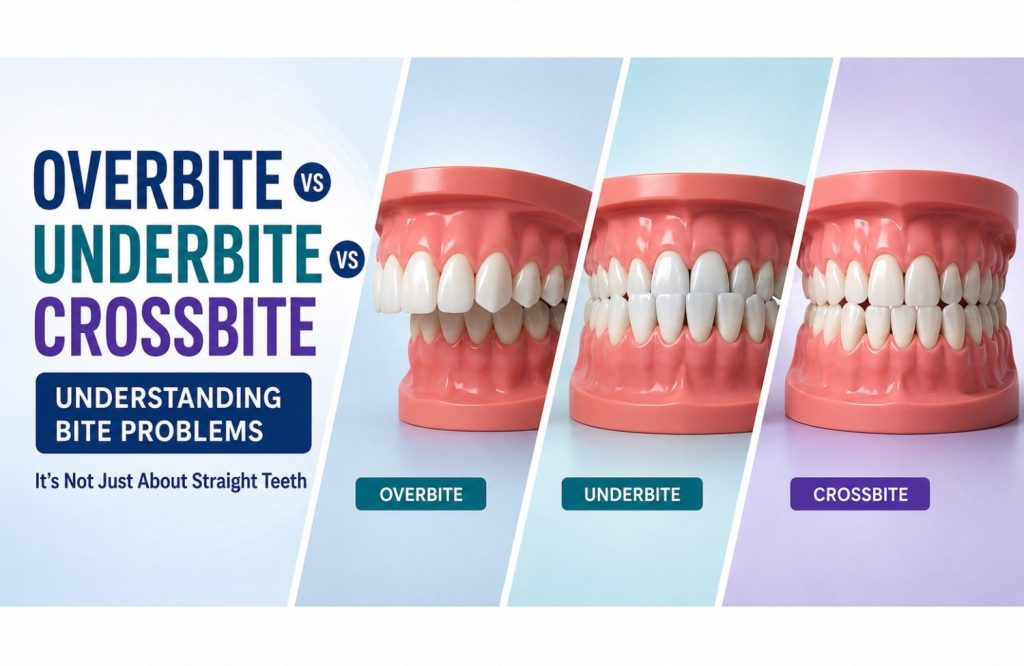
An overbite describes a front-to-back imbalance between the upper and lower arches. A certain amount of overlap is normal. Most upper front teeth naturally sit slightly ahead of the lower front teeth. The difference lies in the amount of overlap and the way it influences the rest of the bite.
Some overbites are limited to the teeth themselves. Others are influenced by the position and development of the jaws. Two patients may both be told they have an overbite while presenting with very different underlying causes and different levels of severity.
As the overlap increases, the distribution of force changes. Front teeth may absorb pressure they were never intended to handle repeatedly, while lower teeth can begin contacting areas they normally wouldn’t. In more pronounced cases, the bite stops functioning as a balanced system and starts directing pressure toward a smaller group of teeth.
The effect extends beyond appearance. Tooth wear, uneven loading, and changes in chewing patterns are often linked to the way the upper and lower arches interact rather than how the teeth look when viewed from the front.
When the lower teeth extend beyond the upper teeth
An underbite reverses the relationship described in an overbite. Instead of the upper front teeth sitting ahead of the lower teeth, the lower arch extends further forward when the jaws close.
In some cases, the difference comes primarily from tooth position. In others, the lower jaw itself sits further forward relative to the upper jaw. Similar bite patterns can arise from very different underlying structures. Jaw position often plays a much larger role in an underbite than it does in many overbite cases.
Chewing changes when the front teeth no longer meet in their intended positions. Certain movements become less efficient, and some teeth begin taking on work they were not designed to handle repeatedly. Speech can also be affected, particularly when sounds rely on precise contact between the upper and lower front teeth.
Wear patterns associated with an underbite tend to develop differently from those seen in an overbite. The teeth are not simply misaligned. The entire relationship between the upper and lower arches has been reversed.
When teeth bite inside instead of outside
A crossbite sits outside the pattern established by overbites and underbites. Those conditions describe a front-to-back imbalance. A crossbite develops across the width of the bite instead.
The difference can involve a single tooth or several teeth. It may appear on one side of the mouth or across both arches. Regardless of extent, the relationship changes in the same direction. Teeth that would normally sit slightly outside their opposing teeth begin meeting on the inside.
Because the imbalance occurs across a different plane, crossbites are evaluated differently from other bite problems. The question is no longer how far forward or backward the arches sit, but how they relate side to side when the jaws close.
Why these bite problems affect more than appearance
The visible part of a bite problem is usually what attracts attention first. Upper teeth may sit further forward than expected, the lower jaw may appear more prominent, or a group of teeth may meet in an unusual position. Those changes are easy to notice because they affect appearance.
The functional side develops more quietly. Teeth are designed to share force with neighbouring teeth and opposing teeth. When the relationship changes, that workload becomes less evenly distributed. One area absorbs more pressure. Another contributes less. The difference may be small at first, but chewing happens thousands of times every week.
For that reason, orthodontists don’t evaluate overbites, underbites, and crossbites as cosmetic variations of the same issue. The position of the teeth matters, but so does the way the entire system works once the mouth closes.
How orthodontists determine which bite problem is present
Appearance is only one part of the picture. Two patients may present with a similar looking overbite while arriving there for completely different reasons. In one case the teeth are responsible for most of the discrepancy. In another, the position of the jaws is driving the relationship.
Photographs and digital scans help document what is visible. The more important question is often what happens when the teeth come together. Contact points throughout the bite, the position of the jaws, and the way the arches relate to one another provide information that a photograph alone cannot.
An orthodontic assessment is built around those relationships. Understanding how the teeth and jaws fit together is the starting point for any meaningful orthodontic assessment. That same process forms the foundation of orthodontic treatment in Abu Dhabi, where planning begins with diagnosis rather than appliance selection.
The assessment also helps determine which bite problems Invisalign can and cannot correct, since the answer depends on the type of imbalance involved, its severity, and the movements required to create a stable result. The name of the condition matters less than its severity, the structures involved, and the type of movement required to create a stable bite.
Why these bite problems are not interchangeable
Overbite, underbite, and crossbite are often grouped together because all three affect the way the upper and lower teeth come together. The similarities become less useful once the discussion moves beyond appearance.