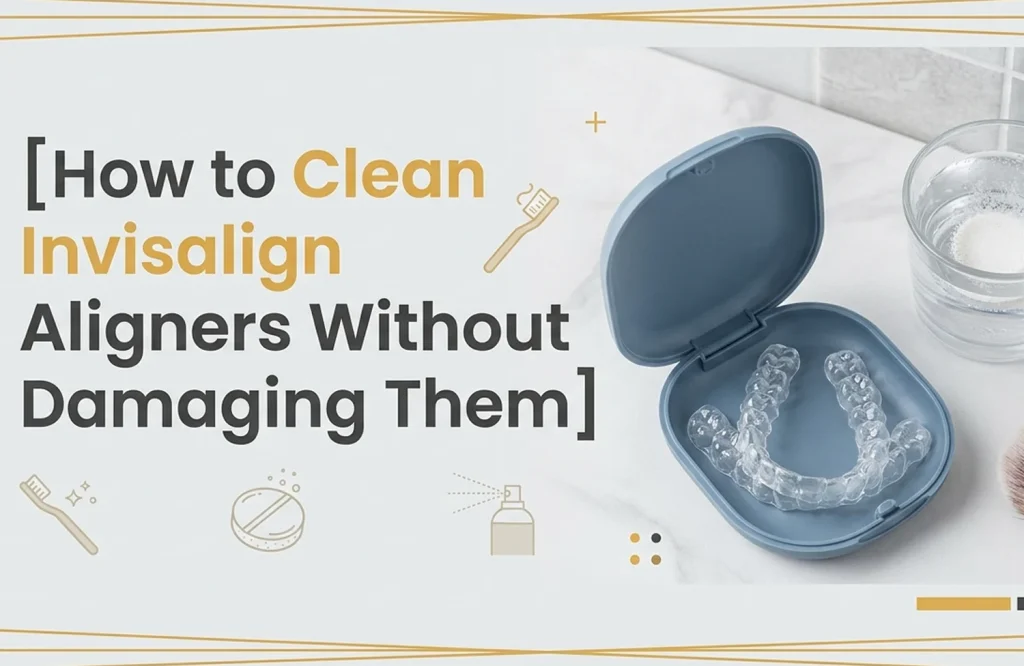
Keeping aligners clean is the part of Invisalign treatment most patients feel confident about. It seems straightforward. Rinse, brush, soak. What’s less obvious is that the cloudiness, the surface scratching, the fit that feels slightly off after a few weeks, frequently trace back to the cleaning routine rather than anything else.
The plastic used in clear aligners is precise by design. It’s shaped to specific tolerances and engineered to move teeth through consistent, controlled pressure. That same precision makes the material responsive to things that seem harmless: the abrasive particles in toothpaste, water temperature, soaking solutions that weren’t formulated for thermoplastic. The damage doesn’t happen in one session. It accumulates.
Understanding what the material actually responds to changes how the maintenance routine looks, and why certain habits that feel thorough are quietly working against the treatment.
Why Clear Aligners Lose Their Clarity
Aligners that were perfectly transparent on day one develop a milky haze within weeks. Not from neglect. From the ordinary chemistry of wearing something in your mouth for twenty-two hours a day.
Saliva contains proteins that bind to the aligner surface continuously. When they’re not fully cleared between wears, they oxidize into a visible film. In Abu Dhabi, where tap water hardness runs significantly higher than WHO guidelines, mineral deposits compound that effect. Calcium and magnesium residue accumulates on the plastic surface with every rinse, dulling transparency in a way that looks like scratching but isn’t.
The scratching is a separate problem. Clear aligner plastic is optically transparent because the surface is smooth at a microscopic level. Toothpaste, even varieties marketed as gentle, contains abrasive particles designed to polish enamel. Enamel is considerably harder than thermoplastic. The same particles that do nothing to a tooth surface create fine scratches across an aligner, and light scatters differently across a scratched surface than a smooth one. The result is cloudiness that no amount of cleaning reverses, because the transparency isn’t being obscured by residue. The surface itself has changed.
Staining settles into that disruption. Coffee or tea consumed immediately before reinsertion, colored mouthwash used while aligners are in, pigmented foods that contact the plastic before it’s been rinsed, all of these find purchase in a compromised surface faster than they would on an intact one. The cloudier the aligner, the more aggressively it stains, and the cycle compounds.
Why Some Cleaning Habits Cause More Harm Than Good
The cleaning habit most reliably responsible for aligner damage is toothpaste. Not because patients are being careless with it, but because it’s sitting at the sink and it works on teeth, so the logic of using it on aligners feels sound. The abrasive compounds in toothpaste, silica in most modern formulas, are calibrated to clean enamel. Enamel has a Mohs hardness of around 5. The thermoplastic Invisalign aligners are made from sits considerably below that on the same scale. Running an abrasive designed for a harder surface across a softer one removes material from it. The effect after a single session is invisible. After two weeks of twice-daily brushing, it shows up as the cloudiness that no subsequent cleaning reverses.
Water temperature produces a structurally different kind of damage. Invisalign trays are manufactured to dimensional tolerances precise enough to move specific teeth by fractions of a millimeter. The thermoplastic holds those tolerances at normal mouth and ambient temperatures. Above approximately 45 degrees Celsius, it begins to soften. The distortion from a single hot rinse is undetectable by feel. Repeated exposure changes the geometry of the tray in ways that affect how it seats against the teeth, where it applies pressure, and whether it’s still doing what it was designed to do. Patients occasionally attribute stalled tooth movement or unexpected soreness to the treatment itself. Warped trays are an underappreciated contributor to both.
Soaking is where duration gets misunderstood. Retainer cleaning crystals and effervescent tablets are formulated to work within a defined window, typically fifteen to thirty minutes. The assumption that longer produces cleaner results is intuitive but wrong. Extended soaking doesn’t remove more residue. It keeps the aligner surface in prolonged contact with a chemical solution past the point it was tested for, and the cumulative effect on surface integrity across weeks of treatment is not neutral.
The pressure applied during brushing matters independently of what’s being used to brush. A soft-bristled brush with a safe cleaning solution and light pressure disrupts surface deposits without abrading the plastic. Adding firm pressure to an already problematic cleaning agent accelerates surface damage at a rate the individual sessions don’t suggest.
Daily Cleaning Works Best When It Stays Simple
The most effective aligner maintenance routine is also the shortest. Not because shortcuts are acceptable, but because the material responds better to frequent light cleaning than to periodic intensive cleaning with the wrong products.
After Removal:
Saliva coats the aligner surface continuously during wear. When aligners come out and sit in open air, that film dries within minutes and becomes considerably harder to remove. A rinse under cool water immediately after removal takes under ten seconds and prevents that film from setting. It isn’t cleaning. It’s the step that makes cleaning at the end of the day less work.
During the Day:
Aligners removed for a meal don’t need a full cleaning cycle before going back in after plain water. After coffee, tea, or anything with color or sugar, a brief rinse and a light pass with a soft-bristled brush and no product is sufficient. The bristles disrupt surface residue without abrasion. No toothpaste. No pressure. Thirty seconds at most.
The rinse that gets skipped most often is the one before reinsertion after a colored drink. That’s also the one most directly responsible for the staining that accumulates across a wear cycle and looks, by week two, like a much larger problem than it actually was at the point it could have been prevented.
Before Reinsertion at Night:
A fifteen to thirty minute soak in a purpose-formulated cleaning solution handles what the quick daytime rinses don’t reach. The aligner should be rinsed under cool water after soaking before it goes back in. Cleaning solution residue in contact with gum tissue across eight hours of sleep is an irritant the routine doesn’t need.
Frequency matters more than intensity here. An aligner maintained at every removal stays optically clear across a full two-week cycle. The same aligner cleaned once thoroughly at the end of each day, with products that feel more rigorous than they should be, arrives at the two-week mark visibly worse.
Choosing Products That Are Safe for Aligners
The frame that makes this question answerable is material compatibility rather than brand preference. Invisalign aligners are made from a proprietary thermoplastic polyurethane. What matters isn’t which products feel thorough. It’s which ones interact safely with that specific material at the concentrations and durations of a daily cleaning routine.
Products that sit within those parameters:
- Invisalign cleaning crystals are the manufacturer’s own formulation, tested against the aligner material at the recommended concentration and soak time. The fifteen-minute window on the packaging isn’t conservative. It reflects what the material was tested to tolerate.
- Retainer cleaning tablets from established orthodontic brands use a similar effervescent formula and are generally compatible with the same thermoplastic, provided the soak time stays within the instructions.
- Mild unscented dish soap diluted in cool water removes protein and lipid deposits without abrasion or chemical reaction with the plastic. It’s unglamorous and it works.
- Clear, alcohol-free soap in a diluted rinse application clears surface residue between full cleaning cycles without the alcohol content that compromises plastic clarity over time.
Products that appear in cleaning guides but perform inconsistently on aligner material:
- Colored or alcohol-containing mouthwash introduces both pigment and a solvent into contact with thermoplastic. The discoloration from regular mouthwash use is one of the more avoidable causes of aligner staining.
- Denture cleaning tablets are formulated for acrylic, which is a chemically different material. Soak durations safe for dentures exceed what thermoplastic tolerates without surface degradation.
- Hydrogen peroxide above three percent appears in DIY cleaning recommendations with some frequency. The effect on thermoplastic clarity across weeks of repeated use is variable enough that it doesn’t belong in a routine that’s supposed to preserve the aligner.
The commonality across products that work safely is the absence of abrasion and the absence of high chemical concentration. The aligner surface doesn’t need either to stay clean. It needs consistent, low-impact disruption of organic deposits at a frequency the material handles without changing.
What Orthodontists Look for During Aligner Maintenance
At a routine check-in, an orthodontist looks at the aligner before asking about the cleaning routine. The tray itself tends to answer the question more accurately than the patient’s account of their habits, not because patients misrepresent what they do, but because surface degradation accumulates gradually enough that it becomes part of the baseline. What looks normal by week two of a set looked different on day one.
Clarity under clinical lighting is different from clarity under a bathroom mirror. Micro-scratching that registers as a vague dullness at home shows up distinctly under the magnification and lighting of a clinical setting. An aligner that has been cleaned with an abrasive across its full wear cycle arrives at the appointment with a surface that narrows down the cleaning history without the patient needing to describe it.
Fit assessment follows. The tray should seat completely and consistently against every tooth surface it was designed to contact. When it rocks, gaps, or requires pressure to seat at a point it shouldn’t, the question is whether the dimensional change came from the tooth movement progressing ahead of the tray, which has its own clinical explanation, or from the plastic itself having changed. Repeated exposure to water above the material’s tolerance threshold produces the second kind of change. It tends to appear gradually across several sets rather than suddenly in one.
Wear distribution tells a different part of the story. Mechanical wear at the biting edges is expected. Surface degradation concentrated on the outer labial face, the smooth surface that doesn’t contact teeth at all, points toward the cleaning instrument rather than the function of the tray. A clinician who has tracked a patient’s aligner condition across multiple sets recognizes that pattern before the patient does, which is part of what distinguishes orthodontic oversight from general dental care.
That accumulated clinical picture across a full treatment arc is what orthodontic care in Abu Dhabi provides at the check-in appointments that patients sometimes treat as optional when treatment feels like it’s progressing normally.
Clarity reflects material condition, not just hygiene
Transparency in a clear aligner isn’t a cosmetic feature. It’s a material condition. An aligner that stays optically clear across a two-week cycle has been maintained in a way that preserves the plastic. One that arrives at the change date cloudy or scratched has a surface that’s been altered, and altered plastic doesn’t hold dimensional tolerances the way it did on day one.
The cleaning routine that keeps aligners looking right is the same routine that keeps them fitting right. Fit determines how consistently the tray applies force to the tooth surface. Consistent force application is what moves teeth on the schedule the treatment was planned around. The appearance of the aligner at the end of a wear cycle is a reasonably accurate indicator of whether the two weeks inside it did what they were supposed to.