
TMJ and Jaw Painz How to Know if Your Dentist Can Help
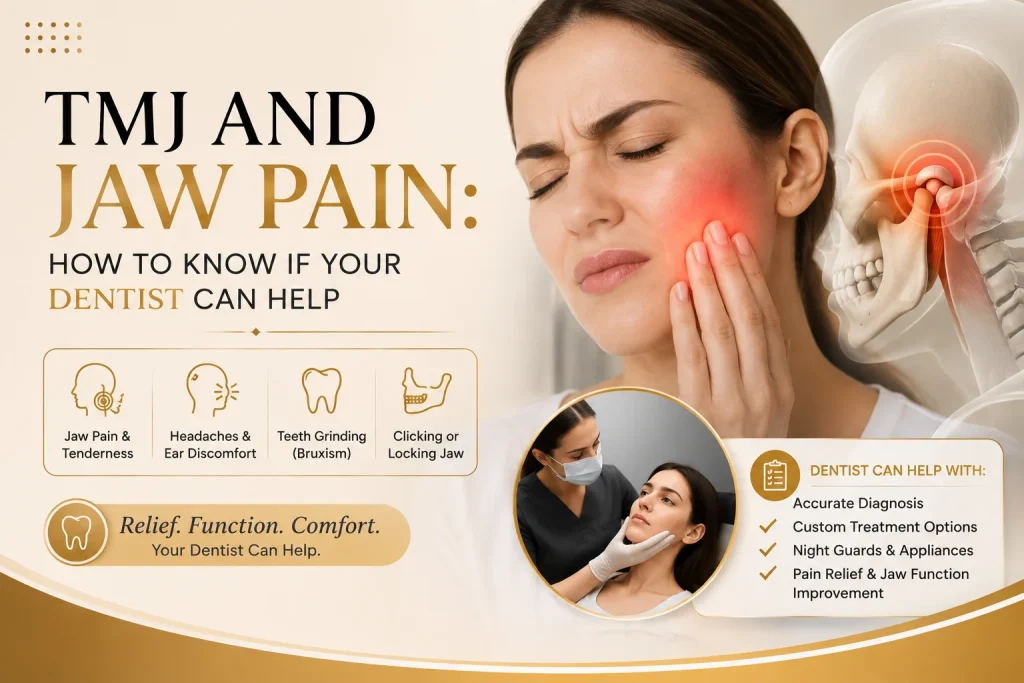
What TMJ Disorder Actually Is TMJ disorder is an umbrella term, not one single condition. It covers problems affecting the jaw joint itself, the muscles that move it, or the way the upper and lower teeth meet. More than thirty distinct issues fall under this category, ranging from muscle tension to structural joint problems. Clicking or popping in the jaw without pain is common. On its own, it doesn’t need treatment. Pain, locking, or a jaw that feels restricted is where the condition starts to warrant a closer look. The Symptoms That Point to TMJ Rather Than Something Else Pain near the ear or along the jaw that gets worse with chewing or extended talking is one of the clearest signals. Clicking or grating that comes with pain, rather than just sound, points the same direction. A jaw that locks, even briefly, when opening wide or closing fully is a stronger indicator than clicking alone. Muscle fatigue after normal use is easy to dismiss. A jaw that feels tired or tight after a regular meal often means the chewing muscles are under more strain than they should be. Morning Jaw Pain and Headaches: The Grinding Connection Waking up with jaw soreness or a dull headache is a pattern many people never connect to what’s happening overnight. Nighttime clenching or grinding repeatedly tenses the jaw muscles for hours without the person being aware of it. That sustained tension produces the morning ache, not anything happening during the day. The muscles involved are the same ones used for chewing. Repeated overnight strain shows up the same way overused muscles do anywhere else in the body. A fitted device worn during sleep interrupts that clenching pattern at its source, which tends to work better than treating the headache after it’s already started. TMJ Pain vs Tooth Pain: Telling Them Apart TMJ pain tends to feel muscular and spread across the jaw or face rather than sitting in one spot. It often changes with jaw movement, easing at rest and increasing with chewing or wide opening. Tooth pain behaves differently. It’s usually sharp, localized to one tooth, and tied closely to temperature or biting pressure rather than jaw motion. Sensitivity adds another layer of confusion here. Sensitivity from grinding tends to affect several teeth at once, often across a wide area of the mouth, and correlates with jaw and muscle symptoms rather than one damaged tooth. Sensitivity from decay is usually confined to a single tooth and doesn’t improve when the jaw is at rest, since decay-related pain has nothing to do with muscle activity. Can a Dentist Actually Treat TMJ, or Do You Need a Specialist? A dentist can assess bite alignment, jaw joint mechanics, tooth wear patterns, and muscle tenderness directly. These four factors account for a large share of TMJ cases, particularly ones connected to grinding, clenching, or an uneven bite. Conservative dental treatment resolves many of these without needing another specialist involved at all. Referral becomes necessary when the cause sits outside dental scope. Arthritis affecting the joint needs a rheumatologist’s input. A nerve-related pain condition or a sleep-breathing disorder contributing to nighttime clenching needs a different specialist too. A dentist who identifies one of these during assessment refers out rather than attempting to treat something beyond what a dental evaluation can address. What a TMJ Evaluation Actually Involves The first part of an evaluation is a detailed history. Questions cover stress levels, sleep quality, grinding or clenching habits, and any recent dental work that might have changed the bite. This history often reveals more than the physical exam alone. A hands-on exam follows. The dentist palpates the jaw joint and surrounding muscles while the patient opens and closes, checking for tenderness, clicking, or restricted movement. Tooth wear patterns get checked too, since flattened or chipped edges often reveal grinding the patient wasn’t aware of. Imaging isn’t a default step. X-rays or scans get added only when exam findings suggest a structural issue that needs a closer look. Conservative Treatment Comes Before Anything More Invasive Mild cases often respond to simple changes. Softer foods reduce strain on the joint while it settles. Heat or cold applied to the jaw eases muscle tension in the short term. Cases connected to clenching or grinding usually need a fitted appliance worn during sleep. Habit changes alone rarely stop something happening unconsciously overnight. Stress-related tension benefits from the same approach, interrupting the physical habit even when the underlying stress takes longer to resolve. Surgery sits at the far end of the treatment scale. It’s reserved for cases that don’t improve with conservative care after a genuine trial period. Most patients never reach that point. Frequently Asked Questions Can a dentist treat TMJ? Dentists treat a large share of TMJ cases connected to bite, jaw mechanics, and grinding. Cases involving arthritis, nerve conditions, or sleep-breathing disorders get referred to the appropriate specialist. How do I know if my jaw pain is TMJ or a tooth problem? TMJ pain tends to feel muscular, spread across the jaw or face, and change with jaw movement. Tooth pain is usually sharp, localized to one tooth, and tied to temperature or biting pressure. Why does my jaw click when I chew? Clicking without pain is common and usually not a concern on its own. Clicking accompanied by pain or a jaw that locks is worth having assessed. Why do I wake up with jaw pain or headaches? Nighttime clenching or grinding often causes morning jaw soreness and headaches, from sustained muscle tension that happens without conscious awareness during sleep. Is TMJ treatment always surgical? No. Most cases respond to conservative treatment such as fitted appliances, dietary adjustments, and muscle rest. Surgery is reserved for cases that don’t improve after a genuine trial of conservative care. Why a Hands-On Evaluation Matters More Than Guesswork Jaw pain rarely has one single cause, and a symptom list can only narrow things down so far. A hands-on evaluation identifies whether the joint,
Dental Fillings in Abu Dhabi: White vs Silver and Why It Matters
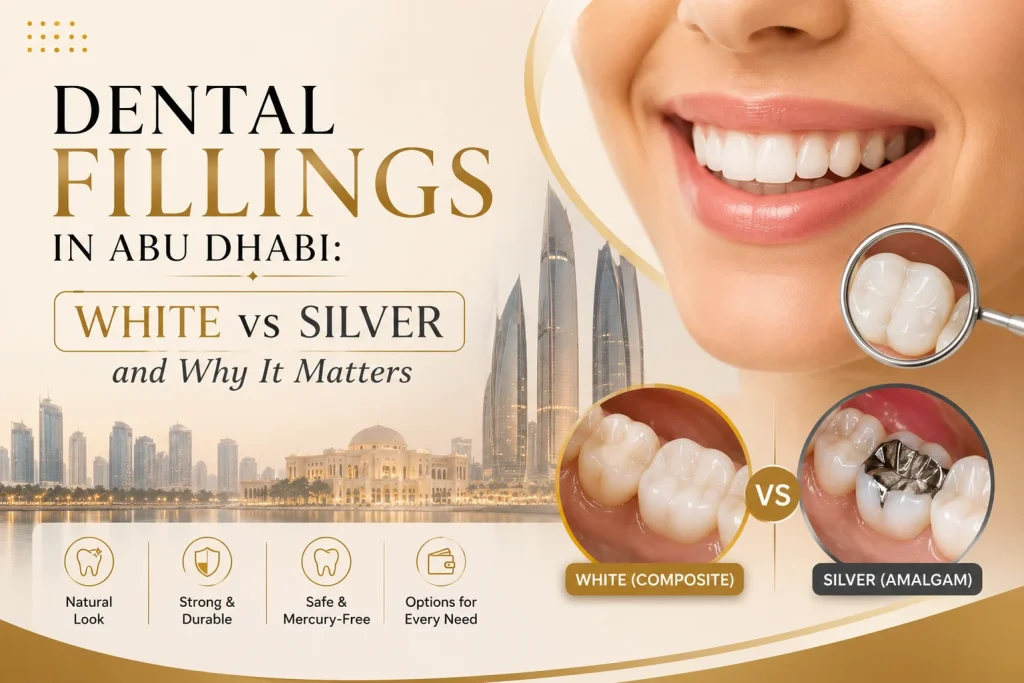
Why Fillings Are So Common in the UAE Tooth decay rates in the UAE rank among the highest in the region, driven partly by sugar consumption patterns and partly by how often decay goes unnoticed until it needs treatment. Our guide on UAE decay rates covers those contributing factors in more depth. Fillings are the most routine restorative procedure in dentistry as a direct result. Almost everyone needs one eventually, whether from a small cavity caught early or decay that’s progressed further. White Filling or Silver Filling: What Actually Separates Them A white filling is made from composite resin, a tooth-coloured material that bonds directly to the remaining tooth structure. A silver filling is made from amalgam, a metal alloy combining silver, tin, copper, and a small amount of mercury. The bonding method differs in a way that matters beyond appearance. Composite chemically bonds to the tooth. This means less healthy tooth structure needs removing to place it. Amalgam is mechanically retained instead, shaped into a cavity cut wide enough to hold it in place without bonding. Composite also sets immediately under a curing light. Amalgam takes several hours to fully harden, though it feels solid enough to bite on within the same day. Durability: Which One Actually Holds Up Better in Back Teeth Amalgam typically lasts ten to fifteen years. Composite typically lasts five to seven years before it needs replacing or repairing. In large molar fillings under heavy daily bite force, amalgam still holds a genuine durability edge. Composite has improved significantly over the past two decades and performs well in most cavity sizes. Very large, multi-surface fillings in back teeth remain the one scenario where amalgam’s strength advantage is hardest to match. Front teeth carry far less bite force, so this durability gap matters much less there than it does in a molar. Should You Replace Old Silver Fillings? The Honest Answer Amalgam is considered safe by major dental health authorities worldwide, supported by decades of clinical use. A silver filling that’s intact, with no cracking, leaking, or decay underneath, generally doesn’t need replacing purely because it’s amalgam. Replacement becomes appropriate under specific conditions instead. A cracked or chipped filling justifies replacement. So does visible decay forming at its edges, or a filling that’s come loose. Proactively replacing a functioning amalgam filling for aesthetic reasons alone is a reasonable personal choice, but it isn’t a safety necessity. A dentist can check the condition of existing fillings at a routine check-up and flag anything that actually needs attention. Filling Cost in Abu Dhabi and What Insurance Actually Covers Amalgam is typically the least expensive filling material. Composite costs somewhat more per tooth, reflecting the material and the additional technique involved in shaping and bonding it. Insurance coverage works differently for fillings than it does for cosmetic treatment. Most UAE insurance plans cover basic restorative fillings as standard care. Some plans specifically cover only the amalgam-equivalent cost for back teeth. Choosing composite instead may then involve a modest upgrade fee rather than the full cost out of pocket. Coverage details vary by provider and plan, so confirming the specifics before treatment avoids surprises at the front desk. Choosing Between White and Silver for Your Specific Tooth Front and visible teeth almost always favour composite. The cosmetic difference matters in a spot people actually see when smiling or speaking, and composite’s shorter lifespan matters less on a tooth that carries lighter bite force. Back molars are where the real trade-off applies. A large cavity in a heavily used molar is the scenario where amalgam’s durability advantage is most relevant, and where composite’s shorter lifespan is most likely to mean an earlier repeat visit. A dentist’s in-person assessment determines which material actually fits a specific tooth. Cavity size and location matter more than a blanket preference for one material over the other. What to Expect After a Filling Mild sensitivity to hot, cold, or biting pressure is normal for a few days after a filling. The tooth typically settles as it adjusts to the new material and the surrounding area calms down from the procedure. Sensitivity that lasts several weeks, worsens instead of improving, or comes with sharp pain when biting down is not typical. It’s worth a follow-up call in that case. Our guide on tooth sensitivity covers what separates a normal healing response from something needing a closer look. A bite that feels slightly off in the first day or two often needs a small adjustment, which a dentist can correct quickly at a short follow-up visit. Frequently Asked Questions Is white filling better than silver filling?Neither is universally better. Composite suits visible teeth well and needs less tooth structure removed. Amalgam holds up better under heavy bite force in large back-tooth fillings. How long do composite fillings last?Composite fillings typically last five to seven years. Amalgam fillings typically last ten to fifteen years, with a stronger durability edge in large molar restorations. Should I replace my old silver fillings?A functioning silver filling with no cracking, leaking, or decay generally doesn’t need replacing purely because it’s amalgam. Replacement is appropriate when damage or decay is actually present. Does insurance cover white fillings in Abu Dhabi?Most UAE insurance plans cover basic restorative fillings. Some plans cover only the amalgam-equivalent cost for back teeth, meaning composite may involve a modest upgrade fee. Are amalgam fillings safe?Amalgam is considered safe by major dental health authorities, supported by decades of clinical use. Safety concerns alone don’t typically justify replacing a functioning amalgam filling. Getting the Right Material for Your Tooth The right filling material depends on where the cavity sits and how much bite force that tooth handles daily. A molar under heavy daily use and a front tooth people actually see call for different priorities entirely. Marigold Dental & Orthodontic Clinic’s team assesses cavity size and location at consultation before recommending either material. Call +971 26414020 to book that assessment.
Composite Bonding in Abu Dhabi- What It Can Fix and What It Can’t
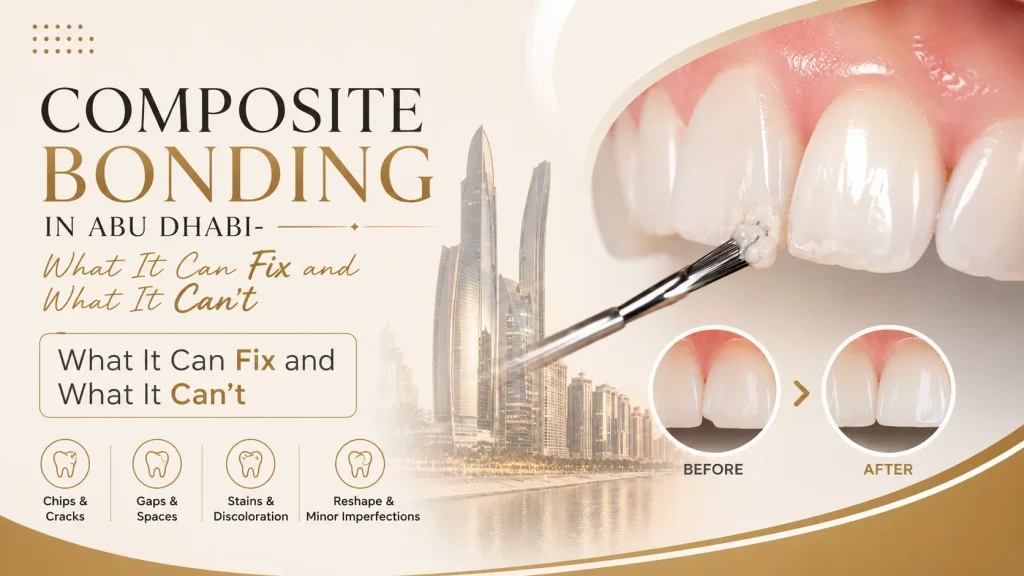
What Composite Bonding Actually Is Composite bonding uses a tooth-coloured resin applied directly onto the tooth surface. A dentist sculpts the resin by hand while it’s still soft, shaping it to match the tooth beside it. A curing light hardens the material in seconds, layer by layer. Most cases need little or no enamel removal. The resin bonds to the existing tooth structure rather than replacing it. This makes bonding one of the least invasive cosmetic options available. What Composite Bonding Can Actually Fix Bonding works well on small, specific problems rather than whole-mouth changes. A chipped edge on a front tooth is one of the most common cases treated this way. Small gaps between the front teeth can often close without orthodontics. Bonding also handles: Each of these cases shares one trait. The underlying tooth structure is healthy. Bonding adds to what’s already there. What Composite Bonding Can’t Fix Bonding cannot lighten a tooth discoloured from the inside. Internal staining, often from an old root canal or trauma, sits beneath the enamel where surface resin can’t reach it. Whitening or a veneer addresses that discolouration instead. Bonding also can’t correct real misalignment. A tooth that’s rotated or significantly out of position needs orthodontic movement, not a surface addition. Disguising major crookedness with bonding usually looks unnatural. It rarely lasts either. Composite resin is softer than porcelain. It holds up to normal biting and chewing but wears faster under heavy bite force or grinding. Someone who grinds their teeth at night sees bonding wear down sooner than someone who doesn’t. Bonding isn’t built to cover an entire discoloured smile either. Applying resin across many teeth to mask overall yellowing tends to look patchy compared to a coordinated veneer or whitening approach. How Reversible Composite Bonding Actually Is Most bonding cases involve minimal enamel removal, and many involve none at all. The tooth underneath stays largely intact. This sets bonding apart from porcelain veneers, which require removing a thin layer of enamel that can’t grow back. Bonding material can be reshaped, repaired, or replaced without damaging the tooth beneath it. A chip in the bonding itself gets fixed by adding more resin, not by starting over. This makes bonding a lower-commitment option for someone still deciding how far they want to go with cosmetic treatment. Composite Bonding Cost in Abu Dhabi and How Long It Lasts Composite bonding costs less per tooth than porcelain veneers. A single tooth typically costs a fraction of what a porcelain veneer runs. This makes bonding the more accessible entry point into cosmetic dentistry. Bonding typically lasts five to seven years before it needs refinishing or replacement. Porcelain veneers last ten to twenty years with normal care. The cost gap narrows once replacement is factored in over a decade. Bonding still tends to work out cheaper for someone treating one or two teeth. The right choice depends on scope. A single chipped tooth rarely justifies the higher upfront cost of porcelain. A full cosmetic overhaul often favours the material with the longer lifespan. What Happens During a Composite Bonding Appointment Shade selection happens first, matching the resin to the surrounding teeth. The tooth surface gets lightly conditioned so the resin bonds securely. Resin is then applied in thin layers, each one shaped and cured before the next goes on. A dentist adjusts the shape while the material is still workable, checking it against the bite and against the neighbouring teeth. The final layer gets polished to match the natural sheen of surrounding enamel. Most bonding cases finish in a single appointment, often within an hour per tooth. No lab fabrication or temporary restoration stage is needed, unlike porcelain veneers. When Bonding Isn’t Enough: Moving to Veneers or a Wider Treatment Plan Bonding suits isolated problems well but has real limits once a case grows larger. Someone needing correction across six or more teeth, or facing discolouration too deep for resin to mask, is usually better served by veneers. Our dedicated veneers page covers that material comparison in more depth. A patient considering a broader cosmetic change, beyond one or two teeth, may be looking at something closer to a Hollywood Smile plan rather than isolated bonding work. Our Hollywood Smile page explains how that treatment differs in scope. A consultation is the fastest way to know which category a specific case falls into. Frequently Asked Questions What can composite bonding fix? Bonding fixes small chips, minor gaps, slight edge unevenness, and small areas of surface wear on otherwise healthy teeth. What can’t composite bonding fix? Bonding can’t lighten teeth discoloured from the inside, correct real misalignment, or reliably cover an entire discoloured smile. Is composite bonding reversible? Most cases involve little to no enamel removal, so the underlying tooth stays largely intact. This makes bonding far more reversible than porcelain veneers. How long does composite bonding last? Bonding typically lasts five to seven years before it needs refinishing or replacement, compared to ten to twenty years for porcelain veneers. How much does composite bonding cost in Abu Dhabi? Bonding costs less per tooth than porcelain veneers, making it a more accessible option for treating one or two teeth rather than a full smile. Finding Out If Bonding Is the Right Fit A chipped tooth or a small gap doesn’t always call for a full cosmetic plan. Composite bonding handles a narrower set of problems well, and knowing where that boundary sits is what makes the treatment worth choosing in the first place. Marigold Dental & Orthodontic Clinic’s team can confirm within a single consultation whether a case fits that boundary, or needs something more.
Dental Veneers in Abu Dhabi: Porcelain vs Composite and How to Choose
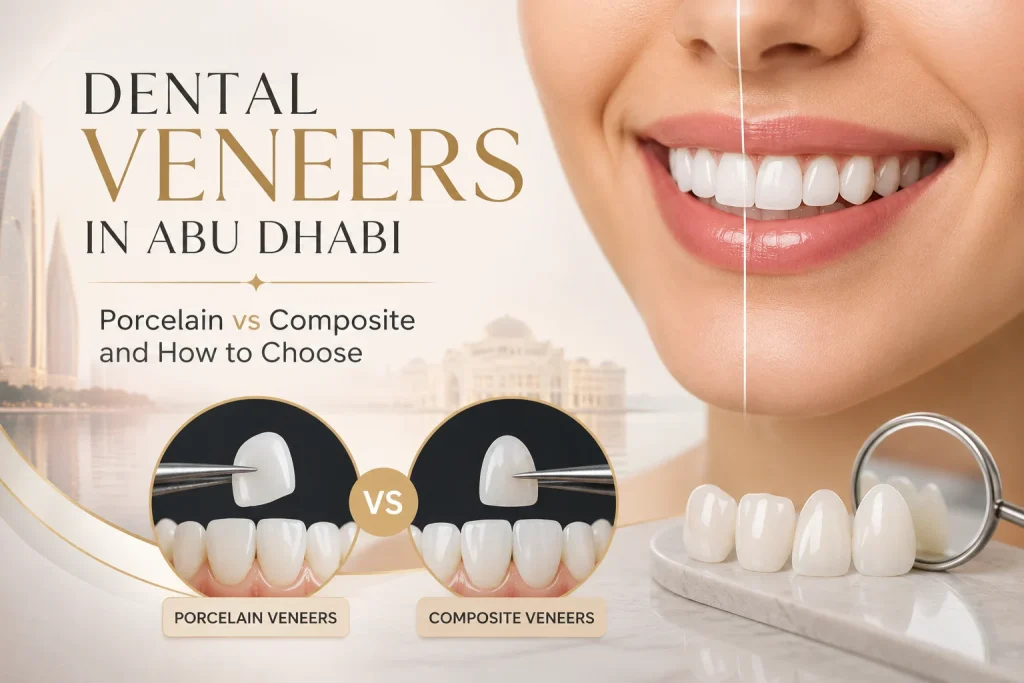
What Dental Veneers Actually Are A veneer is a thin shell bonded to the front surface of a tooth. It changes how the tooth looks without replacing the tooth itself. Veneers correct colour, shape, minor gaps, and the appearance of alignment, all without moving teeth orthodontically. Most veneer cases treat six to ten teeth across the visible smile. A single veneer on one tooth is possible but less common. Matching one new surface to naturally aged teeth beside it is harder to do convincingly. Porcelain, E-Max, and Composite Veneers: The Real Trade-Offs Porcelain and E-Max veneers require removing a thin layer of enamel, typically around half a millimeter. That enamel does not grow back. Once it’s removed, the tooth needs some form of covering permanently, whether a veneer or eventually a crown. Composite veneers usually need little to no enamel removal. The resin builds onto the existing tooth surface rather than replacing part of it. This keeps composite veneers considerably more reversible than porcelain. Durability runs in the opposite direction. Porcelain and E-Max typically last ten to twenty years. Composite typically lasts five to seven years before it needs refinishing. Porcelain also resists staining better over that longer lifespan. The decision comes down to a genuine trade-off. Porcelain offers permanence and longevity at the cost of an irreversible step. Composite offers reversibility and a lower upfront cost at the cost of a shorter lifespan. When a Crown Is the Better Fit Instead of a Veneer Veneers cover only the front surface of a tooth. A crown covers the entire tooth, front, back, and biting surface. This coverage difference decides which one actually solves a given problem. A tooth with significant structural damage or extensive decay usually needs a crown rather than a veneer. So does a tooth with a large existing filling. Teeth that have had root canal treatment often need a crown too, since root-canalled teeth tend to be more brittle and need fuller coverage. Our guide on the different types of dental crowns explains when a crown is the more appropriate choice. Veneers work well on teeth that are structurally healthy but cosmetically imperfect. The distinction is about how much of the tooth actually needs covering, not about which option looks better. Veneers or Composite Bonding: How to Tell Which One Fits Your Case Composite bonding handles small, isolated corrections well. A single chip or a small gap on an otherwise healthy tooth is a strong case for bonding. Minor edge unevenness fits the same category. Our composite bonding page covers exactly what bonding can and can’t address. Veneers become the better option once the case grows beyond what bonding can realistically fix. Internal tooth discolouration, the kind bonding can’t lighten, often responds well to a veneer’s opaque coverage. Real misalignment across several teeth, which bonding can’t correct, is something veneers can visually address without orthodontic movement. Heavy grinding, which wears composite down faster than porcelain, is another reason patients move toward veneers for a longer-lasting result. The clearest signal is scope. One or two small corrections point toward bonding. A coordinated change across several teeth points toward veneers. When veneers are planned as part of a complete smile transformation, they often become one element of a Hollywood Smile treatment. Veneer Cost in Abu Dhabi and What Drives the Price Three things drive the price: material, the number of teeth treated, and whether extra work like whitening or gum reshaping gets added. Composite veneers cost less per tooth than porcelain or E-Max. A full set of porcelain veneers across six to ten teeth commonly reaches into the tens of thousands of dirhams. Insurance rarely covers this. Thiqa, Daman, AXA, ADNIC, NAS, and Neuron UAE plans generally treat veneers as elective cosmetic treatment, excluded from standard coverage. An accurate treatment plan and quote depend on an in-person assessment, since bite alignment and existing tooth condition affect the final recommendation. Marigold Dental’s consultation process is built around giving that number honestly upfront, not adjusting it once treatment has already begun. How Long Veneers Last and What Shortens Their Lifespan Porcelain and E-Max veneers typically last ten to twenty years under normal use. Composite veneers typically last five to seven years before needing replacement or refinishing. Both figures assume reasonably careful daily use. Grinding shortens both materials considerably. Nighttime grinding puts repeated pressure on veneer edges, which can chip porcelain or wear down composite faster than expected. A night guard protects that investment in cases where grinding is confirmed. Routine dental check-ups catch early wear before it becomes a visible problem, extending the practical lifespan of either material. The Veneer Treatment Process, Appointment by Appointment The first appointment covers consultation, shade selection, and a discussion of which material fits the case. Professional teeth whitening is completed first if it’s part of the treatment plan, allowing the veneer shade to be matched to the final tooth colour rather than the original one. Veneer shade then gets matched against the whitened baseline rather than the original tooth colour. Tooth preparation follows for porcelain or E-Max veneers, removing the thin enamel layer needed for a proper fit. Composite veneers skip this step in most cases. Temporary veneers are fitted while the permanent set is fabricated in a lab, typically over one to two weeks. The final appointment removes the temporaries, bonds the permanent veneers, and adjusts bite and shape in the same visit. Frequently Asked Questions How long do porcelain veneers last? Porcelain and E-Max veneers typically last ten to twenty years with normal care. Composite veneers typically last five to seven years. Are veneers permanent or reversible? Porcelain and E-Max veneers require enamel removal that can’t be undone. Composite veneers usually need little to no enamel removal, making them significantly more reversible. How much do veneers cost in Abu Dhabi? Cost depends on material and the number of teeth treated. Composite veneers cost less per tooth than porcelain or E-Max. A full porcelain set commonly reaches the tens of thousands of dirhams.
Hollywood Smile in Abu Dhabi: What It Actually Involves and What It Costs
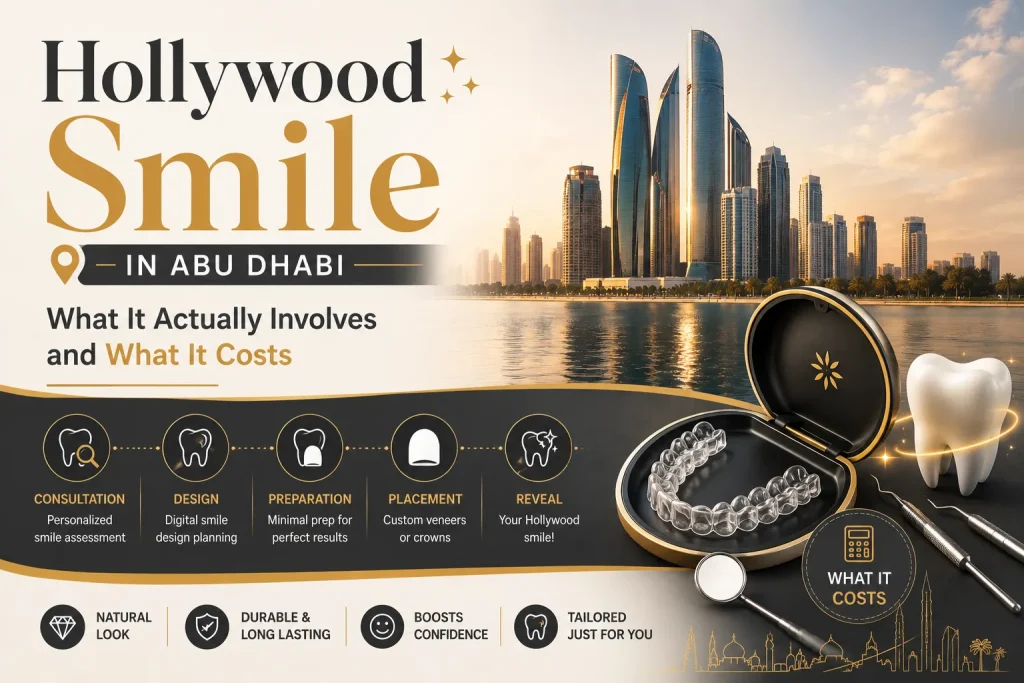
What a Hollywood Smile Actually Means in Dentistry “Hollywood Smile” is not a clinical term. Dentists don’t learn it in textbooks. Patients often see the phrase on social media before booking a consultation. Few arrive knowing which procedure creates that look. A Hollywood Smile usually means a coordinated set of veneers across the upper front teeth. Eight to ten teeth are typically included, chosen to work together rather than individually. Whitening often comes first, setting the shade baseline the veneers will match. Composite bonding sometimes replaces full veneers for smaller corrections. The name describes a result, not one fixed procedure. What varies is the materials and technique a clinic uses to build it. Porcelain, E-Max, Zirconia, and Composite Veneers: What Each Material Involves Porcelain and E-Max veneers require removing a thin layer of enamel, usually about half a millimeter. The enamel reduction cannot be undone once it’s completed. Composite veneers typically need little to no enamel removal, which keeps the process more reversible. Porcelain and E-Max veneers tend to last ten to twenty years with normal care. Composite veneers typically last five to seven years before they need replacing or refinishing. Zirconia sits between the two, offering strength closer to porcelain with a slightly different look and finish. A patient with heavily discoloured or unevenly shaped teeth usually benefits most from porcelain or E-Max. Someone with minor chips or small gaps between otherwise healthy teeth is often a better fit for composite bonding. A dentist confirms which category applies after examining the teeth in person, not from a photo alone. Hollywood Smile Cost in Abu Dhabi and What Changes the Price Three things drive the price: material choice, the number of teeth treated, and whether whitening or gum contouring gets added. Composite veneers across a full smile usually cost the least per tooth. Porcelain and E-Max veneers cost more, often two to three times the composite price per tooth. A full set of eight to ten porcelain veneers commonly totals in the tens of thousands of dirhams. Thiqa, Daman, AXA, ADNIC, NAS, and Neuron UAE plans generally exclude elective cosmetic treatment like this one. An exact price requires an individual treatment plan, since photos alone don’t show bite alignment or existing tooth condition. A consultation at Marigold Dental & Orthodontic Clinic includes that assessment before any treatment plan gets proposed. Getting a Natural-Looking Hollywood Smile Instead of a Uniform Template A digital smile design session comes before any tooth is touched. Photos and scans map your existing teeth, lip line, and facial proportions. The proposed shape and shade get built around those measurements, not a fixed catalogue option. Shade selection accounts for skin tone, not just tooth colour on its own. A shade that looks bright under studio lighting can look artificial in daylight against a specific complexion. Tooth size and edge shape get adjusted to the width of the smile and the shape of the face. They are not enlarged uniformly across every case. A digital preview gets reviewed and approved before any permanent work begins. The Hollywood Smile Treatment Process, Appointment by Appointment The first appointment covers consultation, scans, and the digital smile design preview. Whitening comes next if it’s part of the plan, completed before shade-matching for the veneers begins. Tooth preparation follows for porcelain or E-Max veneers. A thin layer of enamel is removed so the veneer fits without adding bulk. Temporary veneers get fitted the same day. They’re worn for one to two weeks while the permanent set is fabricated in a lab. The waiting period gives a chance to request adjustments before the final veneers are made. The final appointment removes the temporaries, bonds the permanent veneers, and adjusts bite and shape in the same visit. Composite veneers skip the lab stage entirely, built and shaped directly on the tooth in one appointment. A full case typically spans two to four weeks from first consultation to final result. Extra steps push this range further. Gum contouring or additional restorative work can extend the process to six to eight weeks. Hollywood Smile, Veneers, and Composite Bonding: How They Actually Differ Hollywood Smile describes the overall cosmetic goal: a coordinated, symmetrical smile across the visible teeth. Veneers are the specific restorative method most often used to achieve it, whether porcelain, E-Max, or composite. Composite bonding is a lighter-touch option. It suits smaller corrections, like a single chipped tooth or a narrow gap between teeth. A Hollywood Smile search often turns out to mean something smaller than expected. Someone correcting two or three minor chips or gaps may only need composite bonding rather than a full veneer set. Composite bonding is covered in detail on our composite bonding page. Someone seeking a full coordinated change across eight or more teeth is typically looking at veneers instead. Our dedicated veneers page covers that comparison in more depth. Veneer Aftercare and How Long the Result Actually Lasts Porcelain and E-Max veneers hold up well against normal biting and chewing but aren’t immune to damage from grinding. A patient who grinds their teeth at night puts extra pressure on the veneer edges. Over time, that pressure can chip a veneer or loosen its bond. A night guard protects the investment in cases where grinding is confirmed. Staining resistance is strong but not absolute. Porcelain resists staining far better than composite. Both materials benefit from routine cleaning and limited contact with staining agents like tobacco. Regular check-ups catch early signs of bond wear before they become visible problems. Frequently Asked Questions What is a Hollywood Smile? A Hollywood Smile is a coordinated cosmetic result. It’s usually achieved through veneers across the visible upper teeth, sometimes combined with whitening or composite bonding. How much does a Hollywood Smile cost in Abu Dhabi? Cost depends on material and the number of teeth treated. Composite veneers cost less per tooth than porcelain or E-Max. A full set typically totals in the thousands to tens of thousands of dirhams. An in-person assessment confirms an
Your First Dental Visit in Abu Dhabi Guide
The appointment is booked. Now comes the easy part: getting ready for your visit. Most people are surprised by how little preparation is actually needed. You do not need a referral letter to visit a private dental clinic in Abu Dhabi. New patients can book an appointment directly. A first appointment at Marigold Dental usually takes 45 to 60 minutes. Bringing the right documents, understanding the check-in process, and knowing how insurance is handled will help you arrive with confidence. This guide walks you through what to expect before you arrive. It explains what to bring, how check-in works, how insurance is handled, and what to do with the information you receive after your appointment. What to Bring to a First Dental Appointment in Abu Dhabi Bring the insurance card or the digital member ID from the insurer’s app. For Thiqa patients, the physical card is the most reliable document to present at reception. For Daman, AXA, ADNIC, NAS, and Neuron UAE patients, the member ID number from the insurer’s mobile app is sufficient where the physical card isn’t available. Marigold confirms coverage directly with the insurer before the appointment begins. Emirates ID is required for patient registration. A passport serves as an alternative for patients whose Emirates ID is in process. Previous dental X-rays or records, if available and recent, are worth bringing. A patient arriving with bitewing X-rays taken in the last 12 months avoids repeat imaging, saves clinical time, and removes an unnecessary radiation exposure. Records from an overseas clinic or a previous UAE provider are equally useful. The dentist works from whatever baseline exists rather than starting from scratch. A list of current medications is the preparation step that gets overlooked most consistently and carries the most clinical consequence. Blood thinners affect how gum tissue responds to probing and scaling. Bisphosphonates, prescribed for osteoporosis, have specific implications for any procedure involving bone. Diabetes medication affects healing and the periodontal assessment. Antihistamines and certain antidepressants reduce salivary flow in ways that change the decay risk picture. The dentist needs this information before the examination, not partway through it. Arriving at Marigold Dental Abu Dhabi: What Happens at Reception Arrive 10 to 15 minutes before the appointment time. New patients complete a medical history form at registration. Filling it in carefully before being called through is the single most useful preparation a new patient makes. The form covers current medications, systemic health conditions, allergies, previous dental treatment history, and any presenting concern. A form completed in a hurry in the waiting room produces a thinner clinical history than one filled in thoughtfully. Insurance details are confirmed at reception before the appointment begins. Marigold handles direct billing for all six insurance partners: Thiqa, Daman, AXA, ADNIC, NAS, and Neuron UAE. The patient presents the card or member ID. The clinic manages the rest of the confirmation process. Marigold Dental & Orthodontic Clinic is located in Danet Tower B, Al Sa’adah, Zone 1, Abu Dhabi. Parking is available within the building for patients. The reception team speaks both Arabic and English fluently. If you prefer to communicate in Arabic, your entire visit can be conducted in Arabic, from registration and consultation to the discussion after your examination. Using Thiqa, Daman, and Other UAE Insurance at a First Dental Appointment Present the insurance card or member ID at reception. Marigold confirms active coverage and network status directly with the insurer before the appointment begins. A routine check-up and scale and polish are covered under virtually all UAE dental insurance plans without pre-authorization. The patient attends, the clinic bills, and the claim is submitted internally. Where the examination identifies treatment needs beyond the routine visit, Marigold’s insurance team initiates pre-authorization before any treatment appointment is scheduled. The patient doesn’t manage that process. A crown, root canal, or periodontal treatment requiring insurer approval is submitted with the clinical notes and X-rays supporting the recommendation. The insurer responds and the treatment is scheduled accordingly. No treatment above basic restorative begins at Marigold without confirmed written authorization where the plan requires it. Co-payments, where applicable under a patient’s specific plan, are collected at the end of the appointment. The patient is informed of the co-payment amount before treatment begins, not at checkout. Patients uncertain about what their plan covers can ask at the time of booking. The clinic team confirms network status and provides a general picture of likely coverage. The full structure of UAE dental insurance, including plan tiers, exclusions, and when private payment is the more rational choice, is covered in Private Dental Care vs Insurance-Covered Treatment in Abu Dhabi. Returning to the Dentist After a Long Gap: What the First Appointment Covers A first appointment after a gap of two, three, or five years is not a judgment appointment. The clinical priority is establishing the current situation, not discussing why care was deferred. Every dentist in a practice that values long-term relationships understands that gaps happen. The patient who attends after a long absence is doing the right thing. The clinical picture after a gap is different from a routine recall appointment in specific ways. More X-rays are typically taken because no existing chart is available for comparison. The periodontal assessment carries more diagnostic weight because gum disease progresses silently. A patient who noticed no symptoms during the gap may have findings that developed in the interim without warning. Treatment planning after a long gap involves prioritizing: which findings need prompt attention, which can be monitored, and what a realistic sequence looks like across several appointments. A patient anxious about what will be found is in a better position attending than continuing to avoid. What is found can be addressed. What isn’t assessed continues on its own clinical trajectory. Questions to Ask at a First Dental Appointment in Abu Dhabi The information a patient volunteers shapes the quality of the clinical history. Mention current symptoms before being asked: sensitivity to temperature or pressure, pain that comes and goes, bleeding on brushing, a tooth that feels different when biting, grinding or clenching habits, and any anxiety about a specific procedure. A dentist who knows a patient grinds at night examines the occlusal surfaces differently from one who doesn’t. Information the patient doesn’t volunteer doesn’t automatically surface. Before leaving the appointment, ask specifically: what was found and what does it mean clinically; what are the options for each finding including monitoring rather
Transparent Dental Treatment Plans
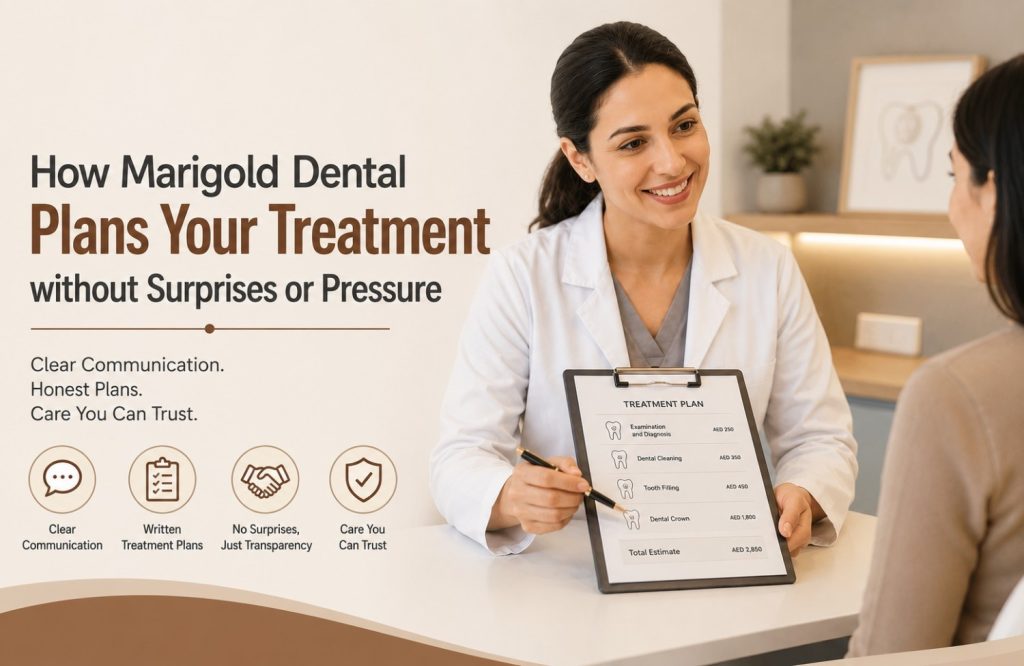
How Marigold Dental Plans Your Treatment without Surprises or Pressure The moment that determines whether a patient trusts a dental practice isn’t the treatment itself. How findings are explained, what options are presented, how pricing works, and what happens when treatment reveals something unexpected: these are the moments where trust is built or lost. A practice that handles each of them specifically and consistently is a different clinical environment from one that claims to. This piece describes how Marigold Dental & Orthodontic Clinic handles each of those moments specifically. How Marigold Communicates Clinical Findings After Every Examination Every finding from the examination is named specifically before any treatment is discussed. Which tooth. What was found. What it means clinically. A patient who hears “you have a few things that need attention” and receives a total at the bottom of a plan has not been consulted. At Marigold, the finding comes before the recommendation, and the two are kept clearly separate. The explanation covers what was found and what the options are. Where monitoring is clinically appropriate, early-stage decay that hasn’t reached the dentinal layer, a marginal restoration that is degrading slowly but hasn’t yet failed, monitoring is presented as a genuine clinical choice rather than a reluctant fallback. A dentist who presents monitoring as a legitimate option is demonstrating that the recommendation follows the clinical picture rather than preceding it. That distinction matters to patients who have received extensive treatment plans at first appointments elsewhere and questioned their necessity. Where clinical photography supports the explanation, patients are shown images of their own findings. A patient who can see the dark line at the crown margin or the early discoloration at the fissure base is working from the same information the dentist has. The criteria that define a trustworthy post-examination discussion are covered in How to Choose a Dentist in Abu Dhabi. Written Dental Treatment Plans at Marigold: What Is Included Before Treatment Begins A written treatment plan is produced at the end of every examination where treatment has been identified. It is provided before any appointment is booked. Not handed over at the treatment appointment. Not emailed later in the week. Before the patient decides whether to proceed with anything, the plan is in their hands. The plan specifies each treatment by name, the tooth or area involved, the clinical reason for the recommendation, and the individual cost of each item. The total follows from those items rather than arriving as a number in isolation. A patient evaluating a treatment plan needs to understand what each component is and why it has been recommended. A plan that doesn’t provide that information isn’t a plan. It’s a quote, and a quote without clinical reasoning is exactly where doubt enters. For insured patients, the plan includes the estimated insurer contribution and the estimated out-of-pocket cost for each item before any treatment is scheduled. The insurance contribution is an estimate at plan stage because final insurer approval may differ from what the plan anticipates. Where it does, Marigold communicates the difference before proceeding. The post-examination discussion that produces this plan is described in detail in What a Dental Check-Up at Marigold Actually Involve. What the first visit experience looks like before the examination begins is covered in Your First Appointment at Marigold: What to Expect and How to Prepare. What Happens at Marigold When Treatment Reveals Additional Findings Clinical dentistry produces situations where treatment reveals more than the examination indicated. A filling removal uncovers decay that extended further than the X-ray showed. A crown preparation reveals a crack that wasn’t visible before the old restoration came off. How a practice handles them is one of the most practically significant transparency questions a patient can ask. At Marigold, when an additional finding emerges during treatment, the procedure stops. The dentist explains what was found, shows the patient where possible, and presents the options: addressing it in the current appointment, scheduling a separate one, or monitoring if the clinical picture supports that. The patient decides. No additional treatment proceeds without explicit consent and without the cost being communicated first. An invoice that differs from the agreed written plan without a prior conversation is not how Marigold bills. How Marigold Sequences Dental Treatment When Multiple Findings Are Present A treatment plan with multiple items raises a specific question: why this order? At Marigold, the recommended treatment sequence follows specific clinical logic. Active infection is addressed before elective treatment. Periodontal health is stabilized before restorative work begins, because placing restorations into a compromised periodontal environment compromises both. Functional needs take precedence over aesthetic ones where both are present. A patient who understands the reasoning can engage with the sequence as a recommendation rather than receiving it as an instruction. The recommended sequence is a clinical recommendation, not a binding requirement. A patient with personal reasons for wanting to address a specific finding first is part of that conversation. Where the full plan can’t proceed at once, the dentist specifies what needs prompt attention, what can be deferred and over what timeframe, and what can be monitored. Second Opinions on Dental Treatment Recommendations at Marigold A patient considering a significant treatment recommendation has a straightforward right to a second opinion. Marigold supports second opinions without qualification. A sound clinical recommendation is confirmed by a second opinion, not undermined by it. For patients wanting a second opinion on a Marigold recommendation, the clinic provides records, X-rays, and the written plan at no additional charge. The records belong to the patient. Patients who have received a recommendation elsewhere and want a second opinion at Marigold can book an assessment appointment directly. The same post-examination process applies: findings are explained specifically, options are presented, and a written plan is provided before anything is scheduled. Insurance Billing and Pricing Transparency at Marigold Dental Abu Dhabi The written treatment plan for insured patients includes the estimated insurer contribution and estimated out-of-pocket cost for each item before any treatment is scheduled. The estimate is subject to insurer confirmation, and the final approved amount may differ from what was submitted for pre-authorization. When it does differ, Marigold communicates the revised figures before the treatment appointment proceeds. A patient sitting down for a crown placement knows the cost before the appointment begins, not at checkout. If the insurer approves a lower amount than anticipated, the patient confirms they want to proceed at the revised cost before the appointment continues. Pre-authorization is submitted and confirmed before any treatment appointment requiring it is scheduled. An invoice that differs
The Link Between Oral Health and Overall Health: What the Evidence Actually Shows
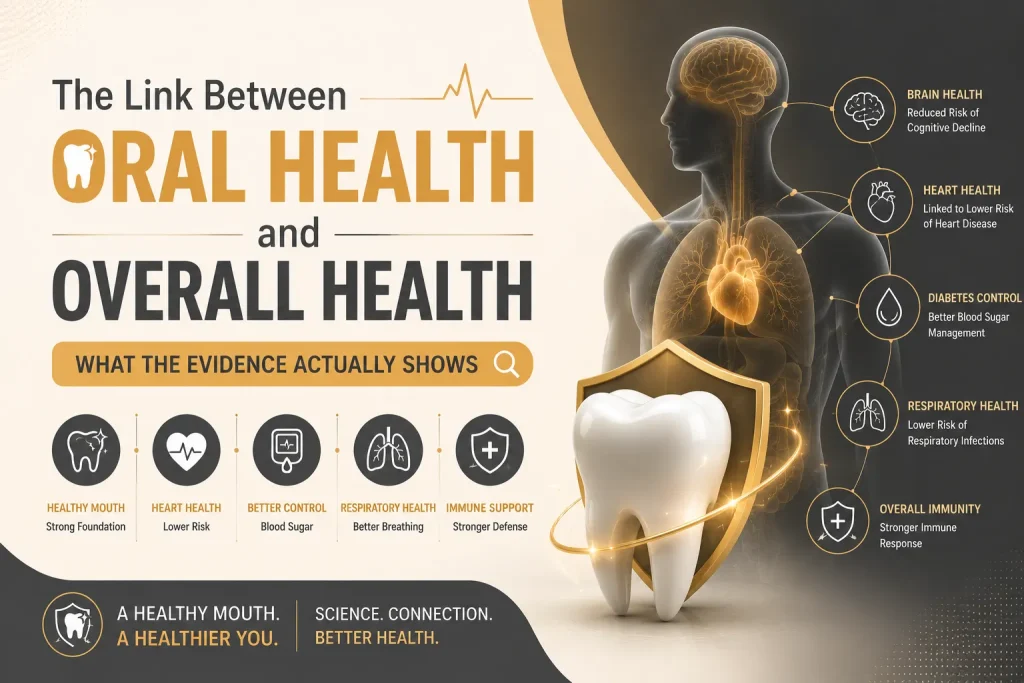
The mouth is not a sealed compartment. Bacteria from periodontal disease enter the bloodstream through inflamed gum tissue, and the immune response to chronic periodontal infection produces inflammatory signals that circulate well beyond the oral cavity. The connections between gum disease and cardiovascular disease, diabetes, pregnancy outcomes, Alzheimer’s disease, and respiratory infections are documented in peer-reviewed research. The strength of that evidence varies by condition. What doesn’t vary is the underlying physiology: a significant untreated periodontal infection is a systemic event, not a local one. This piece covers what the evidence actually shows for each connection, including where causality is established, where the research is associative, and what the clinical implications are for patients managing the conditions involved. How Oral Bacteria Enter the Bloodstream and Trigger Systemic Inflammation In a patient with active periodontitis, the inner lining of the periodontal pocket is ulcerated. The total surface area of this ulceration across a full dentition with moderate-to-severe periodontitis can reach several square centimetres. Across that surface, subgingival bacteria have direct access to the bloodstream. Bacteremia following tooth brushing, eating, and professional dental treatment is well-documented in patients with untreated periodontal disease. The bacteria entering the circulation are the same pathogens driving the infection in the pocket. The immune response to that bacterial load produces cytokines including interleukin-6 and tumour necrosis factor-alpha. These inflammatory mediators do not stay in the gum tissue. They circulate. C-reactive protein, a non-specific marker of systemic inflammation measured routinely in cardiovascular and metabolic risk assessment, is consistently elevated in patients with untreated periodontitis. A patient with unexplained elevated CRP should have a periodontal assessment as part of that investigation. These two pathways, bacterial seeding through the bloodstream and cytokine-mediated systemic inflammation, are the foundation for every specific organ-level connection that follows. The connections differ in mechanism and evidence strength. The underlying physiology is the same across all of them. Gum Disease and Heart Disease: What the Evidence Shows People with periodontitis have a statistically higher risk of cardiovascular disease and stroke than those without it. The association persists after controlling for shared risk factors including smoking, diabetes, and socioeconomic status. A 2020 analysis of over 8,000 patients in the Journal of Clinical Periodontology found significantly elevated cardiovascular event risk in patients with severe periodontitis. Two mechanisms specific to cardiovascular involvement sit on top of the general bacteremia and inflammation pathways. Periodontal pathogens, particularly Porphyromonas gingivalis, have been identified in atherosclerotic plaques recovered from cardiac patients during procedures. The bacteria are not incidental. The same strains causing periodontal infection are present in the arterial lesions. The second mechanism involves systemic inflammation from periodontal disease contributing to endothelial dysfunction and atherosclerotic plaque instability, the process behind the majority of acute cardiac events. The relationship is extensively associative and the evidence for direct causality in humans is building rather than complete. Cardiologists and periodontists increasingly treat the conditions as connected rather than coincidental. For a patient who has had a cardiac event or carries known cardiovascular risk factors, untreated periodontitis is a modifiable risk factor. Treating it does not guarantee cardiovascular protection. Leaving it untreated is not clinically neutral. Oral Health and Diabetes: A Two-Way Relationship The diabetes-oral health connection is defined by something that makes it different from every other oral-systemic relationship: it runs in both directions simultaneously. Diabetes worsens gum disease. Active gum disease worsens diabetes control. A patient managing one without addressing the other is working against both simultaneously. Diabetes impairs the immune response to periodontal bacteria in specific ways. Elevated blood sugar alters the function of neutrophils. Neutrophils are the immune cells that clear bacterial infections in the gum tissue. The result is more aggressive disease progression at lower bacterial loads than would produce the same severity in a non-diabetic patient. Diabetic patients also have impaired tissue healing, which affects response to periodontal treatment. These factors are why periodontal disease is considered the sixth complication of diabetes in the clinical literature alongside retinopathy, nephropathy, neuropathy, cardiovascular disease, and peripheral vascular disease. The reverse direction is where the clinical implications become most practically significant. Active periodontal infection elevates circulating inflammatory cytokines that interfere with insulin signaling and increase insulin resistance. HbA1c, the primary measure of long-term blood sugar control, is measurably higher in diabetic patients with untreated periodontitis compared to those without it. Treating periodontitis in diabetic patients produces statistically significant improvements in HbA1c. Studies have found reductions of 0.3 to 0.5 percentage points following periodontal treatment, a magnitude comparable in some analyses to adding a second oral hypoglycaemic agent to the treatment regime. In the UAE, where adult diabetes prevalence ranks among the highest globally, this bidirectional relationship carries specific clinical weight. A diabetic patient attending a dental appointment without disclosing their condition is providing incomplete clinical information. Their periodontal assessment, treatment thresholds, and expected healing response all differ from a non-diabetic patient’s, and the management plan should reflect that. Oral Health During Pregnancy: Why Dentists and Obstetricians Both Ask Periodontal disease during pregnancy is associated with preterm birth and low birth weight. The proposed mechanism involves inflammatory mediators, particularly prostaglandin E2, produced in response to periodontal infection that in sufficient concentrations can initiate uterine contractions and cervical ripening. Periodontal pathogens have also been identified in amniotic fluid in cases of preterm birth, providing a plausible direct biological pathway rather than a purely associative connection. Pregnancy changes the oral environment in ways that increase susceptibility to gum disease independently of pre-existing periodontal status. Hormonal changes in the second and third trimesters increase gingival blood flow and produce an exaggerated gum response to bacterial plaque. Bleeding, swelling, and tenderness that develop during pregnancy, sometimes called pregnancy gingivitis, are not normal. They are a clinical finding that warrants assessment and management. Dental treatment during pregnancy is safe and recommended. The second trimester is the preferred window for elective treatment. Avoiding dental care during pregnancy out of concern for the foetus carries its own clinical risk. A pregnant patient with active gum disease has a clinical reason for
Private vs Insured Dental Care in Abu Dhabi
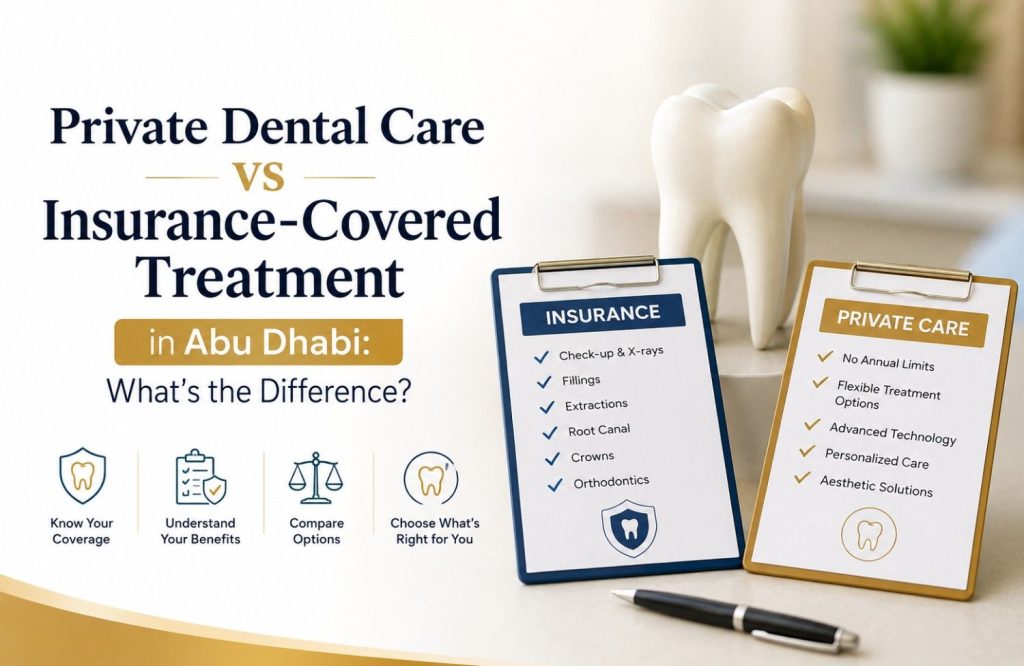
Usually patients discover what their dental insurance doesn’t cover at the worst possible moment. Sitting in the chair, treatment planned, and the receptionist explains that the crown needs pre-authorization, or that implants aren’t covered, or that the annual limit ran out two visits ago. UAE dental insurance is genuinely complex. Six major insurers. Multiple plan tiers within each. Network restrictions, exclusion lists, co-payment structures, and pre-authorization requirements that vary enough between plans to make assumptions dangerous. Understanding the system before the appointment is what prevents that moment. How Dental Insurance Plans Work in the UAE UAE dental plans are sold in tiers. Basic plans cover preventive treatment: check-ups, X-rays, and scale and polish. Enhanced plans add restorative treatment including fillings, extractions, and root canals, usually with a co-payment. Comprehensive plans extend into major restorative work, crowns and bridges, and in some cases limited orthodontic treatment, with higher premiums reflecting the broader coverage. The tier a patient holds determines what treatment the insurer will pay for. A patient on a Basic plan whose dentist recommends a root canal pays privately for that procedure. Clinical necessity is irrelevant to the coverage decision. Network restrictions determine where coverage applies. Each insurer maintains a list of approved clinics. Treatment at a clinic outside that network is either uncovered entirely or reimbursed at a reduced rate after the patient pays upfront. Direct billing, where the clinic invoices the insurer directly, only applies at in-network providers. At out-of-network clinics, the patient pays and claims reimbursement separately with no guarantee the full amount is returned. Annual limits cap the total the insurer will pay across a benefit year, and co-payments add a patient contribution on top of insurer coverage. A plan with an AED 3,000 annual dental limit covers that amount in total. The third filling in a year may land partly or entirely outside the limit. A plan covering 80% of a filling leaves the patient responsible for the remaining 20%. On expensive restorative treatment that figure adds up quickly. Dental Coverage by Insurer: Thiqa, Daman, AXA, ADNIC, NAS and Neuron UAE Coverage parameters below reflect general plan structures. Specific coverage depends on the individual plan document. Confirming coverage with the insurer or the clinic before treatment is the only reliable method. Thiqa is the Abu Dhabi government employee insurance scheme administered by Daman. Coverage is broader than most private Enhanced plans. Check-ups, X-rays, fillings, extractions, root canals, and crowns are generally covered with minimal co-payment at approved providers. Thiqa-insured patients hold the most comprehensive routine dental coverage available in the Abu Dhabi market. Daman operates multiple plan tiers. Basic covers preventive only. Enhanced covers fillings, extractions, root canals, and some crown work with co-payments ranging from 20% to 30%. Comprehensive extends to major restorative and, in selected plans, limited orthodontic treatment with age restrictions. Daman is the most widely held private insurance in Abu Dhabi. AXA follows a similar tiered structure. Enhanced and above covers restorative treatment. Pre-authorization is required for crowns and any treatment above a plan-specific cost threshold. Cosmetic treatment is excluded across all AXA plan tiers without exception. ADNIC plans broadly mirror Daman Enhanced for standard employer plans. Pre-authorization thresholds and co-payment percentages vary by employer contract. ADNIC’s provider network in Abu Dhabi is well-established. NAS is common among mid-market employers. Basic NAS plans cover preventive and emergency treatment only. Enhanced adds restorative with co-payments. Orthodontic treatment is excluded from the majority of NAS plans regardless of tier. Neuron UAE is a newer insurer with growing Abu Dhabi presence. Coverage parameters sit broadly in line with mid-tier Daman. Network expansion in Abu Dhabi is ongoing, so confirming clinic network status directly before booking is particularly relevant for Neuron-insured patients. Marigold Dental accepts all six insurers and handles direct billing internally for in-network patients. Dental Treatments UAE Insurance Plans Typically Do Not Cover Exclusion lists are where the gap between what patients expect and what insurers pay is largest. The treatments below are excluded from most UAE dental plans across most insurers and most plan tiers. Cosmetic treatment is excluded universally. Teeth whitening, porcelain veneers, and composite bonding placed for aesthetic rather than functional reasons are not covered by any standard UAE dental plan. A patient whose treatment plan includes whitening or veneers pays privately for those components regardless of insurer or tier. Dental implants fall outside standard coverage on the majority of UAE plans. Where Comprehensive tier plans include implants, coverage is partial, subject to annual limits, and associated procedures including bone grafting are typically excluded separately. A patient assuming implant coverage without confirming the specific plan document is at significant financial risk. The full breakdown of what implant treatment involves and costs is covered in [Dental Implants in Abu Dhabi: What Does the Cost Actually Include?](link to implant cost piece) Orthodontic treatment is excluded from Basic and Enhanced plans. Where Comprehensive plans include orthodontics, age limits typically under 18 and annual sub-limits apply. Adult orthodontic treatment is privately funded in the vast majority of cases regardless of insurer. Pre-existing conditions are handled differently across insurers, but the general position is consistent. Conditions identified before the insurance policy start date may have a waiting period before coverage applies, or may be excluded entirely. Waiting periods affect new policyholders. A patient who joins a plan and immediately needs a crown may find that major restorative treatment carries a three to six month waiting period. Preventive treatment is typically covered from day one. Treatment without pre-authorization is rejected regardless of whether the treatment falls within the covered list. A crown placed without written insurer approval before preparation begins becomes a private expense even if crowns are covered under the plan. Dental Pre-Authorization in the UAE: How It Works and Why It Matters Pre-authorization is a formal insurer approval required before certain dental treatments begin. Without it, the claim is rejected. The treatment may be clinically necessary and within the covered list. Neither fact protects a patient who skipped the approval step. Treatments that
Why Tooth Decay Is So Common in the UAE
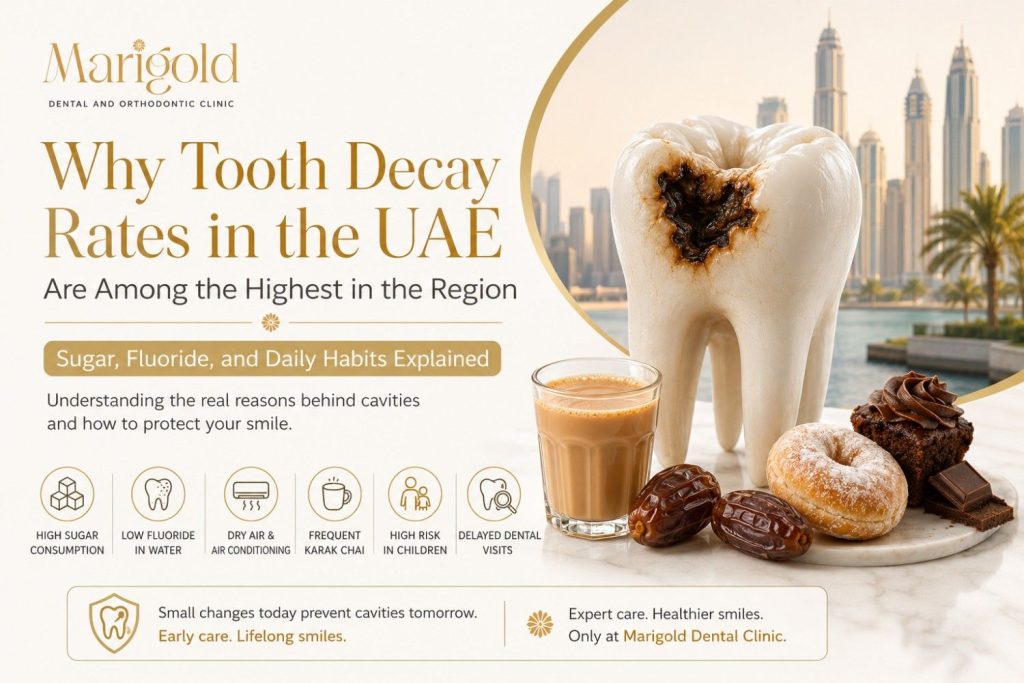
The UAE has some of the highest rates of dental caries in the world. Studies published by the UAE Ministry of Health and regional dental associations consistently place the country among the global leaders in tooth decay, particularly among children. The reasons extend well beyond brushing habits. High sugar consumption, frequent karak chai, desalinated water with little natural fluoride, heavily air-conditioned environments, and delayed dental visits all shape oral health in ways that are specific to life in the Emirates. No single factor explains the numbers. It is the combination, along with the pace and habits of daily life, that makes tooth decay so common. Understanding why cavities develop here is more useful than generic advice about brushing twice a day. Why Sugar Exposure Matters More Than Quantity The UAE ranks among the highest globally for per capita sugar consumption. The figure from the World Health Organization places UAE sugar intake at more than double the recommended daily limit on average. That statistic covers the obvious sources: soft drinks, sweets, pastries. It doesn’t fully account for how sugar enters the diet in less visible ways. Karak chai, consumed multiple times daily by a significant portion of the population, combines condensed milk, sugar, and tea in a preparation that sits against tooth surfaces for extended periods. The frequency matters as much as the quantity. Each sugar exposure triggers an acid response from oral bacteria that lasts approximately twenty minutes. A patient who drinks karak three times between meals is creating three separate acid cycles on top of their meals. The enamel doesn’t recover between them. Date consumption follows a similar pattern. Dates are nutritionally dense and culturally significant, and the concentrated sugars they carry, combined with their sticky texture and the frequency with which they’re consumed during social occasions and Ramadan, create sustained acid exposure that low-frequency consumption wouldn’t produce. How Abu Dhabi’s Climate and Air Conditioning Affect Oral Health Abu Dhabi’s climate drives indoor air conditioning use at a level that directly affects oral health. Heavily air-conditioned environments reduce ambient humidity significantly. Dry air reduces salivary flow over time, and saliva is the mouth’s primary natural defense against decay: it neutralizes acid, remineralizes enamel, and mechanically clears food debris from tooth surfaces. A patient spending twelve hours daily in air-conditioned offices, vehicles, and homes, while compensating for the heat outside with frequent cold drinks, has a different oral environment from someone in a more temperate climate. The cold drinks themselves are frequently carbonated or sweetened, compounding the salivary and acid exposure problem simultaneously. Why Tooth Decay Rates Are So High Among Children in the UAE The statistics on childhood caries in the UAE are stark. Research published in the International Journal of Dentistry found caries prevalence in UAE preschool children exceeding 70% in some studied populations. A separate study from the UAE University found that children attending government schools had significantly higher decay rates than those in private schools, correlating with socioeconomic factors and dietary patterns rather than access to dental services alone. Early childhood caries in the UAE is driven substantially by bottle feeding practices, specifically prolonged bottle use with sweetened beverages or juice at sleep time, combined with late introduction to dental care. The first dental visit recommendation in the UAE is frequently delayed well beyond the internationally recommended age of one year, which means early decay is often identified only once it has become symptomatic rather than at the preventable stage. How Expat Lifestyles and Diet Increase Cavity Risk The UAE population is roughly 90% expatriate. Dietary transitions that accompany relocation from South Asia, Southeast Asia, the Philippines, and Western countries interact with the local food environment in specific ways. South Asian dietary patterns bring high carbohydrate consumption, frequent snacking, and significant tea consumption with sugar. When those patterns meet the UAE’s food environment, which provides cheap, highly processed food, round-the-clock availability of sweetened beverages, and a social culture built around frequent eating and hospitality, the cariogenic load increases. The other factor is irregular dental attendance. Expatriate workers in the UAE on short-term contracts, particularly lower-income workers whose insurance coverage is limited, frequently delay dental care until symptoms become acute. Decay that would have been a simple filling at the twelve-month mark becomes a root canal or extraction at the two-year mark. The pattern repeats across the working population in a way that inflates the severity of decay in the data alongside its prevalence. Does Abu Dhabi’s Water Contain Fluoride? Water fluoridation at therapeutic levels (0.7 parts per million) has been one of the most cost-effective public health interventions for decay prevention in countries that have implemented it. The UAE relies predominantly on desalinated water, which has negligible natural fluoride content. The desalination process removes essentially all minerals, fluoride included, and the UAE does not fluoridate its municipal water supply at therapeutic levels. This means the passive fluoride protection that residents of fluoridated countries receive through tap water consumption simply isn’t present here. The gap is partially filled by fluoridated toothpaste, but only for the population that uses it consistently and in adequate amounts, which doesn’t include a significant portion of young children whose parents are managing fluoride exposure without guidance. The compounding effect of no water fluoridation, high sugar intake, reduced salivary flow from climate and air conditioning, and irregular dental attendance produces decay rates that exceed what any single factor would explain. How UAE Residents Can Reduce Their Risk of Tooth Decay Decay in the UAE isn’t primarily a brushing problem. A patient who brushes twice daily with fluoride toothpaste but drinks three sweetened beverages between meals, lives in a heavily air-conditioned environment, and hasn’t had a professional cleaning in two years is more decay-prone than a patient who brushes once daily but drinks water between meals, has good salivary flow, and attends regular check-ups. The interventions that move the needle are the unglamorous ones: reducing between-meal sugar exposure, rinsing with water after sweetened drinks, using fluoride toothpaste correctly, staying adequately hydrated to support salivary flow, and attending a check-up at an interval that catches early decay before it becomes symptomatic. Early decay is silent and reversible. The same decay six months later is neither. Professional assessment at Marigold Dental in Abu Dhabi identifies what’s developing before it becomes a treatment rather than a conversation. Questions About Tooth Decay